North Europe (6,093 – 4,366 BCE): Middle…
6093 BCE to 4366 BCE
North Europe (6,093 – 4,366 BCE): Middle Holocene — Forests, Wetlands, and the Age of Water
Geographic & Environmental Context
During the Middle Holocene, North Europe—encompassing the British Isles, Scandinavia, the Baltic States, and the North Sea basin—underwent dramatic environmental transformation.
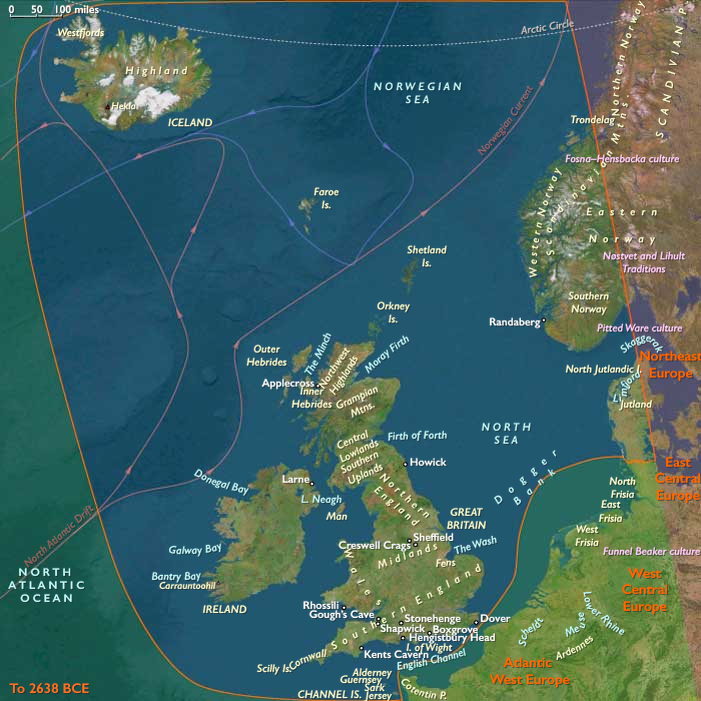
Rising seas drowned the Doggerland plains, severing Britain from continental Europe by c. 6000 BCE, while vast tracts of new wetlands, bogs, and estuaries emerged across the lowlands of Jutland, the Baltic coast, and the British interior.
Two environmental zones framed the region:
-
Northwest Europe, a landscape of drowned river valleys, peatlands, and tidal estuaries—from western Denmark to Britain and Ireland—where foragers adapted to new coastal and freshwater ecologies.
-
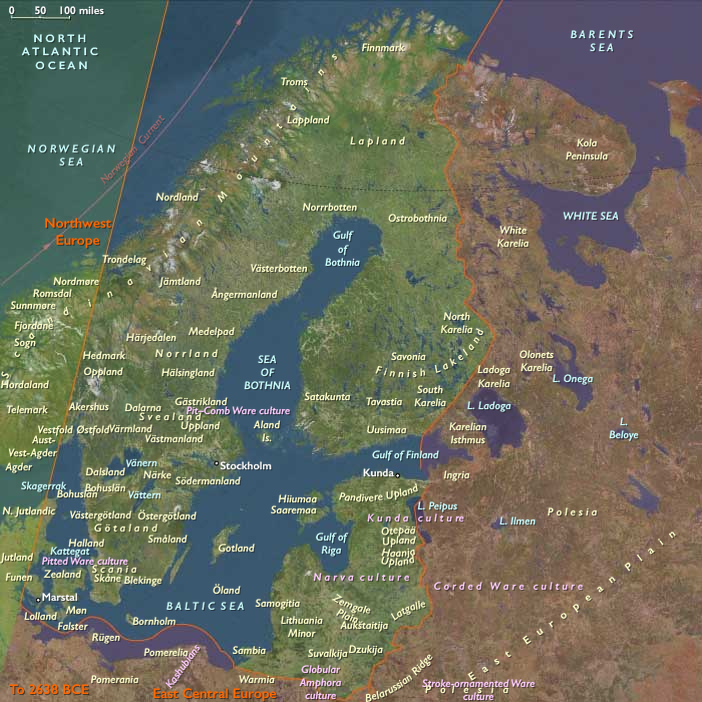
Northeast Europe, the Baltic–Scandinavian lake district, a realm of forests, inland seas, and river corridors stretching from Denmark and Sweden through Finland and the Baltic States into Karelia and the Russian plain.
Together these landscapes became laboratories of human innovation in water management, woodcraft, and seasonal adaptation.
Climate & Environmental Shifts
The Hypsithermal climatic optimum brought warm, moist, and stable conditions.
-
Temperatures across the region were 1–2 °C higher than modern averages; winters milder, summers longer.
-
Forests reached their maximum Holocene extent, dominated by oak, elm, linden, and hazel in the south and pine, spruce, and birch in the north.
-
Expanding wetlands and shallow lakes proliferated as rainfall increased and the water table rose.
This environmental mosaic—forest–wetland–coast—supported high biodiversity and allowed human populations to thrive through diverse resource exploitation.
Subsistence & Settlement
Across North Europe, people developed mixed foraging, fishing, and early horticultural systems finely attuned to their watery world.
-
In the northwest, communities engineered fish weirs, wooden trackways, and lake villages in wetlands and estuaries. They harvested salmon, eel, pike, and shellfish, complemented by red deer, wild boar, and waterfowl hunting.
-
In the northeast, the Narva and Comb Ware cultures established semi-permanent lake-shore settlements with storage pits, pottery hearths, and bark canoes. Fishing and sealing formed the economic backbone, while nut and berry harvests provided reliable carbohydrate sources.
-
Coastal and inland settlements exchanged amber, furs, and flint, creating a vast circum-Baltic interaction zone.
In both regions, life revolved around seasonal mobility and aquatic abundance—a web of small communities linked by waterways rather than roads.
Technology & Material Culture
Technological innovation flourished amid abundance:
-
Pottery emerged widely—Narva-style vessels in the eastern Baltic and Comb Ware in Finland and Karelia marked the region’s first ceramic traditions.
-
Polished stone axes and adzes enabled large-scale forest clearance and woodworking.
-
Ground-slate knives, bone harpoons, and fishhooks demonstrated advanced fishing technology.
-
Bark and dugout canoes, some over 10 m long, allowed travel across rivers, lakes, and coastal lagoons.
-
Amber beads, pendants, and bone combs served as both ornament and currency, traded along the Baltic coasts and Jutland–Scandinavia routes.
This toolkit—light, mobile, and specialized—reflected societies deeply adapted to aquatic landscapes.
Movement & Interaction Corridors
Waterways became the highways of the Middle Holocene North.
-
In Northwest Europe, coastal cabotage linked estuaries from the Rhine to the Skagerrak; wetland trackways enabled cross-bog travel and seasonal migration between forest and coast.
-
In Northeast Europe, rivers such as the Daugava, Nemunas, and Neva connected interior lakes with the Baltic Sea, while Karelian and Finnish lake chains formed inland navigation networks.
-
These routes carried amber, flint, slate, and furs, spreading stylistic unity across thousands of kilometers—the Comb Ware cultural sphere from the Baltic to the White Sea.
The North thus evolved into an aquatic continent, where canoe and current replaced road and trail.
Cultural & Symbolic Expressions
Material and ritual life revolved around water, animals, and ancestors.
-
Rock art proliferated across Sweden, Norway, Finland, and Karelia, depicting elk, reindeer, boats, hunters, and shamanic figures.
-
Wetland deposits of tools, weapons, and animal skulls in Denmark and Britain suggest ritual offerings to water deities or ancestral spirits.
-
Cemeteries became more formalized, often near lakeshores, with burials accompanied by pottery, amber, and ornaments.
-
Dog burials and household hearth shrines in wetlands reflected a spiritual continuity between people and their landscape.
This symbolic world saw water as sacred and generative, binding the living to the animal and spiritual realms.
Environmental Adaptation & Resilience
Adaptation strategies in North Europe emphasized ecological diversity and mobility:
-
Wetland management, including controlled burning and replanting, sustained game and nut trees.
-
Seasonal scheduling—winter inland, summer coast—balanced resources across habitats.
-
Storage pits, drying racks, and smokehouses preserved fish and meat for the cold months.
-
Flexible social organization, small but cooperative, ensured mutual support and knowledge sharing.
These practices produced societies that were resilient, self-sufficient, and sustainable, thriving through stability rather than expansion.
Long-Term Significance
By 4,366 BCE, North Europe had reached a mature Mesolithic–Neolithic interface.
In the northeast, pottery and exchange laid the groundwork for future farming diffusion from the south and east.
In the northwest, sophisticated foragers mastered wetland engineering and ritual deposition, establishing patterns of resource use and belief that would persist into the megalithic age.
The Middle Holocene North was a world of water, forest, and memory—a landscape not yet plowed but profoundly humanized, where people lived in rhythm with the tides, the salmon runs, and the turning seasons of the Hypsithermal world.
Topics
Commodities
Regions