
Northwest Europe (1864–1875): Prosperity, Public Health Breakthroughs,…
1864 CE to 1875 CE
Northwest Europe (1864–1875): Prosperity, Public Health Breakthroughs, and Political Challenges
Mid-Victorian Prosperity and Stability
From 1864 to 1875, Britain sustained its mid-Victorian “Golden Years,” characterized by substantial economic prosperity, social harmony, and diplomatic caution. Historian Bernard Porter highlights this period as one of peace and rising national prosperity, driven by expanding industry, robust global trade, and steady improvements in living standards, particularly for the middle and working classes.
Political reforms, such as Benjamin Disraeli’s Second Reform Act (1867), extended voting rights significantly, reflecting gradual democratization in response to working-class demands initially articulated by the earlier Chartist movement. British society remained stable, with the aristocracy and landed gentry continuing to hold most power and social prestige, though middle-class values steadily permeated society.
Cholera Outbreaks and Advances in Epidemiology
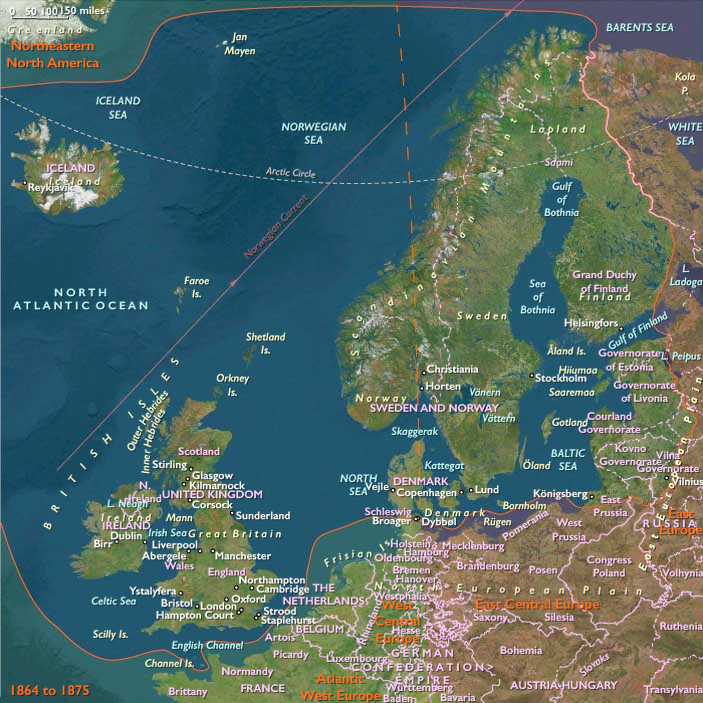
Despite growing prosperity, Britain still grappled with public health crises. In 1866, a localized cholera epidemic erupted in London’s East End, killing 5,596 people. The outbreak occurred just as London's ambitious sewage and water treatment infrastructure, designed by Joseph Bazalgette, neared completion—although crucial sections in the East End remained unfinished. This area’s severe overcrowding amplified the epidemic’s severity.
Noted epidemiologist William Farr conclusively identified contaminated water supplied by the East London Water Company as the source of infection, building on Dr. John Snow’s earlier groundbreaking work from the 1854 cholera epidemic. Farr’s work reinforced acceptance of the waterborne theory of disease, driving comprehensive sanitation reforms. In the same year, contaminated canal water caused another smaller outbreak at Ystalyfera in South Wales, leading to 119 deaths among workers associated with local waterworks and their families. These incidents accelerated nationwide reforms, culminating in legislation such as the Sanitary Act of 1866 and, later, the Public Health Act of 1875.
Irish Nationalism and the Home Rule Movement
In Ireland, nationalist aspirations re-emerged powerfully in the 1870s, as moderate nationalists formed the Irish Parliamentary Party, led prominently by Charles Stewart Parnell. Advocating Home Rule—limited self-government for Ireland under the British Crown—the party rapidly gained influence, significantly reshaping British and Irish politics.
Liberal Prime Minister William Gladstone introduced Home Rule Bills, which, despite their failure in Parliament, profoundly divided British politics. Many Liberals supported Home Rule, but a significant unionist minority—largely Protestant, based in Ulster—opposed it fiercely. Unionists feared discrimination from a predominantly Catholic nationalist parliament in Dublin and economic harm to Ulster’s prosperous industries. This conflict laid lasting groundwork for future political tensions.
Formation of Canada and Imperial Consolidation
Britain continued consolidating its imperial framework. In 1867, Britain united most of its North American colonies as the Dominion of Canada, granting substantial self-government and responsibility for domestic affairs, while retaining control over foreign policy and defense. This development marked a critical shift toward self-governing dominions within the empire, creating a model subsequently applied elsewhere.
Aestheticism, Fashion, and Gender Norms
Social and cultural trends shifted gradually during this era, notably within artistic and intellectual circles. By about 1870, women associated with the Aesthetic Movement adopted dresses featuring an uncorseted appearance, reflecting a subtle challenge to prevailing restrictive fashions. However, neither these aesthetic styles nor earlier progressive designs from the Pre-Raphaelites and Amelia Bloomer significantly displaced corsets, which continued to dominate women’s fashion.
Conversely, the middle-class aspiration toward gentlemanly respectability fostered considerable conformity in men's attire, exemplified by standardized, formal suits. These developments reinforced prevailing middle-class values of modesty, decorum, and social uniformity.
Education Reform: Toward Universal Literacy
Educational reform accelerated dramatically, with Forster’s Elementary Education Act (1870) making elementary schooling compulsory for children, transforming literacy rates and educational access. Local school boards established by this Act significantly improved standards, fostering a more educated populace capable of supporting Britain’s complex, industrialized economy.
Technological Advancements and Global Communication
Technological and industrial innovation continued unabated. Britain's infrastructure, especially railways, expanded considerably, supporting commerce and industry. Additionally, global communications were transformed by the successful laying of the transatlantic telegraph cable in 1866, enabling instant communication between Britain and North America. This advancement profoundly reshaped diplomacy, trade, and information dissemination.
British Diplomacy: Pragmatic Neutrality and Strategic Interests
Britain maintained diplomatic pragmatism during continental conflicts, notably the Franco-Prussian War (1870–1871), adopting a neutral stance while carefully monitoring shifting balances of European power. Persistent concerns regarding Russia’s ambitions toward the declining Ottoman Empire influenced cautious foreign policy aimed at preserving strategic interests in the Eastern Mediterranean and routes to India.
Britain’s earlier controversial support for the American Confederacy during the American Civil War, especially through shipbuilding (notably the CSS Alabama), was diplomatically resolved in the Treaty of Washington (1871), marking a significant precedent for peaceful international arbitration and strengthening future Anglo-American relations.
Persistent Gender Inequality and Early Feminist Advocacy
Although social conditions improved broadly, gender inequality persisted starkly. Economic opportunities for women remained severely limited, prompting early feminist advocacy for enhanced education, employment opportunities, and greater autonomy. Progress remained gradual, with the rigidity of gender norms still deeply entrenched in Victorian society.
Leisure, Tourism, and Victorian Culture
Organized tourism, spearheaded by entrepreneur Thomas Cook, expanded widely, making leisure travel accessible and popular among the middle classes. Cook's tours extended throughout Europe, Egypt, and North America, reflecting Victorian prosperity and curiosity. Literature flourished through writers such as George Eliot, Anthony Trollope, and the late Charles Dickens, portraying contemporary social realities and advocating gradual social reform.
In contrast, the fine arts continued to experience limited official support, overshadowed by the Victorian emphasis on industrial achievements, commerce, and engineering prowess showcased earlier at the Great Exhibition (1851).
Scandinavian and Icelandic National Developments
In Scandinavia, Norway steadily affirmed its distinct national identity within its union with Sweden. Denmark adjusted to territorial losses suffered during the Second Schleswig War (1864), profoundly shaping national consciousness.
Simultaneously, Iceland’s independence movement gained momentum under nationalist leader Jón Sigurðsson, following liberalization of Icelandic trade in the 1850s. The emerging Icelandic nationalism laid critical foundations for increasing autonomy and future independence aspirations.
From 1864 to 1875, Northwest Europe, particularly Britain, navigated complex yet prosperous years. Significant public health breakthroughs and sanitation improvements followed deadly cholera outbreaks, notably in London and South Wales. Political and social reforms gradually reshaped British society, reflected in expanded voting rights, improving labor conditions, educational access, and emerging feminist ideals. Internationally, cautious diplomacy preserved Britain's strategic interests amid continental turmoil and reshaped relationships with North America and Ireland. These developments collectively solidified Britain’s position at its imperial and economic apex, laying critical foundations for the later Victorian era.
People
Groups
Topics
Commodities
Subjects
Regions
North Europe
View →Subregions
