Northwest Europe (2205–2062 BCE): Expanding Bronze Age…
2205 BCE to 2062 BCE
Northwest Europe (2205–2062 BCE): Expanding Bronze Age Networks and Social Complexity
Consolidation of Bronze Age Societies
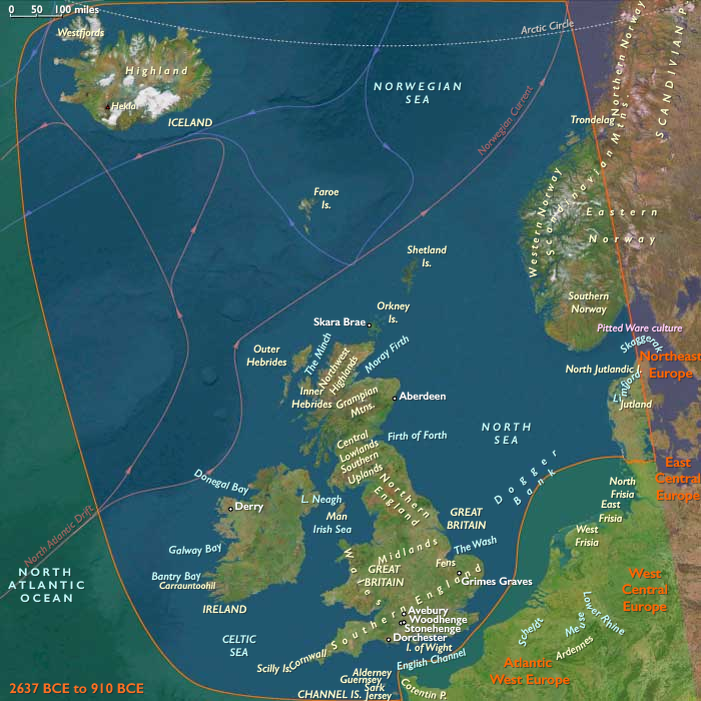
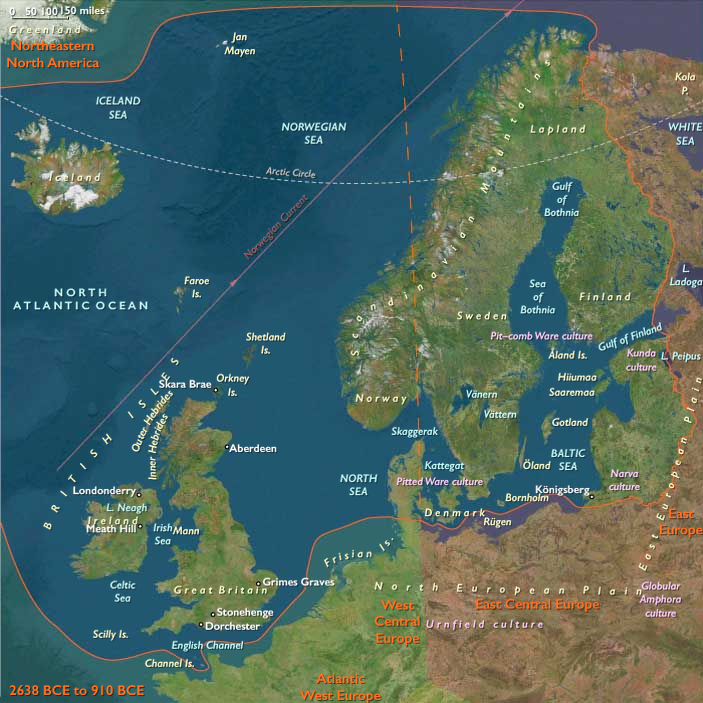
Between 2205 and 2062 BCE, communities across Northwest Europe—including the British Isles, western parts of Denmark and Norway, the Channel Islands, Orkney, and Shetland—further consolidated their Bronze Age identities. Bronze metallurgy became firmly integrated into regional economies, promoting technological advancement, expanded trade networks, and increased specialization in crafts and labor.
Societal Organization and Stratification
Social structures during this era continued to evolve, becoming notably stratified. Elites reinforced their social status through possession and display of bronze weapons, finely crafted ornaments, and specialized pottery. Prominent individuals were often interred in barrow burials, increasingly accompanied by elaborate grave goods, signaling a clear social hierarchy and distinct leadership roles within communities.
Developments at Stonehenge and Associated Monuments
In Britain, monumental complexes remained pivotal to cultural and ritual life. The ceremonial landscape surrounding Stonehenge expanded, with increasing numbers of burial mounds signifying the continued ritual importance of this area. Nearby sites such as Woodhenge maintained ceremonial significance, further illustrating complex social and religious practices of the age.
Flint Mining and Craft Specialization
Significant flint mining operations continued during this era, particularly at sites like Grimes Graves in Norfolk, England. Flourishing in the late third millennium BCE, Grimes Graves represented one of Britain's largest Neolithic flint mines. Miners utilized red deer antler picks, flint axes, and wedges to extract flint, sinking approximately five hundred shafts, some reaching depths of thirteen meters. Side galleries from these shafts allowed for extensive mining activities, and miners used primitive chalk lamps and torches for illumination. Flint and other stone axes from regions such as Langdale and Penmaenmawr in North Wales remained in high demand for forest clearing, agriculture, and settlement expansion.
Regional Centers in Ireland
In Ireland, the monumental complexes of the Boyne River Valley, including Newgrange, Knowth, and Dowth, continued to function as important ceremonial and ritual centers. Although major construction activities had largely ceased, these sites remained focal points for communal rituals and gatherings, maintaining social cohesion and reinforcing communal identity.
Shifts in Orkney and Shetland
Communities in the Orkney Islands continued to focus on ceremonial centers like the Ring of Brodgar and the Stones of Stenness. These sites remained important loci of communal activity, though their use began to shift away from the monumental construction that characterized earlier periods. Similarly, the Shetland Islands integrated broader Bronze Age cultural influences through trade, adopting new technologies and practices despite their geographic remoteness.
Agricultural Intensification and Settlement Expansion
Agricultural practices across Northwest Europe grew increasingly advanced, supported by bronze implements like plows, axes, and sickles. Enhanced agricultural productivity led to expanding settlements, allowing for larger populations and the development of specialized communities, particularly in fertile regions such as western Denmark and southern Britain.
Expansion of Maritime Trade
Maritime networks played a crucial role in the period, connecting coastal communities from Norway and Denmark to the British Isles. These networks facilitated the exchange of valuable commodities—including bronze artifacts, pottery, textiles, and amber—reinforcing cultural interactions and economic interdependencies throughout the region.
Continued Isolation: Iceland and the Faroe Islands
Throughout this period, Iceland and the Faroe Islands remained uninhabited due to their isolated location and challenging environmental conditions. Geological activities in Iceland, particularly volcanic eruptions, continued to provide useful chronological markers for archaeological dating in the broader Northwest European region.
Legacy of the Age
By 2062 BCE, Northwest European societies had firmly established complex Bronze Age communities characterized by sophisticated metallurgy, enhanced agricultural systems, well-developed trade networks, and pronounced social stratification. These advancements provided robust foundations that would support subsequent cultural and technological progress into the Middle Bronze Age.
Commodities
Subjects
Regions
North Europe
View →Subregions