Event
Interest in a canal project is revived…
Interest in a canal project is revived early in the seventeenth century by Philip III of Spain (1598-1621).
The Council of the Indies dissuades the king, arguing that a canal would draw attack from other European nations—an indication of the decline of Spanish sea power.
During the first quarter of the seventeenth century, trade between Spain and the isthmus remains undisturbed.
At the same time, England, France, and the Netherlands, one or all almost constantly at war with Spain, begin seizing colonies in the Caribbean.
Such footholds in the West Indies encourage the development of the buccaneers—English, French, Dutch, and Portuguese adventurers who prey on Spanish shipping and ports with the tacit or open support of their governments.
Because of their numbers and the closeness of their bases, the buccaneers are more effective against Spanish trade than the English had been during the previous century.
The volume of registered precious metal arriving in Spain falls from its peak in 1600; by 1660 volume is less than the amount registered a century before.
Depletion of Peruvian mines, an increase in smuggling, and the buccaneers are causes of the decline.
-
{# Image navigates to the detail page; the magnifying-glass chip is the only Fancybox lightbox trigger (kept a separate sibling — anchors can't nest). #}
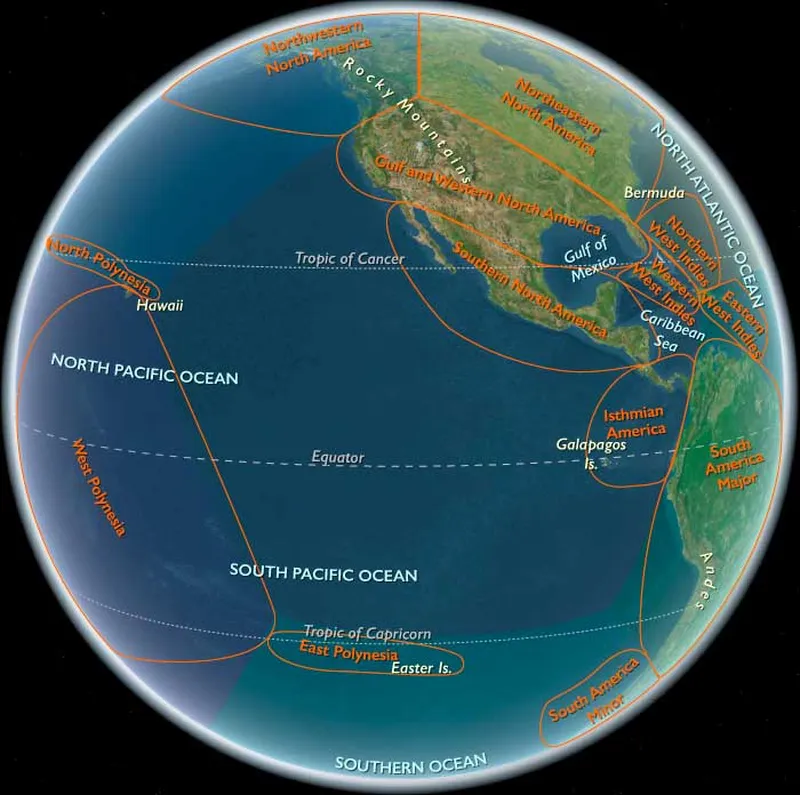 The Far West
World
-
{# Image navigates to the detail page; the magnifying-glass chip is the only Fancybox lightbox trigger (kept a separate sibling — anchors can't nest). #}
 Middle America
Region
-
{# Image navigates to the detail page; the magnifying-glass chip is the only Fancybox lightbox trigger (kept a separate sibling — anchors can't nest). #}
 Isthmian America
Subregion