
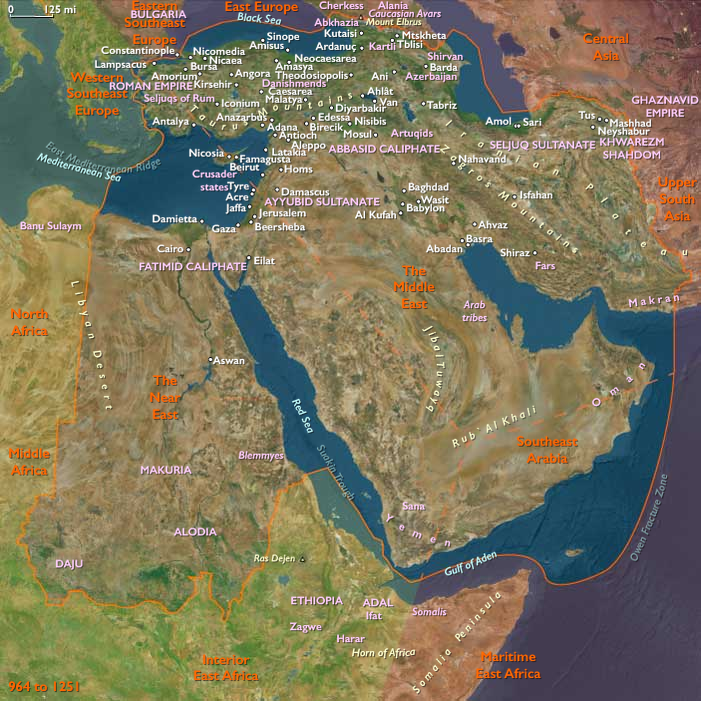
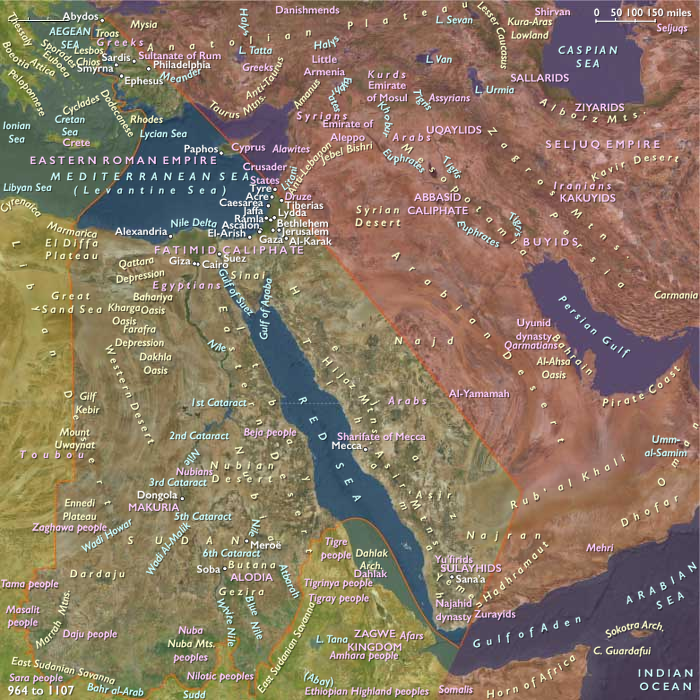
…Philadelphia in 1097–1099. Alexios' daughter Anna …
Years: 1099 - 1099
…Philadelphia in 1097–1099.
Alexios' daughter Anna credits this success to her father's policy and diplomacy but the Latin historians of the Crusade ascribe it to his treachery and falseness.
Locations
People
- Adhemar of Le Puy
- Al-Afdal Shahanshah
- Alexios I Komnenos
- Baldwin I of Jerusalem
- Bohemond I of Antioch
- Constantine I
- Danishmend Gazi
- Eustace III
- Fakhr al-Mulk Radwan
- Godfrey of Bouillon
- Guglielmo Embriaco
- Hugh I
- Iftikhar al-Dawla
- John Doukas
- Kerbogha
- Kilij Arslan I
- Manuel Boutoumites
- Peter the Hermit
- Pope Urban II
- Raymond IV
- Robert Curthose
- Robert II, Count of Flanders
- Stephen
- Tancred
- Tatikios
Groups
- Arab people
- Persian people
- Armenian people
- Jews
- Kurdish people
- Lombards (West Germanic tribe)
- Germans
- Christians, Armenian Apostolic Orthodox
- Christians, Maronite
- Christians, Miaphysite (Oriental Orthodox)
- Coptic Orthodox Church of Alexandria
- Greeks, Medieval (Byzantines)
- Islam
- Egypt in the Middle Ages
- Muslims, Sunni
- Muslims, Shi'a
- Syrian people
- Papal States (Republic of St. Peter)
- Toulouse, County of
- Flemish people
- Flanders, County of
- Abbasid Caliphate (Baghdad)
- Normandy, Duchy of
- Normans
- German, or Ottonian (Roman) Empire
- Turkmen people
- Cyprus, East Roman (Byzantine)
- Fatimid Caliphate
- French people (Latins)
- France, (Capetian) Kingdom of
- 'Uqaylid Dynasty of Mosul
- Hungary, Kingdom of
- Genoa, (Most Serene) Republic of
- Druze, or Druse, the
- Bulgaria, Theme of
- Lorraine (Lothier), Lower, (second) Duchy of
- Seljuq Empire (Isfahan)
- Christians, Roman Catholic
- Christians, Eastern Orthodox
- England, (Norman) Kingdom of
- Danishmends
- Rum, Sultanate of
- Apulia, Norman Duchy of
- Aleppo, Seljuq Emirate of
- Armenia, Baronry of Little, or Lesser
- Roman Empire, Eastern: Komnenos dynasty, restored
Topics
Commodoties
Subjects
Regions
Subregions
Related Events
Filter results
Showing 10 events out of 77 total
West Europe (1396–1539 CE)
Dynastic Struggles, Maritime Republics, and Reformation Currents
Geography & Environmental Context
West Europe in this age bridged the Mediterranean and the Atlantic through two intertwined spheres.
Mediterranean West Europe encompassed southern France (Languedoc, Provence, the Rhône valley, the French Pyrenees), Monaco, and Corsica—a frontier of mountain uplands, terraced coasts, and river plains tied to Italian and Iberian seas.
Atlantic West Europe ran along the Atlantic and Channel coasts of France, the Loire Valley Burgundy, northern France (including Paris), and the Low Countries (Belgium, the Netherlands, Luxembourg)—fertile basins and estuaries linked to Europe’s commercial cores.
From Marseille and Nice to Antwerp, Rouen, and Bordeaux, ports, riverways, and passes bound inland grainlands to sealanes and mercantile emporia.
Climate & Environmental Shifts
The Little Ice Age brought cooler winters, late frosts, and erratic rains.
-
Languedoc–Provence & Corsica: Vine and olive belts suffered frost damage in severe winters; storms battered harbors.
-
Rhône & Loire valleys; Paris Basin; Burgundy: Alternating floods, droughts, and cold snaps reshaped grain and grape yields.
-
Low Countries & Channel coasts: North Sea surges and wetter fields demanded relentless dike upkeep; fisheries endured rougher seas yet remained staples.
Subsistence & Settlement
-
Mediterranean sphere: Mixed farming of wheat, barley, rye, and legumes in valleys; vines and olives on coastal terraces; chestnuts in Corsican uplands. Sheep–goat transhumance linked Pyrenean and island pastures to town markets. Marseille, Avignon, Montpellier, Nice, and Ajaccio thrived as fortified, trade-facing towns.
-
Atlantic sphere: Wheat, rye, oats, and barley dominated; Burgundy’s vineyards and the Loire’s orchards supported regional exchange; flax and hemp in Flanders; dairy and cattle in the Low Countries. Paris, Rouen, Dieppe, Bordeaux, Bruges, Antwerp, Ghent, and Brussels anchored urban craft and export economies. Fisheries for herring and cod—salted and barreled—fed towns and long-distance trade.
Technology & Material Culture
-
Agriculture: Three-field rotations; water- and windmills; hillside terracing across Provence and Corsica.
-
Shipbuilding & seamanship: Mediterranean galleys and Atlantic cogs evolved toward caravels and larger ocean-going hulls; coastal shipyards provisioned fleets from Marseille to Rouen and Antwerp.
-
Architecture: Flamboyant Gothic cathedrals in Narbonne and Montpellier; papal complexes at Avignon; Genoese towers on Corsica; Burgundian ducal palaces; Flemish belfries and town halls; early Renaissance idioms appeared in Loire châteaux.
-
Print & craft: Lyon, Paris, and Antwerp emerged as printing hubs; Flemish woolens and tapestries, Burgundian wines, and Parisian luxury metalwork set European tastes.
Movement & Interaction Corridors
-
Mediterranean sealanes: Marseille and Monaco linked to Genoa, Naples, and Barcelona; Corsica sat astride Italy–Iberia–Maghreb routes.
-
Rhône corridor: Carried salt, wine, and grain north to Lyon and beyond.
-
Atlantic & Channel arteries: Bruges (declining by 1500), Antwerp (rising), and Rouen tied northern Europe to Iberia and the Mediterranean; Bordeaux connected the Loire–Garonne basins to the ocean.
-
Overland networks: Burgundian roads knit Dijon and Brussels to the Empire and France; pilgrimage roads joined Roussillon, Provence, and the Loire to Santiago de Compostela and Rome.
Cultural & Symbolic Expressions
-
Catholic orthodoxy & humanism: Monastic houses and cathedrals structured devotion; Avignon’s papal legacy lingered. Lyon and Avignon sustained humanist circles; Montpellier’s medical school gained renown.
-
Burgundian court culture: Under the Valois dukes (Philip the Good, Charles the Bold), Dijon and Brussels patronized Jan van Eyck, Rogier van der Weyden, and civic pageantry.
-
French monarchy & Renaissance: Post–Hundred Years’ War recovery culminated in Francis I’s embrace of Italianate forms and royal patronage along the Loire.
-
Netherlandish art: Early Netherlandish painters pioneered oil technique; civic commissions in Ghent, Bruges, and Antwerp flourished. Troubadour legacies survived in lyric verse across Provence; confraternities staged processions and charity in town parishes.
Environmental Adaptation & Resilience
-
Diversified ecologies: Mixed cereals, vines, olives, flax, and livestock spread climatic risk.
-
Water & earth works: Terraces and dikes stabilized fragile slopes and polders; flood embankments guarded the Rhône, Loire, and Low Country coasts.
-
Storage & exchange: Communal barns, urban granaries, and salt trade mitigated shortfalls; guild aid, hospitals, and beguinages provided social buffers.
Technology & Power Shifts (Conflict Dynamics)
-
Hundred Years’ War (to 1453): Though major battles lay north, raids and instability touched Languedoc and Provence. French resurgence culminated in Joan of Arc’s campaigns (1429) and Castillon (1453).
-
Aragon–French rivalry: Roussillon oscillated between crowns; Pyrenean frontiers remained militarized.
-
Burgundian Wars (1474–1477): Charles the Bold fell at Nancy; his inheritance split—parts to France, the rest to the Habsburgs—reshaping Low Country sovereignty.
-
Italian Wars (1494–1559): Drew Provence and Corsica into Valois–Habsburg struggles; Fornovo (1495) and Pavia (1525, capture of Francis I) reverberated through Provençal ports.
-
Corsica: Fought over by Genoa and Aragon; Genoa reasserted control, fortifying coasts against Barbary corsairs.
-
Naval theaters: Mediterranean galley wars and Adriatic–Aegean rivalries impacted Marseille and Monaco; the Low Countries pivoted toward Habsburg naval finance and Atlantic networks.
Transition (to 1539 CE)
By 1539, West Europe stood as a frontier of empires and a laboratory of recovery and renaissance.
In the Mediterranean, France had consolidated Provence and Roussillon yet suffered reverses in Italy; Genoa controlled Corsica, bracing against French and Ottoman pressure; Marseille and Monaco thrived as naval–mercantile hubs under the shadow of corsair raids.
Across the Atlantic sphere, Burgundy was partitioned between Valois and Habsburg realms; the Low Countries emerged as Europe’s commercial heart, with Antwerp surpassing Bruges as entrepôt to Iberian spice and silver trades.
Humanism animated Lyon and Avignon; Gothic and early Renaissance forms stood side by side; confessional tensions gathered on the horizon.
Poised between the Mediterranean and the Atlantic, West Europe entered the mid-16th century as both battlefield and marketplace—its rivers and ports set to channel the coming storms of Reformation and Habsburg–Valois rivalry.
Atlantic West Europe (1396–1539 CE): Burgundian Prestige, French Recovery, and Netherlandish Flourishing
Geographic & Environmental Context
The subregion of Atlantic West Europe includes the Atlantic and Channel coasts of France, the Loire Valley, Burgundy, northern France (including Paris), and the Low Countries (Belgium, the Netherlands, Luxembourg). Anchors included the Channel ports (Calais, Rouen, Dieppe, Antwerp, Bruges, Amsterdam), the Loire valley (Orléans, Tours, Nantes), the Burgundian heartlands (Dijon, Beaune), and the Paris Basin. This zone blended coastal trade hubs, fertile river valleys, and political cores, linking France, England, and the Holy Roman Empire.
Climate & Environmental Shifts
The Little Ice Age imposed cooler winters and erratic harvests:
-
Paris Basin & Burgundy: Periodic frosts reduced wheat and grape harvests.
-
Loire valley: Vineyards and orchards remained productive in most decades but saw occasional setbacks from floods and cold snaps.
-
Low Countries: Waterlogged fields required dike maintenance; storm surges (notably 15th-century North Sea floods) devastated coastal settlements.
-
Atlantic coasts: Rough seas complicated fishing and shipping; herring and cod fisheries persisted, anchoring diets.
Subsistence & Settlement
-
Agriculture: Wheat, rye, oats, and barley; vineyards in Burgundy and the Loire; flax and hemp in Flanders; dairy and cattle in the Low Countries.
-
Fishing: Channel and North Sea fisheries for herring, cod, and flatfish; salted and barrelled for trade.
-
Urban centers: Paris as royal capital; Bruges, Antwerp, Ghent, and Brussels as mercantile and craft hubs; Rouen, Dieppe, and Bordeaux on the Atlantic coast.
-
Craft production: Flemish cloth, Burgundian wines, and Parisian luxury goods (illuminated manuscripts, metalwork).
Technology & Material Culture
-
Agrarian systems: Three-field rotation, water- and windmills, improved plows in northern France and the Low Countries.
-
Textiles: Flemish woolens, later outpaced by English cloth but still dominant; silk and luxury fabrics in Lyon by early 16th century.
-
Architecture: Gothic cathedrals (Rouen, Chartres), Burgundian ducal palaces, Flemish town halls, and belfries; early Renaissance style appeared in royal châteaux along the Loire.
-
Print: Presses in Paris, Lyon, Antwerp; humanist works circulated widely.
Movement & Interaction Corridors
-
Channel & Atlantic ports: Bruges (declining), Antwerp (rising after c.1500), and Rouen tied northern Europe to Iberia and the Mediterranean.
-
Loire River corridor: Linked Atlantic ports to Paris and Burgundy.
-
Burgundian roads: Connected Dijon and Brussels to the Empire and France.
-
Pilgrimage routes: To Chartres, Mont-Saint-Michel, and Santiago via Atlantic ports.
Cultural & Symbolic Expressions
-
Burgundian court culture: Centered at Dijon and Brussels under the Valois dukes (Philip the Good, Charles the Bold); patronized Jan van Eyck, Rogier van der Weyden, and courtly pageantry.
-
French monarchy: Reasserted authority after the Hundred Years’ War; patronage of the arts flourished under Francis I, who embraced the Renaissance.
-
Netherlandish art: Early Netherlandish painters pioneered oil painting; civic patronage in Ghent, Bruges, and Antwerp thrived.
-
Religious life: Catholic piety remained dominant; confraternities, processions, and urban guild altars structured devotion. Reformist murmurs appeared by early 16th century.
Environmental Adaptation & Resilience
-
Dike building & poldering: Secured farmland in the Low Countries; towns rebuilt after floods.
-
Diversification: Farmers planted grains, vines, flax, and maintained cattle to spread risk.
-
Grain storage & trade: Surpluses from fertile regions like Artois and Flanders mitigated poor harvests elsewhere.
-
Urban resilience: Guild charities, hospitals, and beguinages provided relief in lean years.
Technology & Power Shifts (Conflict Dynamics)
-
Hundred Years’ War (1337–1453): Culminated in Joan of Arc’s campaigns (1429) and the Battle of Castillon (1453), restoring French control of most territory.
-
Burgundian Wars (1474–1477): Charles the Bold fell at the Battle of Nancy (1477); his lands were split between France and the Habsburgs.
-
French monarchy: Consolidated Loire valley as a royal heartland; launched the Italian Wars (1494–1559)under Charles VIII, Louis XII, and Francis I, drawing Burgundy and French Atlantic ports into continental conflict.
-
Low Countries: Fell under Habsburg rule after the Burgundian inheritance (1477–1482); Antwerp rose as a Habsburg entrepôt, drawing Iberian spice and silver trades by 1500.
-
Franco-Imperial rivalry: Battle of Pavia (1525) saw Francis I captured by Charles V, marking Habsburg predominance; northern France became a frontier of war finance and recruitment.
Transition
By 1539 CE, Atlantic West Europe had shifted from Hundred Years’ War devastation to Renaissance resurgence and early global entanglement. France’s Loire valley glittered with Renaissance châteaux; Burgundy had been absorbed into Valois and Habsburg spheres; the Low Countries emerged as Europe’s commercial heart, with Antwerp surpassing Bruges. Coastal fisheries and Channel ports endured climatic strain, but shipping and finance tied the region ever more tightly to Iberian Atlantic empires. Rivalries between Valois France and Habsburg Spain–Netherlands shaped a region poised at the forefront of European conflict and global expansion.
Northwest Europe (1396–1539 CE): North Sea Commons, Island Kingdoms, and Tudor Beginnings
Geographic & Environmental Context
The subregion of Northwest Europe includes the British–Irish archipelago, Iceland and the Faroes, and the ocean-facing rims of western Norway and western Denmark. Anchors span the North Atlantic fisheries (Iceland, Faroes, Shetland–Orkney), the North Sea littoral (Jutland, Yorkshire–East Anglia, Firths of Forth and Clyde), the Irish Sea and Channel approaches, and inland cores such as the Thames–Severn lowlands, Scottish Highlands/Islands, and Irish midlands. River corridors (Thames, Severn, Humber), firths, and sounds tied agrarian interiors to maritime trade, while the Norwegian fjords and Jutland bights faced wind-heavy seas.
Climate & Environmental Shifts
The Little Ice Age sharpened cold and storminess:
-
North Atlantic fringe (Iceland, Faroes, west Norway): longer sea-ice seasons and harsher gales; erratic cod/herring runs shaped fishing booms and busts.
-
Britain & Ireland: cooler winters, wet summers in some decades; harvest failures recurred locally; severe storms and surges disrupted coasts.
-
Jutland & North Sea: shifting bars and storm surges altered havens; dunes advanced on exposed shores.
Despite volatility, fisheries and mixed husbandry buffered many communities.
Subsistence & Settlement
-
Lowland farms (England, eastern Ireland, Jutland): wheat, rye, barley, oats; cattle, sheep, and dairying; open-field systems persisted in much of England, while enclosed demesnes and pastures spread unevenly.
-
Uplands & isles (Scotland, Wales, west Ireland, Norway): oats, barley, stock-rearing, and transhumant dairying; peat fuel; kelp and shore-gathering in island economies.
-
Iceland & Faroes: subsistence grain marginal; livelihoods centered on cod, dried fish, seabirds, sheep, and trade with Bergen–Hanse merchants.
-
Towns & ports: London (Thames) surged as a staple market; York, Bristol, Dublin, Cork, Edinburgh/Leith, Aberdeen, Bergen, and Aalborg tied hinterlands to sea lanes.
Technology & Material Culture
-
Maritime craft: clinker-built hulks and cogs gave way to round-hulled naos and early caravels; North Sea sailing rigs adapted to shoals and tides; Icelandic and Norse open boats remained crucial.
-
Arms & fortification: English longbow remained decisive into the mid-15th century; early handguns and field guns appeared; castles evolved toward gun-forts and, in Scotland/Ireland, tower houses.
-
Print & craft: William Caxton introduced printing to England (1476); cloth finishing (East Anglia, Yorkshire), tin/lead (Cornwall), and shipwrighting expanded.
-
Architecture & art: Perpendicular Gothic in England; late medieval parish art in Ireland; stave-church legacies and stone churches in west Norway; bardic manuscripts in Gaelic lands; saga copying continued in Icelandic scriptoria.
Movement & Interaction Corridors
-
North Sea/Irish Sea lanes: carried wool, cloth, salt fish (herring, cod), wine, salt, and iron; London, Hull, and east-coast ports linked to Hanseatic towns and Bergen’s fish market.
-
Atlantic ventures: Bristol merchants probed western waters; John Cabot’s voyage (1497) opened English awareness of Newfoundland’s cod banks.
-
Fjord & Jutland coasts: Bergen–Hanse convoy cycles and Jutland’s cattle/grain exports sustained Norway–Denmark’s Atlantic rim.
-
Isles networks: Birlinn and galley traffic knit Hebrides, Islay, Kintyre, Man, and Ulster; inter-island lordships balanced sea power and kin ties.
Cultural & Symbolic Expressions
-
Monarchy & law: English common law courts stabilized after civil war; Scottish kings balanced Highland/Lowland blocs; Gaelic lordships in Ireland maintained Brehon law and bardic patronage alongside the English Pale.
-
Language & letters: Middle English matured into Tudor English; Scots literature flourished (Dunbar, Henryson); Gaelic poetry remained courtly and genealogical; Icelandic annals and sagas preserved memory.
-
Devotion & reform: Late medieval piety—guild altars, pilgrimages (St. Andrews, Walsingham, St. David’s)—coexisted with early humanism; by the 1530s, England’s break with Rome began to reorder ritual and property.
Environmental Adaptation & Resilience
-
Mixed portfolios: grain–livestock rotations, dairying, and woodland management hedged climatic risk; parish granaries and seigneurial stores mitigated famine.
-
Fisheries & curing: salt fish, stockfish, and barrelled herring stabilized caloric intake and trade; salt-pan and coopers’ crafts were critical.
-
Field systems & enclosure: commons and open fields balanced with piecemeal enclosure to protect flocks and improve yields; drainage in fens and dike work on exposed coasts guarded arable.
-
Island adaptations: peat, driftwood, and turf for fuel; drying sheds and fish lofts; seasonal transhumance to shielings.
Technology & Power Shifts (Conflict Dynamics)
-
Hundred Years’ War (to 1453): English chevauchées faded after Joan of Arc’s campaigns (1429); defeat at Castillon (1453) ended English rule in France, redirecting power struggles homeward.
-
Wars of the Roses (1455–1487): Yorkist–Lancastrian civil war saw set-piece battles—Towton (1461), Tewkesbury (1471)—culminating in Tudor victory at Bosworth Field (1485); Henry VII stabilized crown finances and order.
-
Anglo-Scottish warpoints: Border raids persisted; Scotland’s defeat at Flodden (1513) killed James IV, reshaping regency politics.
-
Ireland: Tudor authority remained thin beyond the Pale; Gaelic confederacies and earldoms contested royal initiatives; intermittent wars foreshadowed later Tudor conquest.
-
Scandinavia: Denmark–Norway ruled the Atlantic rim; Bergen’s Hanse links endured; the Count’s Feud (1534–1536) in Denmark–Norway (closing years of this age) ushered in the Lutheran Reformation and tighter royal control.
-
Sea conflict: Privateering and piracy flickered in the Channel and North Sea; naval gunnery began to matter in convoy defense.
Transition
By 1539 CE, Northwest Europe had shifted from external continental wars to internal consolidation and oceanic horizons. England emerged under the Tudors with an embryonic navy and a royal church; Scotland balanced Franco-Scottish ties after Flodden; Ireland’s patchwork lordships and the Pale foreshadowed Tudor campaigns; Denmark–Norway steered the North Atlantic trades toward Lutheran monarchy; Iceland and the Faroes remained fishing outposts within this orbit. Fisheries, wool–cloth trades, and mixed husbandry underwrote resilience in a stormier climate, while printing and court centralization set the stage for later religious and imperial transformations.
In an attempt to forge peace, he marries a French noblewoman, Margaret of Anjou, in 1445, as provided in the Treaty of Tours.
Hostilities resume with France in 1449.
When England loses the Hundred Years' War in August 1453, Henry falls into a period of mental breakdown that lasts until Christmas 1454.
With his inability to control the feuding nobles, civil war begins in 1455.
The conflicts are known as the Wars of the Roses (1455–1485), and although the fighting was very sporadic and small, there is a general breakdown in the authority and power of the Crown.
The royal court and Parliament move to Coventry, in the Lancastrian heartlands, which effectively becomes the capital of England until 1461.
Henry's cousin, who deposes Henry in 1461 and becomes Edward IV, goes a little way to restoring the power of the Crown.
Edward defeats the Lancastrians at the Battle of Mortimer's Cross.
He is briefly expelled from the throne in 1470–1471 when Richard Neville, Earl of Warwick, brings Henry back to power.
Six months later, Edward defeats and kills Warwick in battle and reclaims the throne.
Henry is imprisoned in the Tower of London and dies there.
Northwest Europe (1456–1467 CE): Conflicts and Cultural Developments
England: Escalating Civil War
The Wars of the Roses intensified significantly, with major battles shaping the political landscape. The Yorkist victory at the Battle of Towton in 1461, the largest and bloodiest encounter of the conflict, led to the deposition of the Lancastrian king Henry VI and the crowning of Edward IV as king. Despite Edward's initial triumph, Lancastrian resistance persisted, leading to ongoing instability. The civil war had resumed in 1459, driven largely by Henry VI's queen, Margaret of Anjou, who inspired renewed conflict. Richard, Duke of York, initially became Protector but was dissuaded from claiming the throne outright. By the end of 1460, Richard was killed in battle, paving the way for Edward IV's proclamation as king in early 1461.
Scotland: Consolidation and Cultural Flourishing
In Scotland, James III (1460–1488) assumed power as a minor following the sudden death of his father, James II, in 1460. A regency council initially governed, with significant influence wielded by powerful nobles. Despite political challenges, James III’s reign witnessed the flourishing of Scottish art and architecture, with increased patronage contributing to cultural advancements and closer diplomatic ties to the European mainland.
Ireland: Gaelic Revival and English Constraints
Ireland continued to experience Gaelic resurgence, limiting English control strictly to The Pale. Prominent Gaelic families such as the Fitzgeralds, O'Briens, and O’Neills expanded their territories and influence, while simultaneously resisting English attempts at consolidation. Irish culture, law, and poetry experienced significant growth, reinforcing traditional Gaelic identity.
Scandinavia: Tensions in the Kalmar Union
The Kalmar Union faced ongoing internal tensions, particularly during the reign of Christian I (1448–1481). Sweden continued to push against Danish domination, and while armed rebellions were sporadic, political discontent persisted. Christian I maintained fragile control over the union through diplomacy and occasional military action, but unity remained tenuous.
Iceland: Literary Preservation
Iceland preserved its unique cultural heritage despite political integration into the Kalmar Union. Icelanders continued to produce and maintain their literary traditions, ensuring the survival of sagas, annals, and poetic forms. These efforts strengthened Icelandic identity, maintaining a vibrant cultural continuity amid broader Nordic political instability.
Cultural and Artistic Evolution
Throughout Northwest Europe, artistic and cultural developments continued to flourish. The English composer John Dunstaple maintained his prominence, influencing musical practices with innovative harmonies. Architectural projects progressed, including the ongoing construction and embellishment of York Minster in the increasingly prevalent Perpendicular Gothic style. Social changes, including new individuals rising to positions of power from various parts of society, also contributed to linguistic evolution in England.
Legacy of the Era
By 1467 CE, Northwest Europe was deeply influenced by intense political rivalries and remarkable cultural growth. England remained embroiled in civil conflict despite Edward IV's reign, Scotland navigated the challenges of minority kingship with cultural advancement, Ireland saw a strengthened Gaelic identity, and Scandinavia continued to grapple with internal divisions. These developments left an enduring imprint on the region, shaping political and cultural trajectories in subsequent decades.
The Late Middle English period is a time of upheaval in England.
After the deposition of Richard II of England in 1399, the House of Plantagenet had split into the House of Lancaster and the House of York, whose antagonism culminates in the Wars of the Roses from 1455 to 1487.
The civil war between the Yorkist and Lancastrian claimants to the English throne resumes in 1459 more violently.
Henry VI is captured and Richard, Duke of York, becomes Protector of England, but is dissuaded from claiming the throne.
The Lancastrians, inspired by Henry's Queen, Margaret of Anjou, resume the conflict, and Richard at the end of 1460 is killed in battle.
His eldest son is early in 1461 proclaimed King Edward IV after a crushing victory.
Social change, men coming into positions of power, some of them from other parts of the country or from lower levels in society, also result in linguistic change during this period.
Stability will come only gradually with the Tudor dynasty under Henry VII.
John II of Aragon, who has been King of Navarre since 1425 through his first wife, Blanche I of Navarre, who had married him in 1420, had retained the government of Blanche's lands at her death in 1441, and dispossessed his own eldest son, Charles, who at age two had been made Prince of Viana in 1423.
John had tried to assuage his son with the lieutenancy of Navarre, but his son's French upbringing and French allies, the Beaumonteses, had brought the two into conflict.
They had engaged in open warfare in Navarre in the early 1450s.
Charles had been captured and released; and John had tried to disinherit him by illegally naming his daughter Eleanor, who was married to Gaston IV of Foix, his successor.
John's new wife, Juana Enríquez, had given birth in 1451 to a son, Ferdinand.
Charles had fled his father in 1452, first for France, later for the court of his uncle, John's elder brother, Alfonso V at Naples.
John has governed his brother's Spanish realms—the Crown of Aragon—as lieutenant from 1454.
When Alfonso dies in 1458, Charles is arrested and brought to Majorca.
John succeeds Alfonso as ruler of the Crown of Aragon and in his will names Charles as his heir.
Among John's early unpopular acts is to quit the war against Genoa, upsetting the merchants of Barcelona.
He has also refused to aid his nephew, Ferdinand I of Naples, in securing his throne.
Charles leaves Majorca unauthorized in 1460 and lands in Barcelona, where he is welcomed by the two chief factions, the Busca and the Biga.
John does not initially react to the situation, but he calls Charles to his court at Lleida to discuss the proposed marriage of Charles to Isabella, infanta of Castile.
He still refuses to recognize Charles as his "first born", probably seeking to reserve that title for Ferdinand, but arousing opposition in the meantime.
Charles opens negotiations with Henry IV of Castile, his father's inveterate enemy.
At Lleida on December 2, 1460, he is arrested and imprisoned in Morella.
This causes an uproar in Catalonia, where Charles is immensely popular, and the king is forced to suspend court.
The Generalitat and the Diputació, the municipal council of Barcelona, create a Consell del Principat ("Council of the Principality") to settle the matter of the rightful succession.
A parliament is called for January 8, 1461.
Joan Dusai, the noted doctor of laws, rules at the parliament, that King John II has violated four of the Usatges de Barcelona, four of the Constitucions de Catalunya, and the Furs de Lleida.
The parliament now demands that John name Charles as his first-born son and heir.
This he refuses, and the parliament assembles an army under the Count of Modica.
The army quickly captures Fraga and John capitulates in February.
He frees Charles on February 25, and, on June 21, signs the Capitulation of Vilafranca, whereby Charles is recognized as his first-born son, lieutenant in perpetuity, and heir in all his realms.
The king also surrenders his right to enter the Principality of Catalonia without the permission of the Generalitat.
He is also forced to surrender royal prerogatives.
The appointment of royal officials is to be done only on the advice of representative bodies.
The treaty is a victory for the Catalanists (who stress Catalan independence and preeminence), pactists (who stress the relationship between monarch and Catalonia as a mutual agreement), and the foralists (who stress the ancient privileges, the fueros, of Catalonia).
Charles dies of tuberculosis in Barcelona on 23 September, a fact that threatens the treaty of June.
While Charles had inspired unity, his death sparks the reemergence of factionalism.
Though the treaty allows for the young Ferdinand, only nine years old, to succeed John, Ferdinand's mother is conspiring with the Busca against the Biga to have the treaty overturned.
Margaret travels to Scotland to negotiate for Scottish assistance.
Mary of Gueldres, Queen Consort to James II of Scotland, agrees to give Margaret an army on condition that she cede the town of Berwick to Scotland and Mary's daughter be betrothed to Prince Edward.
Margaret agrees, although she has no funds to pay her army and can only promise booty from the riches of southern England, as long as no looting takes place north of the River Trent.
She takes her army to Hull, recruiting more men as she goes.
Years: 1099 - 1099
Locations
People
- Adhemar of Le Puy
- Al-Afdal Shahanshah
- Alexios I Komnenos
- Baldwin I of Jerusalem
- Bohemond I of Antioch
- Constantine I
- Danishmend Gazi
- Eustace III
- Fakhr al-Mulk Radwan
- Godfrey of Bouillon
- Guglielmo Embriaco
- Hugh I
- Iftikhar al-Dawla
- John Doukas
- Kerbogha
- Kilij Arslan I
- Manuel Boutoumites
- Peter the Hermit
- Pope Urban II
- Raymond IV
- Robert Curthose
- Robert II, Count of Flanders
- Stephen
- Tancred
- Tatikios
Groups
- Arab people
- Persian people
- Armenian people
- Jews
- Kurdish people
- Lombards (West Germanic tribe)
- Germans
- Christians, Armenian Apostolic Orthodox
- Christians, Maronite
- Christians, Miaphysite (Oriental Orthodox)
- Coptic Orthodox Church of Alexandria
- Greeks, Medieval (Byzantines)
- Islam
- Egypt in the Middle Ages
- Muslims, Sunni
- Muslims, Shi'a
- Syrian people
- Papal States (Republic of St. Peter)
- Toulouse, County of
- Flemish people
- Flanders, County of
- Abbasid Caliphate (Baghdad)
- Normandy, Duchy of
- Normans
- German, or Ottonian (Roman) Empire
- Turkmen people
- Cyprus, East Roman (Byzantine)
- Fatimid Caliphate
- French people (Latins)
- France, (Capetian) Kingdom of
- 'Uqaylid Dynasty of Mosul
- Hungary, Kingdom of
- Genoa, (Most Serene) Republic of
- Druze, or Druse, the
- Bulgaria, Theme of
- Lorraine (Lothier), Lower, (second) Duchy of
- Seljuq Empire (Isfahan)
- Christians, Roman Catholic
- Christians, Eastern Orthodox
- England, (Norman) Kingdom of
- Danishmends
- Rum, Sultanate of
- Apulia, Norman Duchy of
- Aleppo, Seljuq Emirate of
- Armenia, Baronry of Little, or Lesser
- Roman Empire, Eastern: Komnenos dynasty, restored
