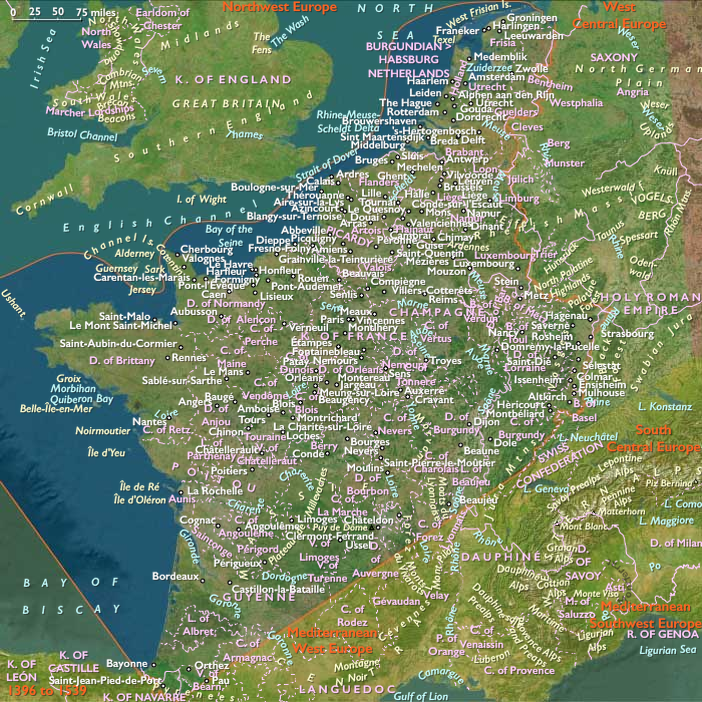
Philip the Good and the Burgundian Alliance…
1420 CE
Philip the Good and the Burgundian Alliance with England (1419–1420)
Upon the assassination of his father, John the Fearless, in 1419, Philip the Good, then twenty-three years old, succeeded as Duke of Burgundy and Count of Flanders and Artois. Unlike his father, who had been deeply entangled in French political affairs, Philip pursued a more calculated and pragmatic approach, maintaining a loose alliance with England while distancing himself from direct involvement in French politics.
I. Philip the Good’s Rise to Power (1419)
- Philip was the son of John the Fearless and Margaret of Bavaria-Straubing, inheriting Burgundy, Flanders, and Artois after his father’s murder.
- The assassination at Montereau (1419) deeply embittered Philip against the Armagnac faction and the Dauphin Charles (the future Charles VII of France).
- Seeking retribution for his father’s death, Philip aligned Burgundy more closely with England in the Hundred Years’ War.
II. The Burgundian-English Alliance in the Hundred Years’ War
- Philip passively supported Henry V of England in his efforts to usurp the French throne, though he was more cautious than his father in engaging directly in French affairs.
- This loose Burgundian-English alliance culminated in the Treaty of Troyes (1420), which:
- Recognized Henry V as the heir to the French throne.
- Disinherited the Dauphin Charles.
- Cemented Burgundian support for Henry’s control over northern France.
- Unlike John the Fearless, Philip did not fully entangle himself in English military campaigns, instead focusing on consolidating Burgundian power and influence.
III. Philip’s Political Strategy: Caution Over Direct Engagement
- Philip avoided the reckless political entanglements that had led to his father’s assassination.
- While maintaining a favorable relationship with England, he ensured that Burgundy retained its autonomy.
- His primary focus was on strengthening Burgundian rule in the Low Countries, rather than becoming embroiled in the chaos of the French civil war.
IV. Consequences and the Future of the Burgundian State
- Philip’s calculated diplomacy allowed Burgundy to rise as a dominant power in Europe, independent of both France and England.
- While he supported the Treaty of Troyes, his ultimate loyalty remained to Burgundian interests, which would later lead to a shift in alliances in 1435.
- His political acumen enabled Burgundy to flourish, expanding its economic and cultural influence throughout the Low Countries and beyond.
Philip the Good’s passive support of Henry V’s claim to the French throne (1419–1420) reflected his strategic approach to Burgundian politics—preserving English ties while ensuring Burgundy’s independence and long-term strength.
Locations
People
Groups
Topics
Commodities
Subjects
Regions
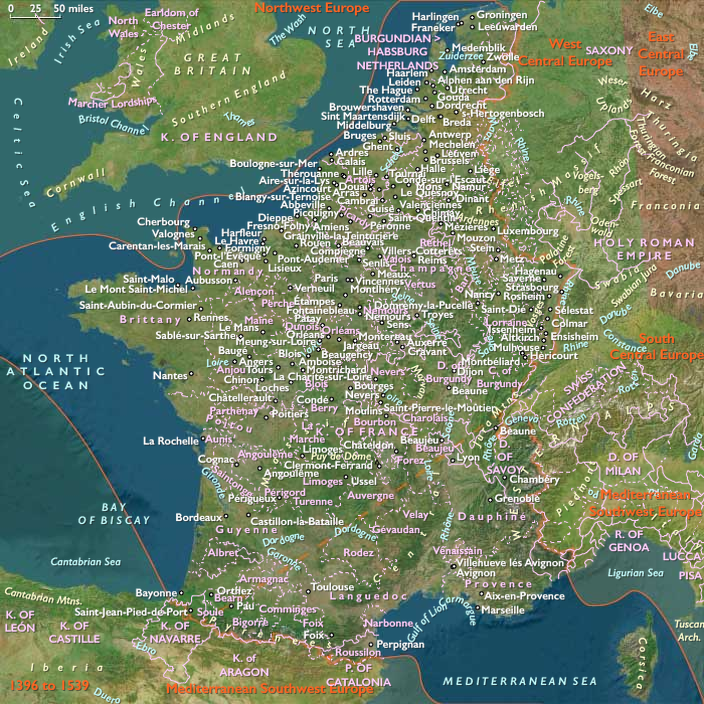
West Europe
View →Subregions