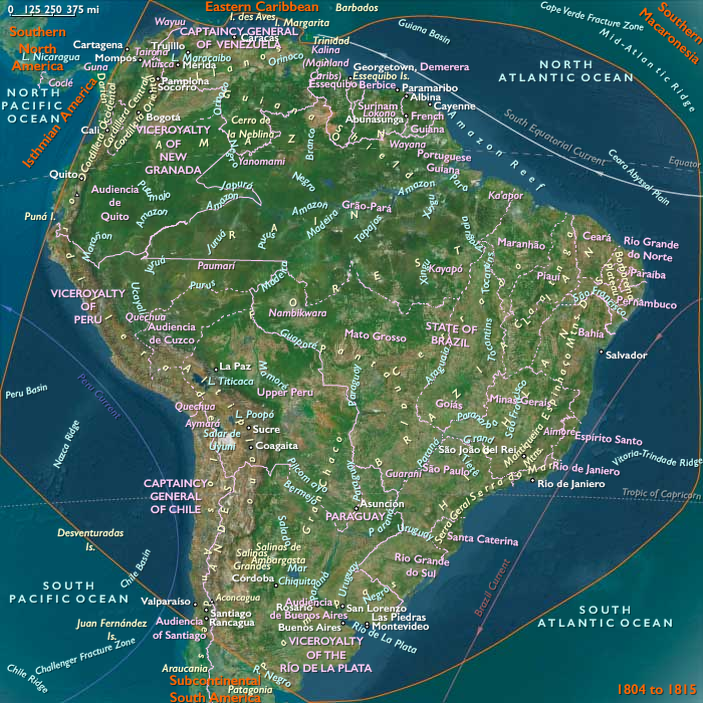
A congress convoked by the junta on…
1811 CE
Miranda assumes command of the army and leadership of the junta.
A constitution, dated December 21, 1811, marks the official beginning of Venezuela's First Republic.
Known commonly by Venezuelan historians as La Patria Boba, the Silly Republic, Venezuela's first experiment at independence suffers from myriad difficulties from the outset.
The cabildos of three major cities—Coro, Maracaibo, and Guayana—preferring to be governed by Joseph Bonaparte rather than by the Caracas cabildo, never accept independence from Spain.
The First Republic's leadership, furthermore, distrusts Miranda and deprives him of the powers necessary to govern effectively until it is too late.
Most damaging, however, is the initial failure of the Caracas criollo elite insurgents to recognize the need for popular support for the cause of independence.
Venezuela's popular masses, particularly the pardos, do not relish being governed by the white elite of Caracas and therefore remain loyal to the crown.
Thus, a racially defined civil war underlies the early years of the long independence struggle in Venezuela.
People
Groups
Basque people
View →
Christians, Roman Catholic
View →
Franciscans, or Order of St. Francis
View →
Spaniards (Latins)
View →
Spain, Habsburg Kingdom of
View →
Capuchin, Order of Friars Minor
View →
Canary Islanders
View →
Britain, Kingdom of Great
View →
Guipuzcoan Company of Caracas
View →
New Granada, Viceroyalty of
View →
Venezuela, Captaincy General of
View →
Topics
Commodities
Subjects
Regions
South America
View →Subregions