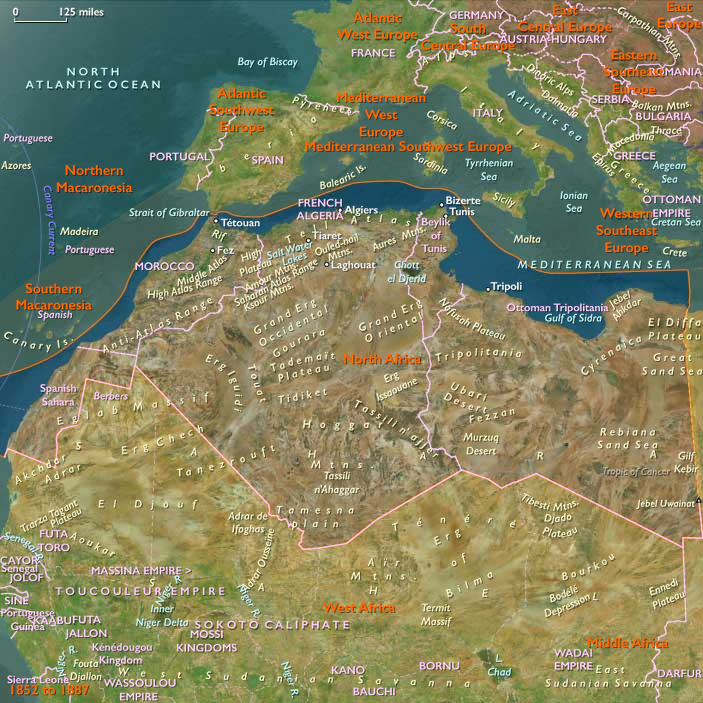
President Louis Napoleon of the French Second…
1852 CE to 1863 CE
Abdelkader moves in 1855 from the Byrsa, the citadel area of Carthage, to Damascus.
There in 1860, Abdelkader intervenes to save the lives of an estimated twelve thousand Christians, including the French consul and staff, during a massacre instigated by local Ottoman officials.
The French government, in appreciation, confers on him the Grand Cordon of the Legion of Honor, and additional honors follow from a number of other European governments.
Declining all invitations to return to public life, he will devote himself to scholarly pursuits and charity until his death in Damascus in 1883.
Abdelkader is recognized and venerated as the first hero of Algerian independence.
Not without cause, his green and white standard will be adopted by the Algerian liberation movement during the War of Independence and become the national flag of independent Algeria.
The Algerian government will bring his remains back to Algeria to be interred with much ceremony on July 5, 1966, the fourth anniversary of independence and the one hundred and sixtieth anniversary of the French conquest.
A mosque bearing his name will be constructed as a national shrine in Constantine.
Locations
Groups
Arab people
View →
Berber people (also called Amazigh people or Imazighen, "free men", singular Amazigh)
View →
Jews
View →
Christians, Miaphysite (Oriental Orthodox)
View →
Kabyle people
View →
Islam
View →
Christians, Roman Catholic
View →
Turkish people
View →
Ottoman Empire
View →
Ottoman Algeria
View →
Damascus Eyalet
View →
Topics
Secession of Constantine (Algeria)
View →
French Blockade of Algiers
View →
French Conquest of Algiers
View →
French Revolution of 1830 (July Revolution)
View →
Abd el-Kader, First War of (Algerian French Wars of 1832-1847)
View →
Abd al-Qadir, or Abd el-Kader, Second War of (Algerian French Wars of 1832-1847)
View →
Regions
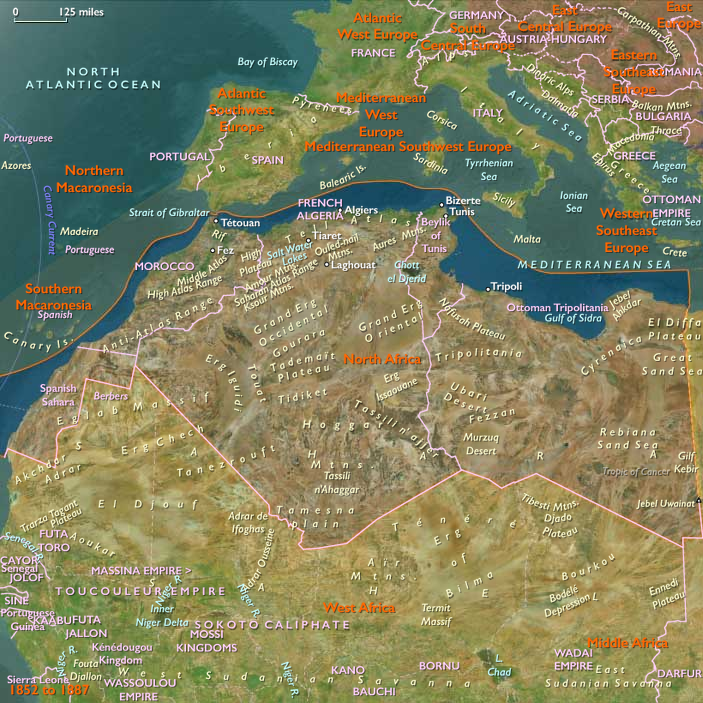
North Africa
View →Subregions