The wartime allies—Austria, Britain, Russia, and Prussia—conclude…
June 1815 CE
The wartime allies—Austria, Britain, Russia, and Prussia—conclude the Congress of Vienna by signing the Quadruple Alliance, which pledges them to uphold the peace settlement.
In a secondary document, the European monarchs agree to conduct their policies in accordance with the Christian principles of charity, peace, and love.
This "Holy Alliance," proposed by the Russian tsar, Alexander I, is of little practical import, but it gives its name to the cooperative efforts of Austria, Russia, and Prussia to maintain conservative governments in Europe.
Austria emerges from the Congress of Vienna as one of the great powers in Europe, but throughout the nineteenth century its status and territorial integrity will depend on the support of at least one of the other great powers.
As long as the allies are willing to cooperate in the "Congress System" to maintain the peace, order, and stability of Europe, Austrian interests are protected, but the other great powers, which are better able to defend their interests by force, will not always share Austria's devotion to Metternich's creation.
Locations
People
Groups
Regions
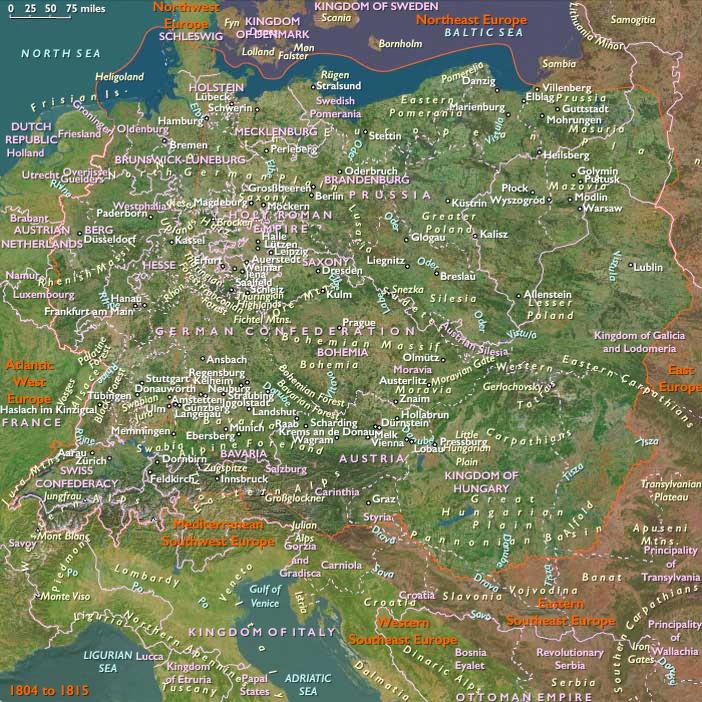
Central Europe
View →Subregions