
Portuguese Victory at Baltanás (November 18, 1475)…
1475 CE
Portuguese Victory at Baltanás (November 18, 1475) and Afonso V’s Strategic Retreat
As the War of the Castilian Succession (1475–1479) progressed, Portuguese forces continued their efforts to secure Castile for Joanna la Beltraneja, but Afonso V's lack of military aggression weakened his cause.
The Battle of Baltanás (November 18, 1475)
- Rodrigo Alfonso Pimentel, Count of Benavente, a supporter of Isabella I of Castile, was stationed with a small force in Baltanás to monitor Portuguese movements.
- On November 18, 1475, Afonso V’s army attacked, achieving a decisive victory.
- Pimentel was captured and imprisoned, marking a rare success for Afonso’s forces.
- This victory opened the way to Burgos, a key city in northern Castile, where Afonso could have reinforced his claim and gained more Castilian supporters.
Afonso V’s Strategic Withdrawal to Zamora
- Despite this hard-won victory, Afonso V chose to withdraw rather than press forward to Burgos, opting instead to fall back to Zamora.
- His reluctance to launch an offensive campaign confused and demoralized his Castilian allies, especially those who had expected bolder action against Isabella and Ferdinand.
- This hesitation contributed to the disintegration of Joanna la Beltraneja’s alliance, as Castilian nobles began defecting to Isabella’s side, seeing her as the stronger and more determined ruler.
Consequences of Afonso’s Inaction
- Weakened Support for Joanna – Castilian nobles who had supported Joanna lost confidence in Afonso, leading to further defections.
- Strengthening of Isabella’s Position – Ferdinand of Aragon and Isabella of Castile took advantage of Afonso’s lack of aggression, consolidating their political and military strength.
- Lost Opportunity at Burgos – Had Afonso advanced to Burgos, he might have shifted the war in his favor. Instead, his retreat to Zamora weakened his campaign.
The War’s Turning Point
- Afonso’s continued military passivity led directly to the Battle of Toro (March 1, 1476), a militarily inconclusive battle that nevertheless cemented Isabella’s political dominance.
- By 1479, the war ended with the Treaty of Alcáçovas, where Isabella and Ferdinand were recognized as rulers of Castile, and Portugal retained dominance over Atlantic exploration.
Afonso V’s failure to capitalize on his military successes, particularly at Baltanás, accelerated the collapse of his claim to Castile, ensuring the ultimate victory of Isabella and Ferdinand.
Locations
People
Groups
Commodities
Subjects
Regions
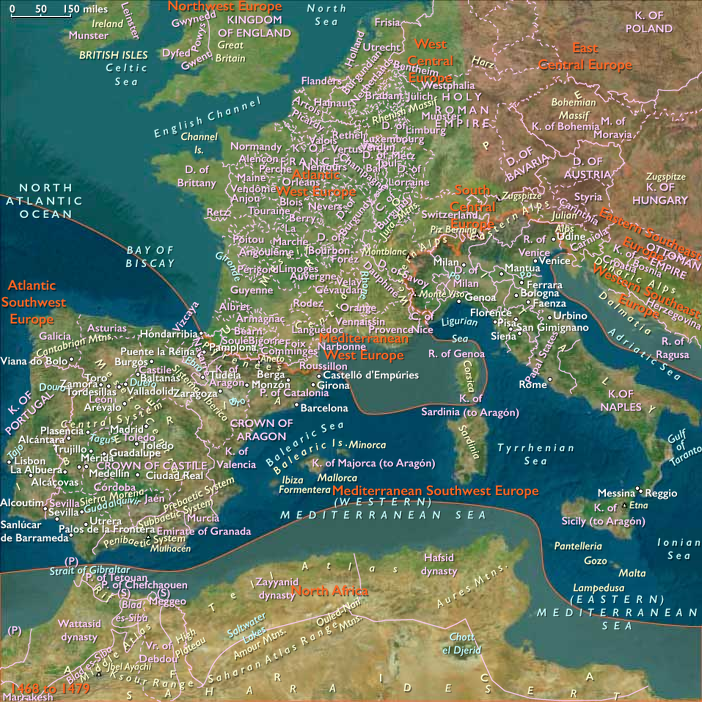
Southwest Europe
View →Subregions
