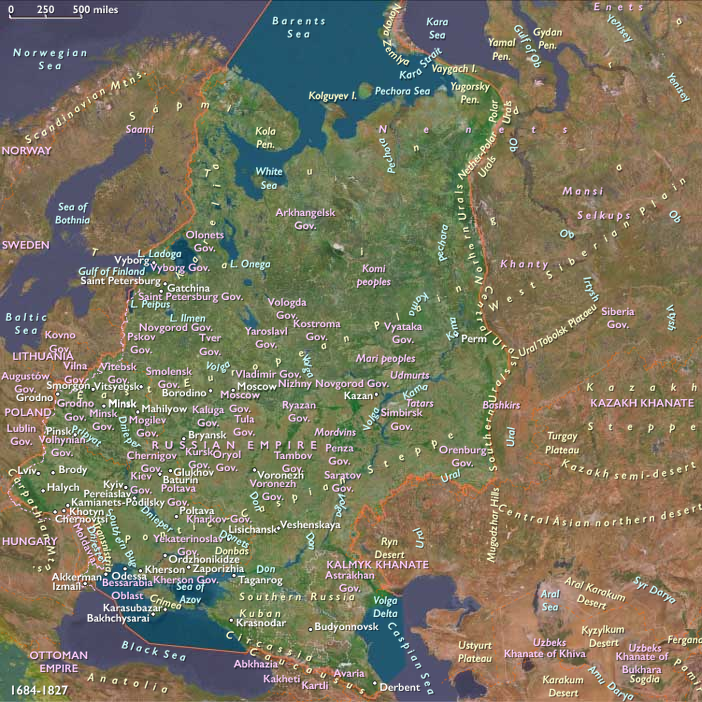
The partitioning of Poland greatly adds to…
1792 CE to 1803 CE
The partitioning of Poland greatly adds to Russia's territory and prestige, but it also creates new difficulties.
Having lost Poland as a buffer, Russia now has to share borders with both Prussia and Austria.
In addition, the empire becomes more ethnically heterogeneous as it absorbs large numbers of Poles, Ukrainians, Belorussians, and Jews.
The fate of the Ukrainians and Belorussians, who are primarily serfs, changes little at first under Russian rule.
Roman Catholic Poles resent their loss of independence, however, and prove to be difficult to integrate.
Russia had barred Jews from the empire in 1742 and views them as an alien population.
A decree of January 3, 1792, formally initiates the Pale of Settlement, which permits Jews to live only in the western part of the empire, thereby setting the stage for anti-Jewish discrimination in later periods.
At the same time, Russia abolishes the autonomy of Ukraine east of the Dnepr, the Baltic republics, and various Cossack areas.
With her emphasis on a uniformly administered empire, Catherine presages the policy of Russification that later tsars and their successors will practice.
People
Groups
Topics
Regions
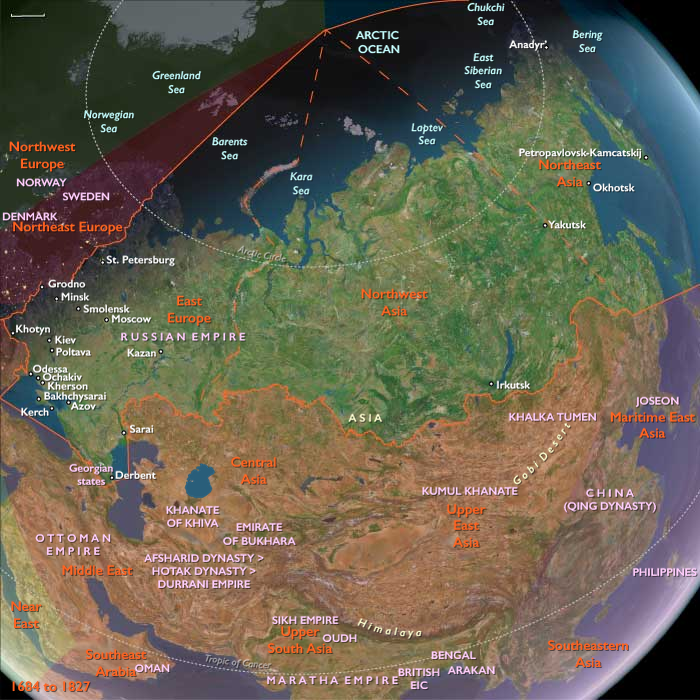
Northeastern Eurasia
View →Subregions