Lutheran Sweden's peace negotiations with the Empire,…
October 1648 CE
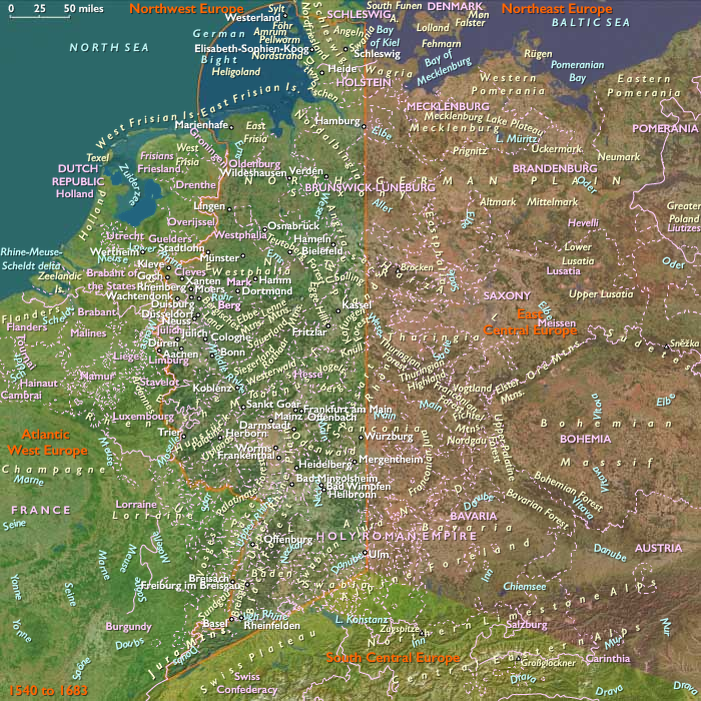
Lutheran Sweden's peace negotiations with the Empire, including the allies of both sides, takes place in its preferred conference venue, Osnabrück.
the Thirty Years War, after five years of negotiations between Spain and the United Provinces, and between France, Sweden, the Holy Roman Emperor and the German princes, ends with the 1648 Peace of Westphalia.
The treaties of Osnabruck and Münster result from the first modern diplomatic congress, thereby initiating a new political order in central Europe, based upon the concept of a sovereign state governed by a sovereign.
In the event, the treaties’ regulations becomes integral to the constitutional law of the Holy Roman Empire.
The power taken by Ferdinand III in contravention of the Holy Roman Empire's constitution is stripped and returned to the rulers of the Imperial States.
This rectification allows the rulers of the Imperial States to independently decide their religious worship.
Protestants and Catholics are redefined as equal before the law, and Calvinism is given legal recognition.
Also, each of the four hundred or so princes of the Holy Roman Empire are given equal authority to that of the Emperor, decentralizing the government and effectively ending the power of the Holy Roman Empire.
The Holy See is very displeased at the settlement, with Pope Innocent X reportedly calling it "null, void, invalid, iniquitous, unjust, damnable, reprobate, inane, empty of meaning and effect for all time".
Barriers to trade and commerce erected during the war are abolished, and "a degree" of free navigation is guaranteed on the Rhine.
It is agreed that the Prince-Bishopric of Osnabrück will alternate between Protestant and Catholic holders, with the Protestant bishops chosen from cadets of the House of Brunswick-Lüneburg.
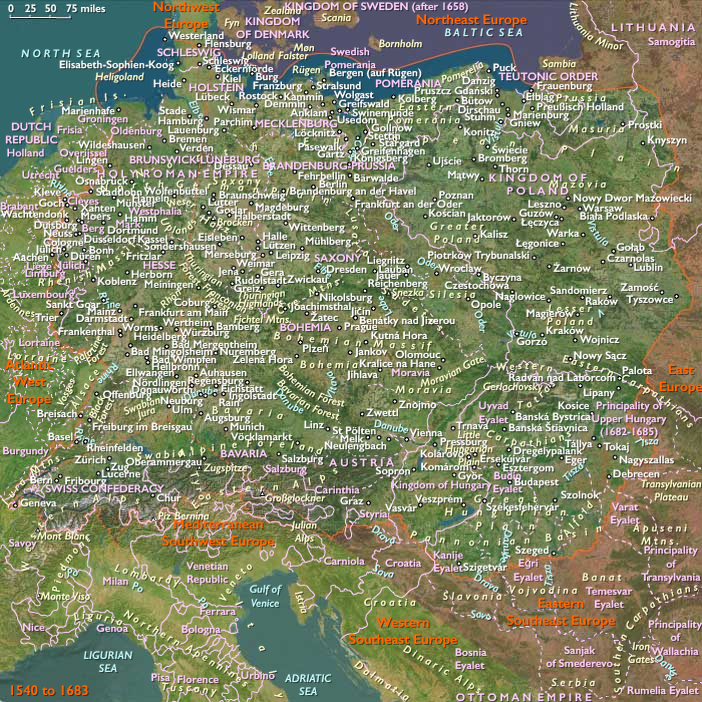
There are also territorial adjustments: ...
Locations
Groups
Topics
Commodities
Subjects
Regions
Central Europe
View →Subregions