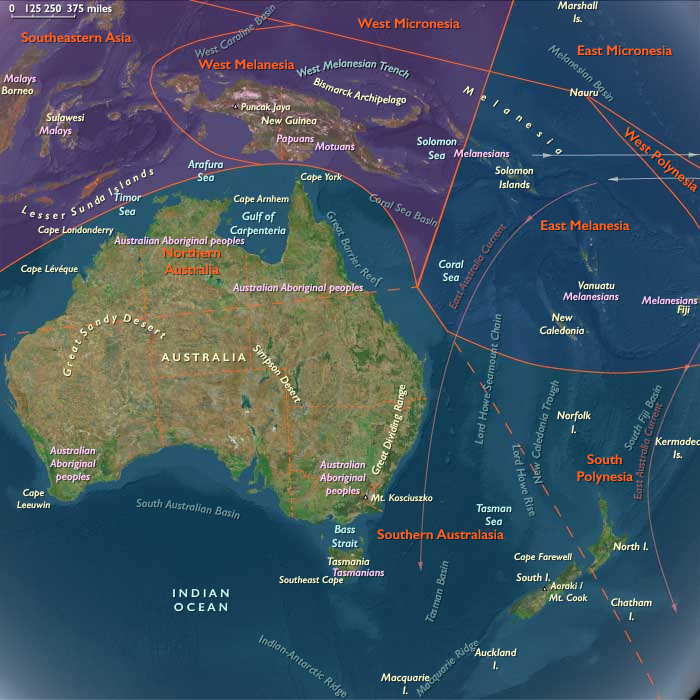
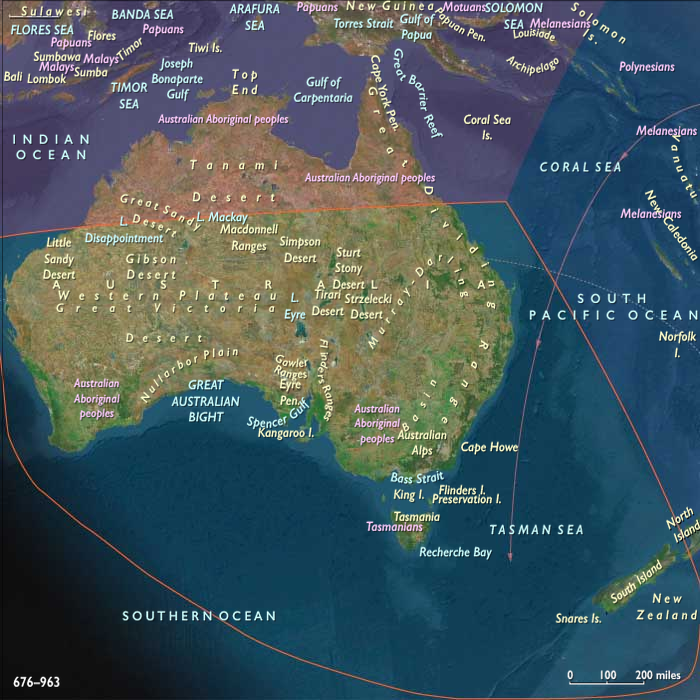
Australasia (909 BCE – 819 CE): Southern…
909 BCE to 819 CE
Australasia (909 BCE – 819 CE): Southern Worlds in Continuum — Fire, Stone, and the Last Unsettled Frontiers
Regional Overview
Across the vast southern reaches of the Indo-Pacific, Australasia stretched from the monsoon coasts of northern Australia to the cool, wind-lashed islands lying beyond the Tasman.
Between these extremes unfolded one of the world’s most continuous human stories — the Aboriginal lifeways of Australia — and, beyond the continental shelf, one of Earth’s last great uninhabited biomes: the islands of South Polynesia, awaiting Polynesian discovery.
Together they defined a single environmental arc: a landmass already ancient in human time joined to a constellation of islands that would not feel human footsteps for another millennium.
Geography and Environment
The region encompassed a spectrum of climates and ecologies.
In Northern Australia, tropical savannas, floodplains, and coral coasts responded to the pulse of the monsoon — lush green worlds in the wet, tawny firelands in the dry.
Farther south, temperate Australasia (New South Wales, Victoria, South Australia, Tasmania, and southern Western Australia) presented a mosaic of grasslands, eucalypt forests, and alpine wetlands shaped by controlled burning.
Beyond the continental rim lay the southern island arc — Aotearoa’s unpeopled forests, Norfolk and the Kermadecs under seabird dominion, and the storm-beaten Chathams — a pre-human ecology of staggering fertility.
Climatically, the era was stable: the waning late Holocene warmth supported consistent rainfall in the southeast and dependable wet-dry cycles in the north. Periodic droughts or floods merely reinforced the adaptive breadth of Aboriginal subsistence systems and preserved, in the islands beyond, untouched biotic reserves.
Societies and Lifeways
Aboriginal Australia
From the Kimberley to the Murray-Darling, societies organized through kinship, language, and sacred geography. Songlines — the melodic maps of Dreaming ancestors — bound together communities across thousands of kilometers, each verse a charter of law, ecology, and memory.
Seasonal mobility underpinned political and economic order: coastal clans harvested fish and shellfish in the dry season, then moved inland for fruiting cycles, eel harvests, and great inter-group ceremonies.
In the tropical north, Arnhem Land and the Kimberley sustained elaborate rock-art traditions: X-ray renderings of barramundi and turtles, Dynamic Figures of ritual dance, and ancestral beings bridging spirit and human realms.
To the south, along the basalt plains of Victoria, the Budj Bim aquaculture complex — a network of stone-walled channels and ponds — trapped migrating eels, a feat of engineering and ecological insight unmatched anywhere in prehistoric temperate Australia.
Southern Australasia
In temperate Australia, complex fire regimes (“fire-stick farming”) maintained open mosaics rich in game and edible tubers. In Tasmania, isolated by post-glacial seas, Palawa communities adapted to cooler climates, emphasizing seal and bird harvests, grass-tree resins, and coastal shell middens that ringed the island like archives of time.
The Unpeopled Islands
South Polynesia — New Zealand’s North Island (north of its southern coast), the Chathams, Norfolk, and the Kermadecs — remained uninhabited throughout this age.
The Taupō eruption (c. 232 CE) rejuvenated Aotearoa’s soils with volcanic ash, leaving a landscape primed for later cultivation. Flightless birds — the giant moa, the agile weka, and their predators, the massive Haast’s eagle — thrived in predator-free balance; seabird colonies and eel-rich rivers produced the ecological abundance that Polynesian voyagers would one day harness.
Economy and Material Culture
Across continental Australasia, subsistence was guided by ecological intimacy rather than surplus accumulation. Plant and animal foods — yams, tubers, fruits, seeds, fish, marsupials, and birds — were gathered through rotational foraging.
Tools of stone, bone, and wood — the ground-edge axe, digging stick, boomerang, spear-thrower (woomera) — were perfected within localized traditions. Bark canoes and rafts, often temporary, sustained inshore navigation and cross-estuarine trade.
Far to the north, ochre from the Kimberley and Arnhem Land circulated inland in networks spanning the continent; in the southeast, stone blades from Mount William were exchanged over hundreds of kilometers, testament to interregional integration without urbanism.
Belief and Symbolism
The Aboriginal cosmos was a seamless continuum between human and environment. Dreamtime (Tjukurrpa) stories traced the creation of landforms, waters, and species, binding each clan to its custodial estate.
Ritual cycles — initiation, increase ceremonies, rainmaking — renewed ecological and social balance. Art, song, and dance were vehicles of law, not ornament: every motif a legal document in pigment and rhythm.
In contrast, the southern islands, still beyond human reach, stood as a mythic frontier in later Polynesian imagination — the far southern Hawaiki Raro, where untraveled seas met the cold breath of the underworld.
Adaptation and Resilience
Australasia’s success lay in mobility, fire, and reciprocity. Fire managed vegetation; mobility balanced resources; kin reciprocity redistributed food and ritual labor across groups.
Wet-dry scheduling in the north, and altitudinal movement in the south, buffered seasonal extremes. When drought struck inland basins, coastal and riverine routes provided safety nets.
For ecosystems beyond human presence, resilience manifested in undisturbed cycles: seabird guano fertilizing forests, volcanic ash enriching soils, and hydrological renewal across the unpeopled islands.
Regional Synthesis and Long-Term Significance
By 819 CE, Australasia embodied both deepest continuity and imminent transformation.
On the mainland, Aboriginal civilizations had refined millennia-old ecological stewardship into artful equilibrium — landscapes engineered by fire and law.
Beyond the Tasman horizon, the pristine archipelagos of South Polynesia waited, ecologically poised for human arrival.
The unity of the region lay not in empire or migration but in a shared environmental grammar: monsoon and westerly, reef and fire, rhythm and return.
This dual reality — a peopled continent of timeless tenure beside untouched islands at the edge of discovery — reveals why Australasia naturally divides into subregions:
each expresses a phase of the same story — from enduring human custodianship in Australia to the silent readiness of Aotearoa’s forests.
Together they form a single southern world, complete in its balance of memory and possibility.
Subjects
Regions