Event
Southeast Asia (2,637 BCE–910 BCE): Early Antiquity…
Southeast Asia (2,637 BCE–910 BCE): Early Antiquity — Farming Frontiers, Island Voyagers, and Emerging Metal Worlds
Geography
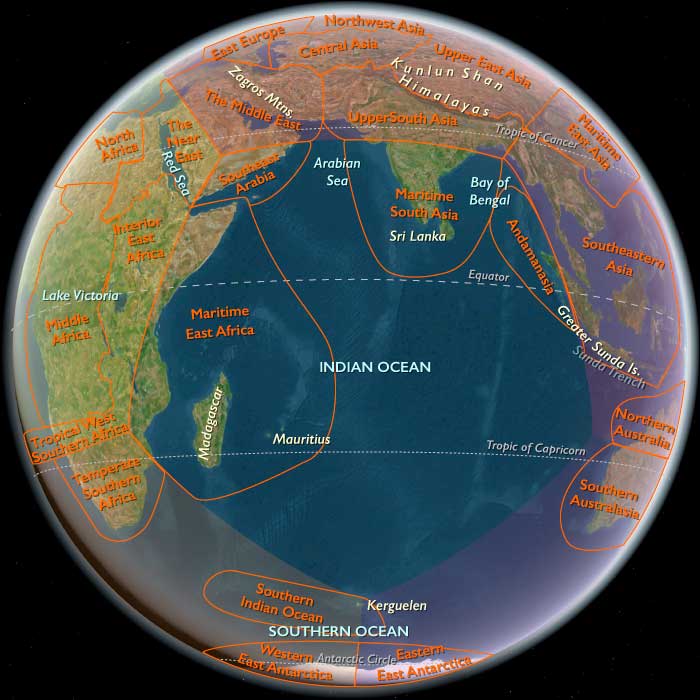
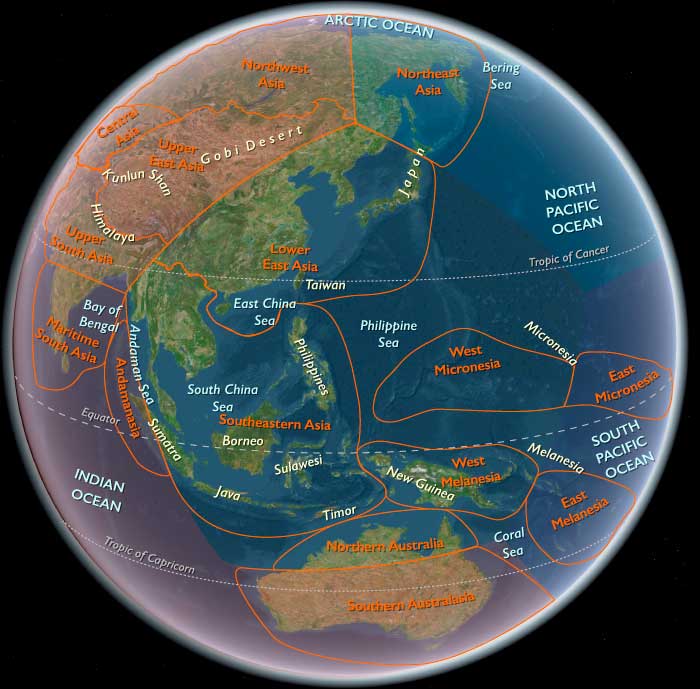
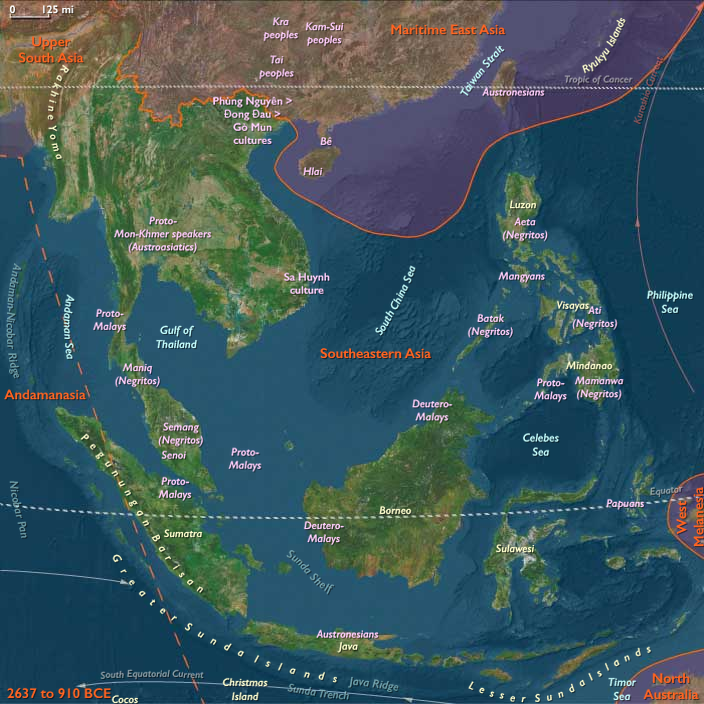
Southeast Asia combined Sundachina and Andamanasia, spanning the mainland between eastern India and southern China and the island worlds between the Bay of Bengal and the western Pacific.
Sundachina included southern and eastern Myanmar, Thailand, Cambodia, Laos, Vietnam, and the Malay Peninsula, together with the principal island systems to their south and east: Sumatra east and south of the Belawan–Padang division, Java, Borneo, Sulawesi, the Philippines, and the eastern Indonesian archipelagos through the Banda, Molucca, Ceram, Halmahera, and Sulu seas.
Northwestern Myanmar—including the Chindwin and Myittha valleys—lay outside Southeast Asia in Upper South Asia, while the central and southern Irrawaddy basin belonged to Sundachina.
Andamanasia formed the western maritime arc. It included the Andaman and Nicobar Islands; Preparis, Coco, and Little Coco off Myanmar; Aceh and the western side of northern Sumatra southward to about Padang, including the northern Barisan highlands; Simeulue, Nias, the Batu Islands, and Mentawai; and the Cocos (Keeling) Islands.
The internal division therefore crossed Sumatra itself: Aceh and the western Sumatran corridor to Padang belonged to Andamanasia, while the Malacca Strait side and the remainder of Sumatra belonged to Sundachina.
Together these subregions linked mainland river valleys, monsoon forests, volcanic island chains, major straits, and maritime passages across the Bay of Bengal, South China Sea, and Indonesian archipelagos.
Across the exact 1,728-year epoch from 2,637 BCE through 910 BCE inclusive, mainland and island Southeast Asia changed through related but distinct sequences of farming, migration, settlement, maritime expansion, exchange, and eventually metallurgy.
Historical Synthesis
At the exact opening of Early Antiquity in 2,637 BCE, Southeast Asia was already a deeply inhabited region, but its mainland and island sectors began from different historical baselines.
Across Sundachina’s mainland, long-established communities occupied forests, river valleys, uplands, caves, floodplains, deltas, and coasts. Hunting, fishing, gathering, plant management, and localized cultivation remained central; permanent farming villages had not yet become widespread across most of the region.
Across Sundachina’s island worlds, equally old societies already depended on fishing, arboriculture, tubers, sago, forest foods, shellfish, and inter-island movement. Borneo, Sulawesi, the Philippines, Java, Sumatra, and the eastern archipelagos were therefore not empty spaces awaiting incoming farmers, but inhabited maritime landscapes with their own deep histories.
Andamanasia added a third setting. Aceh and the western Sumatran corridor belonged to the ancient Sunda world and participated in coastal and island movement around Sumatra. Simeulue, Nias, Batu, and Mentawai followed their own western-island trajectories. The Andaman and Nicobar chains lay farther into the Bay of Bengal, while the remote Cocos (Keeling) Islands remained beyond permanent settlement.
The epoch’s first major transformation would affect these zones differently.
c. 2,200–2,000 BCE — Farming Expands Across the Mainland
After about 2200 BCE, farming populations from southern China moved more visibly into mainland Southeast Asia.
By around 2000 BCE, rice and millet cultivation, pottery, domesticated animals, storage, and more durable village settlement had become established in parts of northern Vietnam, Thailand, Laos, and neighboring corridors.
The Red River, Mekong, Chao Phraya, and related basins became important settlement zones because fertile floodplains and terraces supported repeated occupation.
The shift remained uneven. Rice became important in many districts, while millet retained a major role in some drier or upland settings. Hunting, fishing, gathering, and forest use continued alongside cultivation.
These farming communities did not simply replace older populations. They entered inhabited landscapes, and the resulting societies developed through migration, exchange, intermarriage, and local adoption of crops and technologies.
While village farming was becoming established on the mainland, the island world was approaching a different transformation.
c. 2,000–1,500 BCE — Austronesian Expansion Reorganizes the Islands
During the early second millennium BCE, Austronesian-speaking communities expanded southward through the Philippines and onward into Borneo, Sulawesi, the Moluccas, and other parts of Island Southeast Asia.
They carried pottery, cultivated plants, domestic animals, languages, and new maritime networks.
But the societies they encountered already possessed ancient fishing, arboricultural, forest, and voyaging traditions. The emerging island world therefore combined incoming and older populations rather than reproducing one migrant culture intact.
Austronesian languages spread widely, while subsistence remained highly varied. Rice and millet became important in some districts; elsewhere sago, tubers, tree crops, fishing, shellfish, and forest foods remained more central.
By roughly 1800–1500 BCE, movements of people, pottery, shell ornaments, stone, crops, and animals increasingly connected the Philippines, Borneo, Sulawesi, and the eastern Indonesian archipelagos.
At the same time, mainland farming communities were becoming more securely rooted in particular valleys.
c. 1,500–1,200 BCE — Mainland Villages and Island Societies Become Localized
After about 1500 BCE, the earlier expansions began producing more distinct regional societies.
On the mainland, villages developed their own ceramic styles, burial customs, crop combinations, animal economies, and exchange relationships. Vietnam, Thailand, Laos, Cambodia, and Myanmar no longer represented stages of one southward farming movement; they increasingly contained settled local traditions.
The Malay Peninsula became more important as a connector between mainland and island worlds. Its rivers and coasts linked the South China Sea with Sumatra and the Bay of Bengal.
Across Sundachina’s islands, the same localization occurred within maritime societies.
In the Philippines, long-distance connections continued while communities developed increasingly local settlement and ceramic traditions. In Borneo, river systems, forests, and coasts supported different mixtures of cultivation, arboriculture, and exchange. Sulawesi developed strongly regional communities separated and connected by mountain interiors and deeply indented seas.
Java and Sundachina’s portion of Sumatra combined fertile agricultural zones with extensive riverine and coastal networks. Farther east, the Moluccan and Banda seas linked smaller islands whose populations depended heavily on maritime movement, forest products, horticulture, and exchange.
Within Andamanasia, the Aceh–western Sumatra corridor participated increasingly in the maritime world linking Sumatra, the Malay Peninsula, and the Bay of Bengal. Simeulue, Nias, Batu, and Mentawai developed within that western Sumatran sphere but retained their own island histories.
The Andaman Islands preserved older forager traditions. The Nicobars occupied an intermediate maritime position between the Bay of Bengal and Island Southeast Asia. Preparis and the Coco islands lay close to the Myanmar–Andaman approaches, while the distant Cocos (Keeling) Islands remained beyond permanent settlement.
c. 1,200–1,100 BCE — Exchange Networks Thicken on Land and Sea
During the twelfth and early eleventh centuries BCE, both mainland and island systems became more interconnected.
On the mainland, farming villages exchanged pottery, livestock, crops, stone, ornaments, and other materials along routes linking lowlands, uplands, rivers, and coasts.
Across the islands, repeated voyaging connected the Philippines, Borneo, Sulawesi, Sumatra, Java, the Moluccas, and neighboring seas. Maritime movement now linked communities whose local traditions were becoming increasingly distinct.
The Malay Peninsula and both sides of northern Sumatra stood at the intersection of these worlds, connecting mainland routes with the Malacca Strait, western Sumatran coast, and Bay of Bengal.
These networks were already mature when a new technology began to enter selected mainland societies.
c. 1,100–910 BCE — Metallurgy Appears as Maritime Networks Continue Expanding
Beginning around the eleventh century BCE, copper-base metallurgy became securely established in parts of mainland Southeast Asia.
At places such as Ban Non Wat, clearly metal-using phases appeared around 1050–1000 BCE.
Metalworking entered communities whose farming, settlement, and exchange systems were already centuries old. Copper and tin had to move between mining areas, workshops, villages, and regional routes, extending existing networks rather than creating them from nothing.
Bronze objects became valued goods, and in some communities they appeared in burials alongside exotic ornaments and other indications of unequal access to prestige materials.
The social effects remained local. Households and lineages could gain influence through control of valued objects or exchange relationships, but territorial states had not yet appeared.
Across Island Southeast Asia, the principal late-epoch development remained maritime rather than metallurgical.
Voyaging networks continued linking the Philippines, Borneo, Sulawesi, Java, Sumatra, the Moluccas, and the eastern seas, while communities adapted crops, animals, technologies, and exchange practices to their own islands.
Within Andamanasia, Aceh and the western Sumatran islands increasingly participated in these maritime movements, while the Andamans retained older forager histories and the most remote islands remained outside permanent settlement.
Legacy of the Age
At the exact endpoint of 910 BCE, Southeast Asia stood within a new historical configuration.
Across much of the mainland, farming villages had been established for many centuries. Local crop regimes, pottery traditions, burial customs, livestock economies, and exchange routes were deeply rooted, while bronze metallurgy was only beginning to add new forms of craft specialization and social distinction.
Across the island worlds, Austronesian-speaking maritime societies had likewise had centuries to develop local identities while maintaining extensive networks of voyaging and exchange from the Philippines through the Indonesian archipelagos and around both sides of Sumatra.
The contrast present at 2,637 BCE had therefore changed profoundly. Mainland farming and island maritime expansion had both become enduring regional structures, and by 910 BCE they were increasingly connected through the Malay Peninsula, the Malacca Strait, the Aceh–western Sumatra corridor, and the surrounding seas.
-
{# Image navigates to the detail page; the magnifying-glass chip is the only Fancybox lightbox trigger (kept a separate sibling — anchors can't nest). #}
 The Indian Ocean Lands
World
The Indian Ocean Lands
World
-
{# Image navigates to the detail page; the magnifying-glass chip is the only Fancybox lightbox trigger (kept a separate sibling — anchors can't nest). #}
 The Far East
World
The Far East
World
-
{# Image navigates to the detail page; the magnifying-glass chip is the only Fancybox lightbox trigger (kept a separate sibling — anchors can't nest). #}
 Southeast Asia
Region
Southeast Asia
Region
-
{# Image navigates to the detail page; the magnifying-glass chip is the only Fancybox lightbox trigger (kept a separate sibling — anchors can't nest). #}
 Sundachina
Subregion
Sundachina
Subregion
-
{# Image navigates to the detail page; the magnifying-glass chip is the only Fancybox lightbox trigger (kept a separate sibling — anchors can't nest). #}
 Andamanasia
Subregion
Andamanasia
Subregion