Australasia (1684 – 1827 CE) Settled Worlds,…
1684 CE to 1827 CE
Australasia (1684 – 1827 CE)
Settled Worlds, First Fleets, and the Musket Age
Geography & Environmental Context
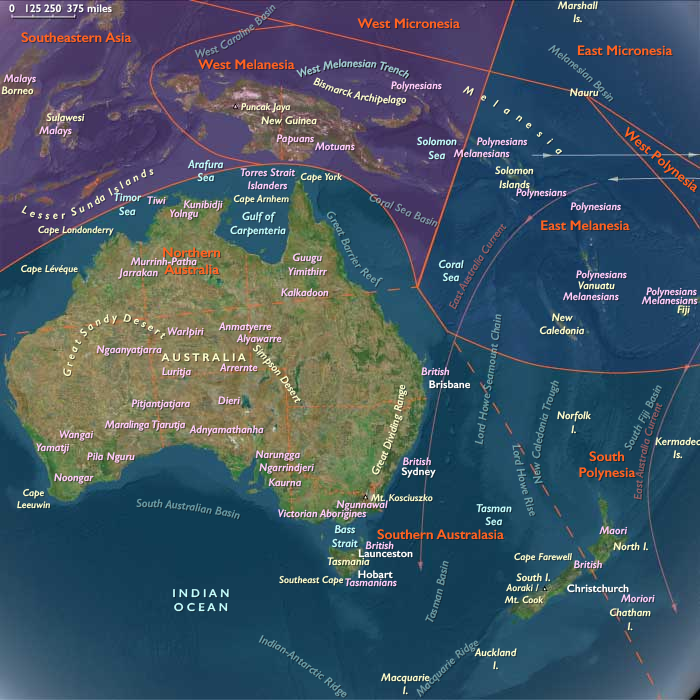
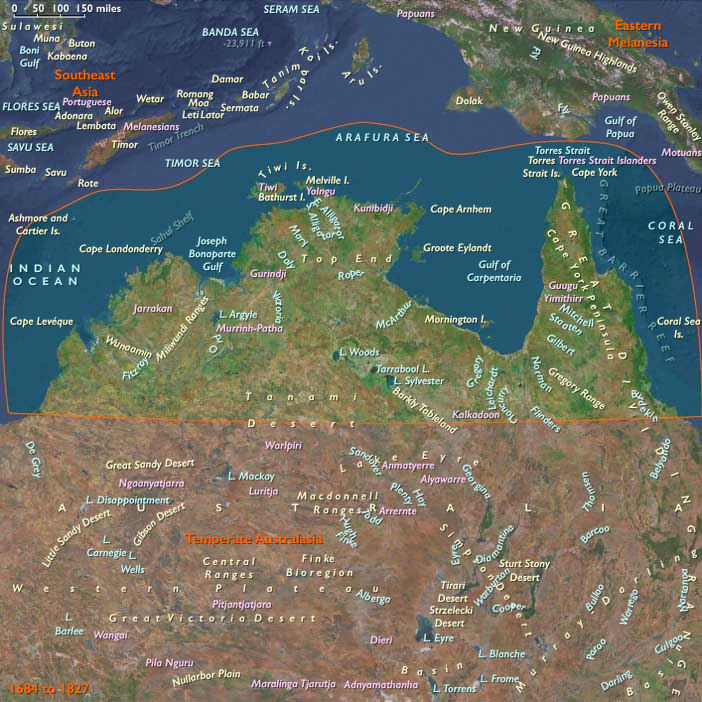
The region spans the Australian continent—from monsoonal north to arid interior and temperate south—and Aotearoa /New Zealand, with its volcanic ranges, alpine ridges, and fertile coasts. It also embraces the Chatham, Norfolk, and Kermadec Islands, outer nodes in the wider Tasman world.
Across these lands, Aboriginal, Torres Strait Islander, Māori, and Moriori communities managed landscapes through burning, gardening, fishing, and ceremony, sustaining intricate ecologies shaped by tens of millennia of stewardship.
Climate & Environmental Shifts
The waning Little Ice Age brought alternating drought and flood to Australia’s riverine corridors, cooler winters in Tasmania and New Zealand, and cyclone belts that brushed northern coasts.
ENSO oscillations re-patterned rainfall, challenging inland foraging and Māori horticulture alike. Volcanic activity—Tongariro, White Island, and others—periodically refreshed soils while unsettling settlements. After 1788, deforestation, stock grazing, and fire altered local hydrology; seal and whale stocks declined under commercial exploitation.
Subsistence & Settlement
Aboriginal Australia practiced mobile yet engineered subsistence:
-
Firestick farming renewed grasslands and tuber fields.
-
Stone-walled eel traps at Budj Bim and river weirs in Victoria supported semi-sedentary communities.
-
Wet-dry calendars in the north coordinated yam harvests, barramundi fishing, and waterfowl hunts.
Māori Aotearoa developed intensive kūmara, taro, and gourd cultivation in the north, balanced by fern-root, forest-bird, and marine resources farther south. Pā fortifications crowned ridges, signaling population density and inter-iwi rivalry.
In the Chathams, the Moriori sustained a pacifist, marine-based economy—fishing, birding, and root crops adapted to cool maritime climate. Norfolk and the Kermadecs, though uninhabited, drew later European interest for timber and anchorages.
After 1788, the First Fleet established New South Wales at Sydney Cove. Grain fields spread along the Hawkesbury–Nepean; sealing stations dotted Bass Strait and New Zealand’s coasts; Van Diemen’s Land (from 1803) expanded pastoral frontiers.
Technology & Material Culture
-
Indigenous technologies: Ground-edge axes, adzes of basalt or pounamu, bark and dugout canoes, woven nets, and fish traps exemplified regional adaptation.
-
Art & architecture: Rock engravings, Arnhem Land x-ray paintings, carved meeting houses (wharenui), and feather or skin cloaks embodied law and lineage.
-
Introduced materials: Iron, muskets, glass, and textiles entered through Macassan trepangers in the north and whalers in the south. Māori integrated muskets and metal tools into canoe-building and fortification; Aboriginal craft incorporated iron blades into ancient toolkits.
-
Colonial works: Brick kilns, watermills, and early roads marked Sydney’s hinterland; timber, flax, and seal oil fed a trans-Tasman economy.
Movement & Interaction Corridors
-
Overland and ceremonial routes: Aboriginal songlines linked sacred waterholes, ochre mines, and gathering grounds; in New Zealand, trails and portages connected harbors and inland rivers.
-
Maritime exchange: Macassan fleets from Sulawesi harvested trepang along Arnhem Land, trading iron and cloth; Torres Strait Islanders transmitted dugout-canoe technology.
-
Tasman and Pacific routes: Whalers, sealers, and traders plied between Sydney, Hobart, and the Bay of Islands, establishing early multiethnic shore communities.
-
Missionary and migration flows: After 1814, missions at Rangihoua spread literacy and Christianity; convict and free settler streams reshaped Australia’s demography.
Cultural & Symbolic Expressions
Across the region, spirituality bound people to place.
-
Australia: The Dreaming (Tjukurpa) structured law, ceremony, and art, linking ancestors to country through dance and song.
-
New Zealand: Whakapapa genealogies, marae oratory, haka, and carving expressed mana and tapu; new Christian hymns entered Māori chant traditions.
-
Northern Australia: Rock and bark paintings portrayed ancestral beings and, later, Macassan praus—recording contact within enduring cosmology.
-
Chathams: Moriori ritual and oral tradition upheld peace and ecological restraint.
Selective adoption of European goods—cloth, mirrors, muskets—reframed symbols of status without erasing older meanings.
Environmental Adaptation & Resilience
-
Diversified production and long-term stewardship buffered climatic shocks: irrigation ditches in Māori gardens, eel-smoking and seed-grinding in Australia, fish-trap regulation in wetlands.
-
Mobility and reciprocity redistributed food during drought or flood.
-
Fire management maintained biodiversity and prevented catastrophic burns.
-
Kin-based exchange of stone, shell, and ritual knowledge reinforced ecological balance.
These systems persisted into the early colonial period, demonstrating extraordinary continuity beneath accelerating change.
Political & Military Shocks
-
Colonial expansion:
-
1788 – First Fleet at Port Jackson; penal and free settlements spread outward.
-
1803 – Founding of Van Diemen’s Land; frontier wars erupt across southeastern Australia.
-
1808 – Rum Rebellion exposes tensions between military and civil authority.
-
-
Musket Age in Aotearoa:
-
1810s–1820s – Muskets acquired through Bay of Islands trade empower inter-iwi campaigns led by Hongi Hika, redrawing settlement patterns.
-
Fortification design evolves to absorb gunfire; large-scale migrations reshape tribal geographies.
-
-
Missions and governance: 1814 – CMS mission at Rangihoua initiates sustained cultural exchange; Governor Macquarie (1810–1821) modernizes colonial infrastructure and policy.
-
Northern contacts: Regular Macassan voyages integrate Arnhem Land into the Arafura trade sphere, foreshadowing future colonial entanglements.
Transition
Between 1684 and 1827 CE, Australasia stood at the meeting edge of ancient continuity and global intrusion. Aboriginal, Torres Strait, Māori, and Moriori societies maintained resilient economies, sacred geographies, and complex diplomacy even as iron, muskets, and epidemics began altering balance and belief.
The rise of Sydney and Hobart, the spread of missions and maritime trade, and the onset of Musket Wars and frontier conflicts bound the Tasman world into expanding imperial circuits.
By 1827, the region was still largely Indigenous in structure and spirit—but the first sustained colonial footholds and the transformative reach of global exchange had set its course toward the convulsive century that followed.
Groups
Topics
Subjects
Regions