Giovanni Bellini's achievements as a painter have…
1516 CE
Giovanni Bellini's achievements as a painter have far surpassed those of his father and brother.
Giovanni's position as sole master (since the death of his brother and of Alvise Vivarini) in charge of the paintings in Venice's Hall of the Great Council had been threatened in 1513 by one of his former pupils.
Young Titian had desired a share of the same undertaking, to be paid for on the same terms.
Titian's application had been granted, then after a year rescinded, and then after another year or two granted again; and the aged master must no doubt have undergone some annoyance from his sometime pupil's proceedings.
Giovanni had in 1514, undertaken to paint The Feast of the Gods for the duke Alfonso I of Ferrara, but dies in 1516; Titian will complete the work in 1529.
Bellini is interred in the Basilica di San Giovanni e Paolo, a traditional burial place of the doges.
The Republic of Venice from 1516 tobliges the Jews to live in an area of the city where the foundries, known in Venetian as "geti", had been situated in ancient times, to wear a sign of identification and to manage the city's pawnshops at rates established by the Serenissima.
Many other onerous regulations are also included, in exchange for which the Community is granted the freedom to practice its faith and protection in the case of war.
The first Jews to comply with the decree are the Ashkenazim from mid-eastern Europe.
Their guttural pronunciation changes the Venetian term "geto" into "ghetto", creating the word still used today to indicate various places of emargination.
The "ghetto" is closed during the night, and the boats of the Christian guards scour the surrounding canals to impede nocturnal violations.
Located in Cannaregio, in the north of the city, it will become a model for ghettos in Italy.
Though political restrictions on Jewish rights and residences existed before this date, this legally enforced confinement gains the Venetians maximum economic advantage from the Jews' presence (including taxes), while ensuring minimal social contact with the Christian population.
The Venetian ghetto will become home to a large number of Jews but the population living in the Venetian Ghetto will never assimilate to form a distinct, "Venetian Jewish" ethnicity.
Its synagogues, constructed between the early sixteenth and mid seventeenth centuries, are known as "Scole". (The word "scole" can be compared with the Yiddish "shul", the Italian "scuola", or the English "school".)
Four of the eventual five synagogues are clearly divided according to ethnic identity: separate synagogues will exist for the German (the Scuola Grande Tedesca), Italian (the Scuola Italiana), Spanish and Portuguese (the Scuola Spagnola), and Levantine Sephardi communities (the Scola Levantina).
The fifth, the Scuola Canton, is built as a private synagogue for the four families, one of them the Fano family, who fund its construction, and may serve the Provençal Jewish community.
Locations
Groups
Subjects
Regions
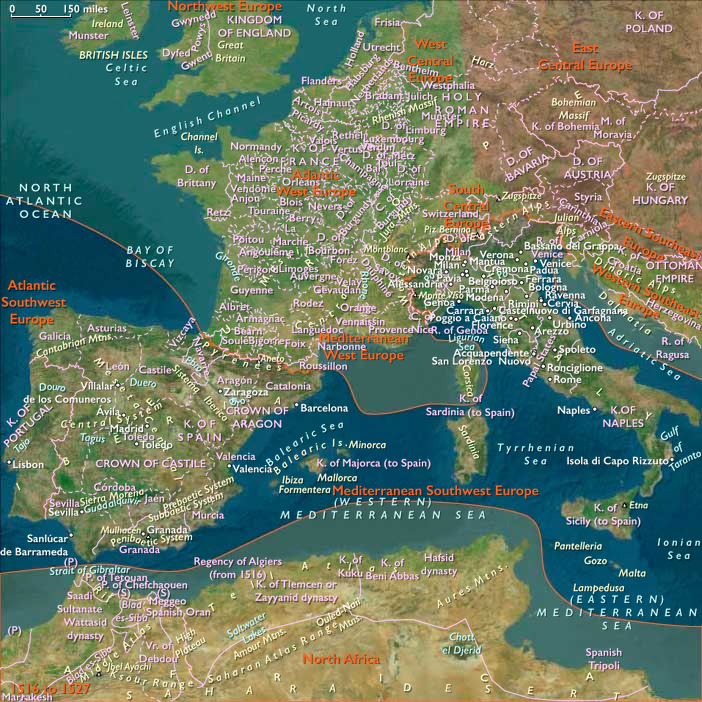
Southwest Europe
View →Subregions