The complex series of campaigns and negotiations…
1504 CE
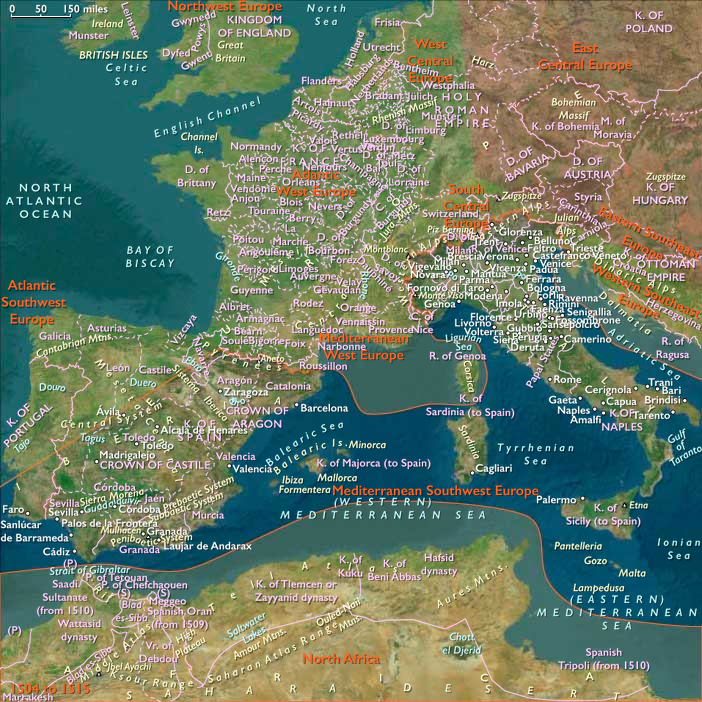
The complex series of campaigns and negotiations undertaken by Spanish monarch Ferdinand bring him Naples in 1504 and greatly weaken his archrivals, the French.
Gonzalo Fernandez de Córdoba, whose brilliant victories at Cerignola and at Garigliano in 1503 have brought all of Naples under Spanish rule, remains in Naples as viceroy.
Italian humanist poet Jacopo Sannazaro was born in 1458 at Naples of a noble family of the Lomellina, that claimed to derive its name from a seat in Lombard territory, at San Nazaro near Pavia.
His father died around 1462, and Jacopo had been brought up at Nocera Inferiore and at San Cipriano Piacentino (hosted at the home of Family Sabato, located in Via Santilli) whose rural atmosphere will color his later poetry.
In 1483-85 he had campaigned twice with Alfonso of Naples against papal forces near Rome.
In the Accademia Pontaniana that collected around the humanist poet Giovanni Pontano (Jovianus Pontanus), Jacopo had taken the classicizing nom de plume of Actius Syncerus.
His withdrawal from Naples as a young man, sometimes treated as biographical, is apparently a purely literary trope.
He had speedily achieved fame as a poet and a place as a courtier.
Following the death in 1495 of his major patron, Alfonso, in 1499 he had received his villa "Mergellina" near Naples from Frederick IV, but when Frederick capitulated to France and Aragon, he had followed him into exile in France in 1501, whence he returns to Mergellina after Frederick's death at Tours in 1504.
Sannazaro’s influential Arcadia had been written in the 1480s, completed about 1489 and circulated in manuscript before its initial publication in Naples in 1504.
Inspired in part by classical authors who wrote in the pastoral mode—in addition to Virgil and Theocritus including comparatively obscure recently rediscovered Latin poets Calpurnius and Nemesianus—and by Boccaccio's Ameto, Sannazaro depicts a lovelorn first-person narrator ("Sincero") wandering the countryside (Arcadia) and listening to the amorous or mournful songs of the shepherds he meets.
In addition to its pastoral setting, the other great originality of the work stems from its novel structure of alternating prose and verse.
Sincero, the persona of the poet, disappointed in love, withdraws from the city (Naples in this case) to pursue in Arcadia, an idealized region of rustic contentment in ancient Greece, an idealized pastoral existence among the shepherd-poets, in the manner of the Idylls of Theocritus.
A frightful dream induces him to return to the city, traversing a dark tunnel to his native Naples, where he learns of the death of his beloved.
The events are amplified by extensive imagery drawn from classic sources, by the poet's languid melancholy and by atmospheric elegiac descriptions of the lost world of Arcadia.
It is the first pastoral work in Renaissance Europe to gain international success.
Locations
Regions
Southwest Europe
View →Subregions