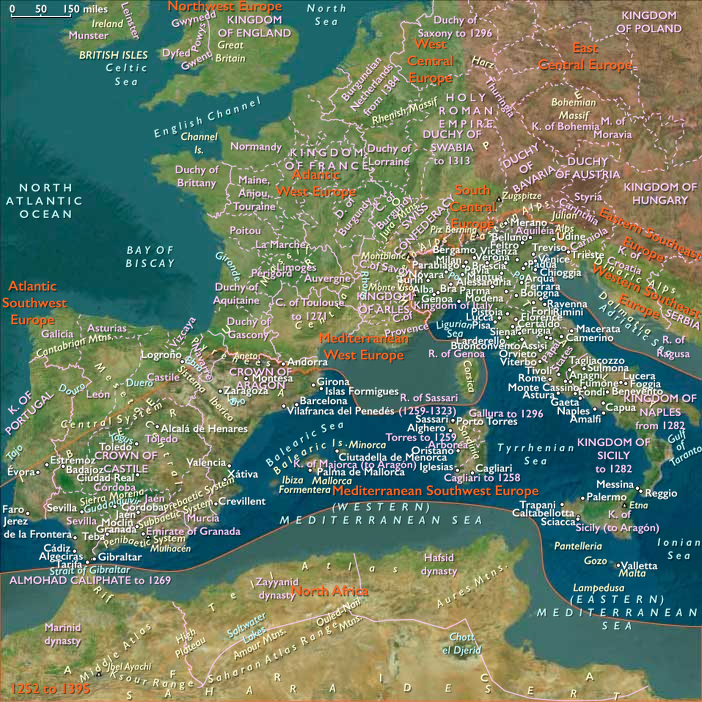
The failure of Hugo de Sully's expedition…
1281 CE
The failure of Hugo de Sully's expedition has convinced Charles of Anjou that an invasion of the Empire by land is not feasible, and he thus considers a naval expedition against Constantinople.
He finds an ally in Venice and in July 1281, the Treaty of Orvieto formalizes this collaboration.
Its stated purpose is the dethronement of Michael VIII in favor of the titular Latin emperor Philip of Courtenay and the forcible establishment of the Union of the Churches, bringing the Greek Orthodox Church under the authority of the Pope.
Its principal motivation, however, is to reestablish the Latin Empire, under Angevin domination, and to restore Venetian commercial privileges in Constantinople.
Under the terms of the treaty, Philip and Charles are to supply eight thousand troops and cavalry, and sufficient ships to transport them to Constantinople.
Philip, the Doge of Venice Giovanni Dandolo, and Charles himself or Charles' son, Charles, Prince of Salerno, are to personally accompany the expedition.
In practice, Charles would have supplied almost all of the troops, Philip having little or no resources of his own.
The Venetians are to supply forty galleys as escorts for the invasion fleet, which is to sail from Brindisi no later than April 1283.
Upon Philip's restoration to the throne, he is to confirm the concessions of the Treaty of Viterbo and the privileges granted to Venice at the founding of the Latin Empire, including recognition of the Doge as dominator of "one-fourth and one-eighth of the Latin Empire."
A second document is also drawn up to organize a vanguard to precede the main expedition of 1283.
Charles and Philip are to supply fifteen ships and ten transports with about three hundred men and horses.
The Venetians are to provide fifteen warships for seven months of the year.
These forces would make war against Michael VIII and "other occupiers" of the Latin Empire (presumably the Genoese), and would meet in Corfu by 1 May 1282, paving the way for the next year's invasion.
The two treaties are signed by Charles and Philip on July 3, 1281, and are ratified by the Doge of Venice on August 2, 1281.Venice's aim in particular is to recover the broad trading privileges it had exercised in the days of the Latin Empire and to oust its arch foe, the Genoese, from the lucrative Greek markets.
Locations
Groups
Subjects
Regions
Southwest Europe
View →Subregions