
The Pannonian Ostrogoths who have been settled…
423 CE
The Pannonian Ostrogoths who have been settled in Thrace south of the Danube by Theodosius II organize a farmers' strike.
Only payment of what amounts to a huge farm loan prevents them from occupying Rome.
People
Groups
Topics
Commodities
Regions
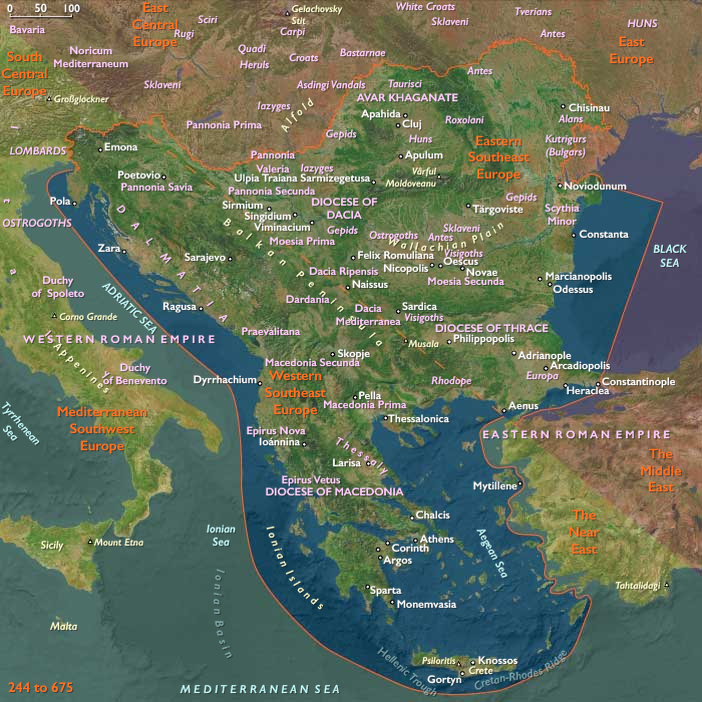
Southeast Europe
View →Subregions
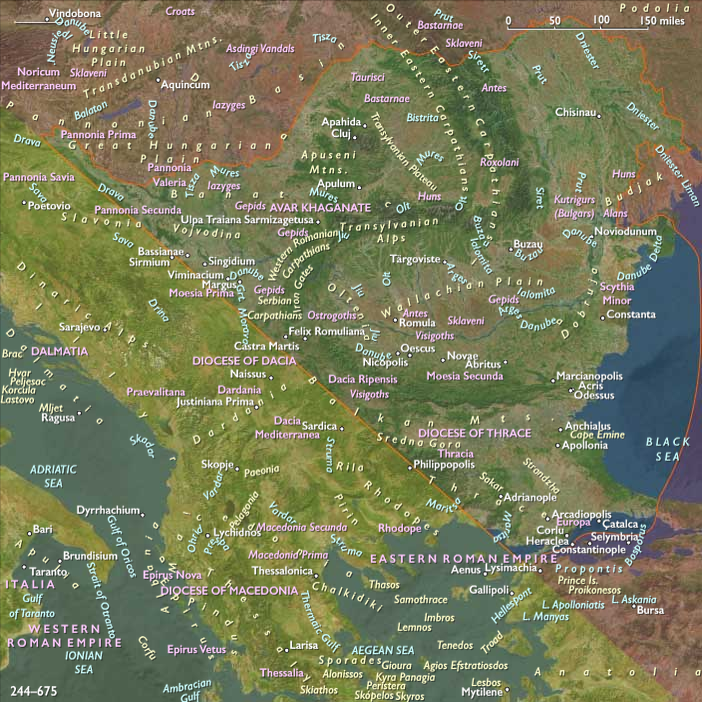
Eastern Southeast Europe
View →Related Events
No active filters.
Showing 10 events out of 59032 total
Emperor Mingyuan also starts a major building project in 423—the building of a wall on the northern borders to defend against Rouran attacks.
Emperor Mingyuan dies in winter 423, and Crown Prince Tao takes the throne as Emperor Taiwu.
Northern Wei forces also stall in their siege of Hulao, defended by the capable Liu Song general Mao Dezu, but are meanwhile able to capture Luoyang and Xuchang (in modern Xuchang, Henan) in spring 423, cutting off the path of any Liu Song relief force for Hulao.
In summer 423, Hulao falls.
The campaign then ceases, with Northern Wei now in control of much of modern Henan and western Shandong.
Theodoret, a Christian theologian of the Antiochene school and a monk of Apamea, is consecrated bishop of Cyrrhus, Syria, in 423.
Honorius dies on August 15, 423, by which time the disintegration of the empire appears irreversible.
As his closest male relative, Valentinian, son of Galla Placidia, is currently at Constantinople, the power vacuum allows Ioannes (John) the primicerius notariorum (chief notary) to seize power in the West.
Virtually nothing is known of Ioannes, who has the support of the magister militum Castinus and of Aetius, son of the magister militum Gaudentius.
After his acclamation at Rome, Ioannes transfers his capital to Ravenna.
Ioannes' rule is accepted in Gaul, Spain and Italy, but not in Africa.
The Early Training of Patrick
While Patrick’s early life remains uncertain, he likely trains for the Christian ministry in Britain following his escape from Irish captivity. Later traditions suggest that he pursues further religious education in Gaul, studying under Germanus of Auxerre, a former Roman advocate who had risen to prominence as bishop of Auxerre in 418 CE.
At this time, Gaul remains an important intellectual and religious center within the Western Roman Empire, home to influential Christian leaders and theologians. Germanus, a defender of Nicene orthodoxy, plays a key role in combating Pelagianism, a doctrine that had gained traction in Britain. If Patrick did indeed study under him, it would suggest that he was deeply influenced by mainland Christian thought before his legendary mission to Ireland.
Though details of Patrick’s education remain speculative, his connection to both Britain and Gaul highlights the enduring religious and cultural ties between the Roman world and the emerging Christian communities in Ireland—a relationship that will shape the island’s development in the centuries to come.
The so-called Reign of Yuanjia, a period in Chinese history under the Liu Song Dynasty that is comparatively wealthy, tranquil, and stable compared to previous and later periods, occurs under the diligent Emperor Wen of the Liu Song dynasty, who is an able administrator.
The Xianbei people, a federation of sizable non-Han groups of which the most important is the Tuoba, had first become a significant part of Chinese culture during the Han Dynasty, during which they had occupied the steppes in Mongolia, Hebei and Liaodong.
After the fall of the Han dynasty in 220, the Xianbei had formed a number of empires of their own, including the Yan Dynasty, Western Qin, Southern Liang and most significantly, the Northern Wei.
The Sixteen Kingdoms, or less commonly the Sixteen States, refers to a collection of numerous short-lived sovereignties in China proper and neighboring areas from 304 to 439 after the retreat of the Jin Dynasty (265-420) to South China and before the establishment of the Northern Dynasties.
Almost all rulers of the kingdoms are part of the Wu Hu ethnicity and claim to be the emperors and wangs (kings).
The Han Chinese had founded four of these states: Northern Yan, Western Liang, Former Liang, and the state of Wei.
(The Northern Wei Dynasty is not counted as one of the Sixteen Kingdoms even though it is founded during the Period.)
The Hephthalites, a people of obscure origin called Ephthalites by the Greeks and Hunas by the Indians, are an agricultural people with a developed set of laws.
First mentioned by the Chinese, who described them as living in Dzungaria in 125, they had displaced the Scythians and conquered Sogdia and Khorasan before 425, in which year they cross the Syr Darya (Jaxartes) River and invade Sassanian Persia.
East Central Europe (424–435 CE): Rise of Attila and Bleda, Hun Ascendancy, and Regional Realignments
Between 424 and 435 CE, East Central Europe—including Poland, Czechia, Slovakia, Hungary, and those portions of Germany and Austria lying east of 10°E and north of a line stretching from roughly 48.2°N at 10°E southeastward to the Austro-Slovenian border near 46.7°N, 15.4°E—entered a decisive period marked by the emergence and expanding dominance of the Huns under the brothers Bleda and Attila, following the death of their uncle and predecessor, King Rua (Rugila) (d. 434). Their rise intensified Hunnic influence and further fragmented the remaining Roman authority along the Danube frontier. Nevertheless, the Rugii maintained diplomatic stability, skillfully navigating the shifting balance of power, while proto-Slavic communities persisted, maintaining their cultural coherence amid escalating Hunnic dominance.
Political and Military Developments
Leadership Transition: From Rua to Attila and Bleda
-
Following the death of King Rua in 434 CE, his nephews Bleda and Attila assumed joint leadership of the Huns, swiftly consolidating their authority and significantly expanding Hunnic military power across East Central Europe.
-
Under their rule, Hunnic dominance reached unprecedented heights, decisively reshaping regional geopolitics and establishing their realm as a formidable power.
Accelerated Roman Frontier Decline
-
Roman provinces (Pannonia Prima, Secunda, Savia, and Valeria) struggled severely under intensified Hunnic pressures, losing the capacity to maintain frontier integrity. Roman control became largely nominal, with real power increasingly passing to Hunnic rulers and local tribal leaders.
Rugian Diplomatic Resilience
-
Rugian communities maintained their stability and relative autonomy along the upper Tisza through skillful diplomacy, balancing relationships carefully with the ascendant Huns, fragmented Roman authorities, and neighboring Germanic groups.
Economic and Technological Developments
Localized Economic Adaptation
-
Regional economic structures adapted further to prolonged instability, shifting decisively toward local agriculture, pastoralism, and small-scale, community-based trade networks that operated cautiously under the shadow of Hunnic influence.
Frontier Infrastructure in Decline
-
Maintenance and improvements to Roman frontier fortifications and infrastructure declined substantially, limited mostly to essential defensive works responding to immediate Hunnic threats.
Cultural and Artistic Developments
Heightened Cultural Hybridization
-
Material culture increasingly reflected a strong Hun influence, integrated with Roman and Germanic elements. Jewelry, decorative objects, weaponry, and pottery demonstrated sophisticated cultural blending indicative of the era’s complex interactions.
Proto-Slavic Cultural Stability
-
Proto-Slavic populations remained culturally resilient, continuing their traditional ways of life and maintaining stable social structures despite intensified external pressures from dominant Hunnic and Germanic groups.
Settlement and Urban Development
Roman Frontier Towns in Decline
-
Roman frontier settlements (Carnuntum, Vindobona, Aquincum) deteriorated further in demographic size and economic function, primarily existing as military garrisons with limited civilian populations, struggling to respond effectively to escalating threats.
Rugian Settlements as Stable Centers
-
Rugian communities along the upper Tisza continued their relative stability and prosperity, serving as regional anchors amid broader instability and facilitating localized economic and diplomatic interactions.
Social and Religious Developments
Rugian Leadership Adaptation
-
Rugian tribal elites maintained internal cohesion and regional significance through adaptive diplomacy and strategic alliances, ensuring their continued autonomy despite growing Hunnic dominance.
Proto-Slavic Social Cohesion
-
Proto-Slavic communities maintained strong internal social hierarchies and religious practices, emphasizing collective resilience amid the profound regional transformations driven by Hunnic power.
Long-Term Consequences and Historical Significance
The era 424–435 CE was crucially significant for East Central Europe, marking the decisive rise of Attila and Bleda and the peak expansion of Hunnic authority. The continued erosion of Roman frontier control dramatically altered regional dynamics, while local groups such as the Rugii and proto-Slavic peoples adeptly maintained stability through diplomatic flexibility and cultural resilience. These developments set the stage for the dramatic events and further geopolitical transformations that would characterize subsequent decades, profoundly influencing the region's historical trajectory.
The Notitia Dignitatum: A Window into Late Roman Administration
The Notitia Dignitatum, a unique imperial chancery document, stands as one of the few surviving records of Roman government, offering a detailed account of the administrative and military structures of both the Eastern and Western Empires. Compiled in the late fourth and early fifth centuries, it catalogs thousands of imperial offices, from the highest court officials to provincial administrators, providing an invaluable snapshot of the late Roman state at a time of growing instability.
The Roman Army in the Late Fourth Century
The Notitia also outlines the structure of the Roman army at the end of the fourth century, by which time approximately 200,000 troops guard the empire’s frontiers, supported by an additional 50,000 reserve forces ready for rapid deployment. However, by this period, the composition of the imperial military has undergone a significant shift—many soldiers are now non-Roman auxiliaries, drawn from Germanic federates such as the Alemanni, Franks, Goths, Saxons, and Vandals.
While these foederati serve as crucial reinforcements for the overstretched Roman legions, their growing prominence signals the progressive Germanization of the Roman military, a transformation that will play a pivotal role in the empire’s eventual disintegration.
The Unchecked Settlement of Barbarian Tribes
By 424 CE, Rome’s grip on its Western provinces has weakened to the point that barbarian groups—including the Vandals, Alans, Suebi, and others—begin settling in Roman territory without opposition. This shift from defensive warfare to passive accommodation marks a decisive moment in the collapse of imperial authority, as the empire can no longer enforce its will over large swaths of its own domain.
These barbarian settlements create a wave of displacement, not only for indigenous Gallo-Roman, Hispano-Roman, and Romanized African populations but also for Illyrians and others fleeing the chaos of migration and conquest. The urgent need for large-scale housing construction arises as entire regions are reshaped by newcomers and refugees alike, permanently altering the social and political fabric of Gaul, Hispania, and North Africa.
Though the Notitia Dignitatum provides a detailed record of imperial administration, its static depiction of Rome’s military and bureaucratic structure already lags behind the rapidly changing reality of the Western Empire—an empire that, by the mid-fifth century, is on the verge of fragmentation.