
Atlantic West Europe (45 BCE–99 CE): Roman …
Years: 45BCE - 99
Atlantic West Europe (45 BCE–99 CE): Roman Conquest, Consolidation, and the Rise of Gallo-Roman Civilization
Between 45 BCE and 99 CE, Atlantic West Europe—including Aquitaine, the Atlantic coast, northern and central France, Alsace, and the Low Countries—was profoundly transformed through Roman conquest, administrative consolidation, economic integration, and cultural assimilation. From Julius Caesar’s final pacification of Gaul to the flourishing provincial life under the early Roman emperors, this period marked the establishment of a thriving, interconnected Gallo-Roman civilization.
Political and Military Developments
Conquest and Early Romanization (45 BCE–14 CE)
-
Julius Caesar’s victory over the Gallic tribes (completed by 51 BCE) firmly established Roman dominance in Atlantic West Europe.
-
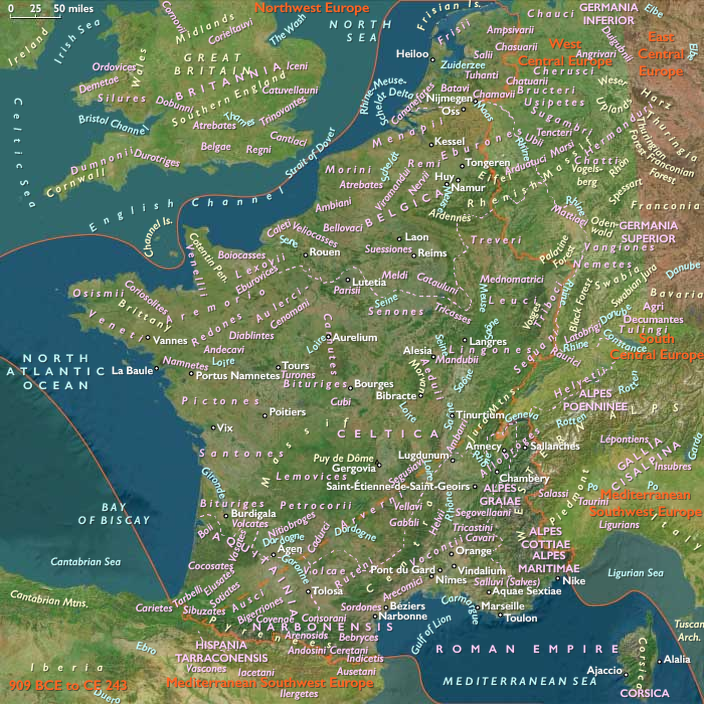
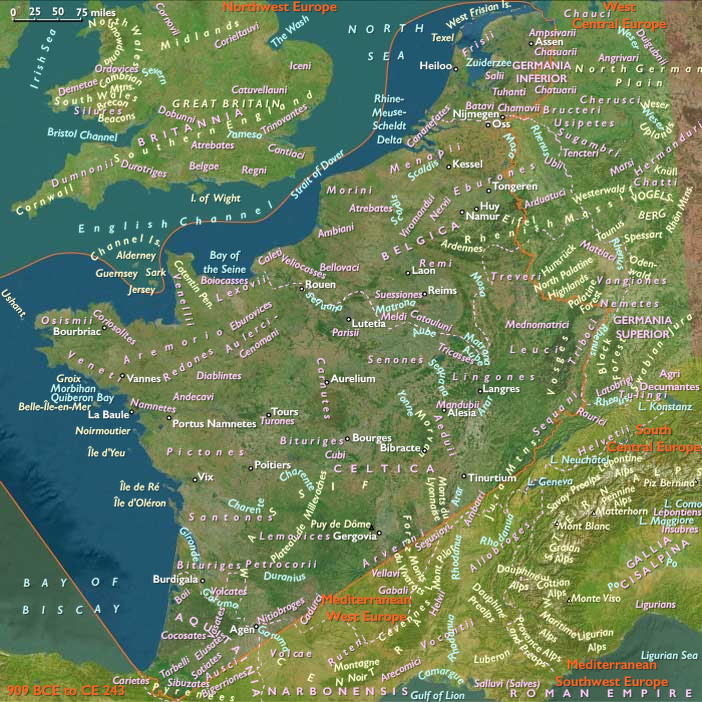
Augustus reorganized the conquered territories (27 BCE–14 CE), creating provinces such as Gallia Aquitania, Gallia Belgica, and Gallia Lugdunensis, laying the groundwork for administrative stability and cultural integration.
-
The establishment of a legionary presence along the Rhine frontier (notably near present-day Nijmegen and Xanten) secured the region against Germanic incursions, initiating the strategic defense of Rome’s northern boundary.
Consolidation under the Julio-Claudian Dynasty (14–68 CE)
-
Emperors Tiberius (r. 14–37 CE), Caligula (r. 37–41 CE), Claudius (r. 41–54 CE), and Nero (r. 54–68 CE) expanded administrative efficiency, securing lasting Roman governance across the region.
-
Claudius notably extended Roman citizenship to local elites, further integrating the region’s political and social fabric into the empire.
Stability during the Flavian Dynasty (69–96 CE)
-
Under Vespasian (r. 69–79 CE), Titus (r. 79–81 CE), and Domitian (r. 81–96 CE), the Rhine frontier fortifications were significantly strengthened, ensuring regional stability and defense against external threats.
-
Domitian’s robust military policies solidified the Rhine limes, providing the region with lasting peace and security.
Economic and Social Developments
Expansion of Trade and Urbanization
-
Roman roads and infrastructure greatly expanded, enhancing connectivity between major centers and facilitating commerce.
-
Major cities such as Burdigala (Bordeaux), Rotomagus (Rouen), Durocortorum (Reims), and Lutetia (Paris) thrived as trade and administrative hubs.
-
Aquitanian wines became an important export commodity, notably from Bordeaux, setting the stage for long-term economic prosperity.
Agricultural Development and Population Growth
-
Advanced Roman agricultural techniques, including the use of villas for efficient agricultural management, significantly increased productivity, leading to population growth and economic surplus.
-
The rise of villa estates throughout the region provided increased stability and prosperity, establishing a durable pattern of rural settlement.
Social Integration and Roman Citizenship
-
Local elites actively adopted Roman customs, language (Latin), and citizenship, deeply embedding the region within the broader Roman identity.
-
A distinct Gallo-Roman culture emerged, characterized by fusion between indigenous Gallic traditions and Roman institutions, language, and customs.
Religious and Cultural Developments
Romanization of Religious Practices
-
Roman religious institutions and imperial cults (notably worship of Augustus and subsequent emperors) were widely adopted, reinforcing Roman authority.
-
Local deities and Celtic spiritual traditions increasingly blended with Roman beliefs, creating a syncretic religious culture across the region.
Artistic, Architectural, and Literary Achievements
-
Monumental Roman architecture proliferated, exemplified by amphitheaters, baths, aqueducts, and temples, demonstrating wealth, sophistication, and cultural integration.
-
Gallo-Roman cities developed forums, public baths, and theaters, significantly altering the urban landscape and daily life.
Intellectual and Cultural Flourishing
-
Roman education systems and Latin literacy spread rapidly among local elites, fostering cultural cohesion and intellectual integration.
-
Latin literature and law profoundly influenced regional governance, scholarship, and social life.
Key Figures and Events
-
Julius Caesar (d. 44 BCE): Completed conquest and pacification of Gaul, laying foundations for Roman rule.
-
Augustus (27 BCE–14 CE): Systematically reorganized provincial governance, establishing stability and effective administration.
-
Claudius (41–54 CE): Extended Roman citizenship to Gallic elites, ensuring deeper regional loyalty and integration.
-
Domitian (81–96 CE): Reinforced Rhine defenses, securing the region’s stability and prosperity.
Long-Term Significance and Legacy
By the end of the first century CE, Atlantic West Europe had undergone profound transformations, including:
-
Complete integration into the Roman political and administrative system, ensuring long-term regional stability.
-
Economic prosperity driven by thriving trade networks, agricultural productivity, and urban growth.
-
Deep cultural integration, establishing a Gallo-Roman identity that blended Roman institutions with indigenous Gallic traditions.
-
Strategic military fortification along the Rhine frontier, establishing the foundations for centuries of regional security and prosperity.
This formative era created enduring political, economic, and cultural legacies, firmly embedding Atlantic West Europe into the Roman Empire’s vast network and setting the stage for continued flourishing throughout the imperial period.
People
Groups
- Polytheism (“paganism”)
- Roman Republic
- Gallo-Roman culture
- Roman Principate (Rome)
- Gallia Lugdunensis (Roman province)
- Gallia Aquitania (Roman province)
- Gallia Belgica (Roman province)
- Roman Empire (Rome): Julio-Claudian dynasty
- Roman Empire (Rome): Flavian dynasty
- Roman Empire (Rome): Nerva-Antonine dynasty
Topics
Commodoties
Subjects
Regions
Subregions
Years: 45BCE - 99
People
Groups
- Polytheism (“paganism”)
- Roman Republic
- Gallo-Roman culture
- Roman Principate (Rome)
- Gallia Lugdunensis (Roman province)
- Gallia Aquitania (Roman province)
- Gallia Belgica (Roman province)
- Roman Empire (Rome): Julio-Claudian dynasty
- Roman Empire (Rome): Flavian dynasty
- Roman Empire (Rome): Nerva-Antonine dynasty
Topics
Commodoties
Subjects
Regions
Subregions