
The Senate has issued, in vain, several…
4 CE to 15 CE
The Senate has issued, in vain, several edicts to prohibit the wearing of silk, on economic and moral grounds: the importation of Chinese silk has caused a huge outflow of gold, and silk clothes are considered to be decadent and immoral.
The Roman historian Florus also describes the visit of numerous envoys, including Seres (perhaps the Chinese), to Emperor Augustus.
Locations
People
Subjects
Regions
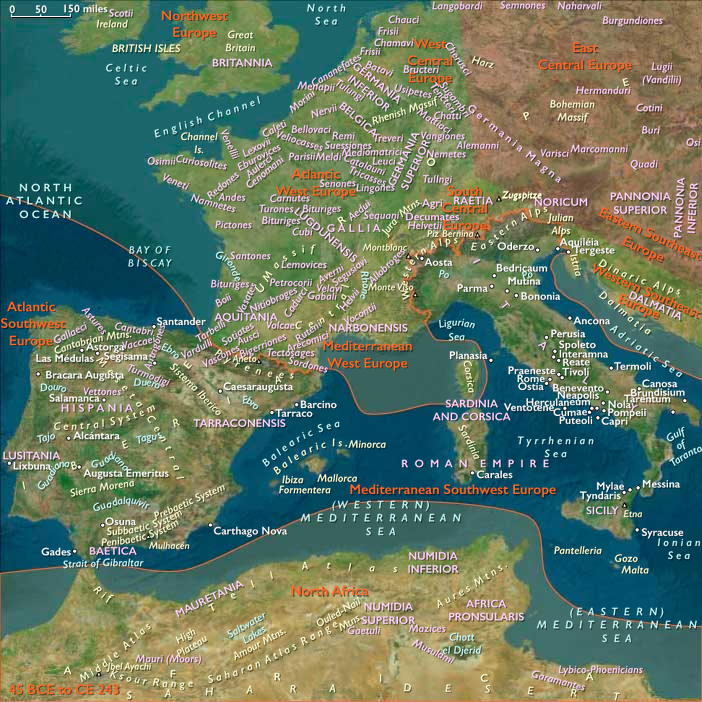
Southwest Europe
View →Subregions
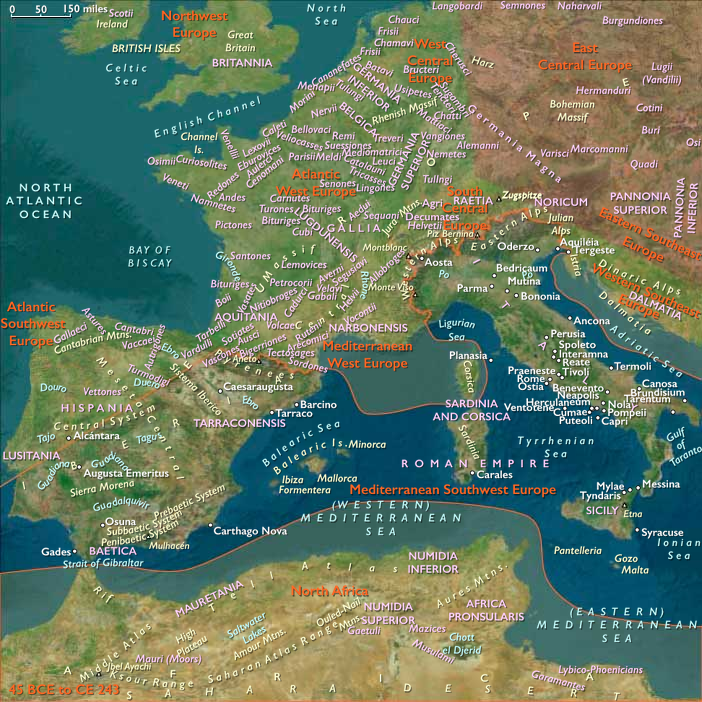
Mediterranean Southwest Europe
View →Related Events
No active filters.
Showing 10 events out of 62082 total
Wang Mang bases his sweeping reforms, intended to remedy the economic crisis into which the Han dynasty has fallen, on his revival of Zhou dynasty classics concerning the ideal Confucian state.
He institutes such radical measures as abolition of slavery, imposition of an income tax, currency debasement, nationalization of the land, and state loans to peasants at moderate interest rates.
A descendant of the Han rulers, Liu Xiu, effects a restoration of the old dynasty.
Wang Mang’s brief rule thus separates the Han Dynasty into two periods: that of the Former, or Earlier, Han, and that of the Later Han.
Augustus’ Reforms and the Foundations of the Roman Empire
After restoring peace and stability following years of civil war, Augustus implemented sweeping reforms that shaped the Roman Empire for centuries. His policies strengthened governance, economy, infrastructure, and culture, ensuring Rome's long-term prosperity.
Major Reforms Under Augustus
-
Restructuring the Senate – Reduced its size, making it more efficient while maintaining aristocratic influence.
-
Taxation Reform – Created a more equitable tax system, reducing corruption and provincial exploitation.
-
Revival of the Census – Allowed for better tax assessment, military recruitment, and social organization.
-
Urban Development in Rome – Launched an ambitious rebuilding program, famously declaring:
"I found Rome a city of bricks and left it a city of marble."
-
Moral and Religious Revival – Promoted traditional Roman values, religious customs, and family life through laws reinforcing marriage, childbirth, and morality.
-
Patronage of the Arts – Supported Virgil, Horace, and Ovid, fostering a Golden Age of Latin literature.
Unifying the Empire: Roads, Trade, and Communication
- Augustus oversaw the construction of a vast network of roads, facilitating military movement, commerce, and communication.
- The establishment of an efficient postal system helped administrative control and information flow.
- Trade flourished across Rome’s far-reaching provinces, strengthening economic integration.
The Augustan Principate and Rome’s Expanding Frontiers
The governmental system Augustus established, later known as the principate, was built upon:
- The loyalty of the army and people to the emperor.
- Collaboration between the emperor, the Senate, and the equestrian class.
Under Augustus, Rome’s territorial expansion secured its dominance:
- Western Frontiers – Rome extended its borders to the Danube and the Rhine, stabilizing Central and Western Europe.
- Eastern Frontiers – Rome reached the Euphrates River, establishing buffer states and securing trade routes to the East.
Augustus' reign laid the foundation for a regime that would endure in some form for nearly fifteen hundred years, influencing the Byzantine Empire and later European governance.
The Cult of Divus Augustus and His Lasting Legacy
- After his death in 14 CE, Augustus was deified as Divus Augustus, making his cult a central element of Roman state religion.
- His worship continued until Emperor Theodosius I officially adopted Christianity in 391 CE.
- Numerous statues, busts, and inscriptions of Augustus survive, commemorating his enduring influence on Roman history and governance.
Augustus’ reign transformed Rome from a fragile Republic into a stable Empire, ensuring its political, economic, and cultural supremacy for centuries.
The place of Ovid’s exile is Tomis, a primitive town on the Black Sea (near modern Costanza, Romania).
Arriving there in spring of 9, Ovid battles his loneliness and longing for his friends and beloved Rome by writing poetry about exile.
His Tristia, addressed to anonymous Roman friends and written between 8 and 12, and From the Black Sea, four books of elegiac letters addressed to named friends and written between 12-16, display Ovid's talents in adapting to his personal tragedy.
The Getae have commercial contact as well as military conflicts with many peoples besides the Greeks.
Ovid writes that for many years Getian tribesmen would steer their plows with one hand and hold a sword in the other to protect themselves against attacks by Scythian horsemen from the broad steppe lands east of the Dniester River.
The Middle East: 4–15 CE
Dynastic Turmoil and Roman Influence
The diplomatic settlement of CE 1 between Rome and Parthia, which mandates the withdrawal of Parthian troops from Armenia, provides only a fragile peace, as the contest for influence in this strategically vital region continues unabated. Throughout this period, Rome skillfully maintains its dominance by manipulating power relations among client kingdoms and allies.
In Parthia, internal instability escalates dramatically. The reign of Phraates V comes to an abrupt end around CE 4, marked by dynastic intrigue and his assassination. This turmoil facilitates the brief ascendancy of Orodes III, whose reign proves equally short-lived due to ongoing political factionalism. By approximately CE 8, Vonones I, who had previously spent significant time in Rome and thus embodies Roman cultural and political influence, secures the Parthian throne with initial Roman backing. His distinctly pro-Roman inclinations, however, quickly raise suspicion and hostility among the Parthian nobility and aristocratic elite, who resent foreign interference in their affairs.
Throughout this turbulent decade, Rome maintains a careful diplomatic posture, navigating complex regional dynamics with calculated interventions aimed at ensuring a stable frontier. Armenia remains at the heart of Roman strategic concerns, serving as both a buffer state against Parthian expansion and a focal point of sustained Roman political and military interest. This period solidifies Rome’s strategic approach of managing regional power balances through indirect means, setting the stage for continued rivalry and diplomacy in the decades that follow.
Near East (CE 4–15): Roman Consolidation and Jewish Unrest
With the division of Herod the Great’s kingdom following his death, Judea, Samaria, and Idumea continue under the contentious rule of his son, Herod Archelaus. Archelaus, however, proves unpopular and ineffective, marked by increasing civil unrest and tension with Rome. In CE 6, Augustus Caesar decisively intervenes, removing Archelaus from power and annexing his territories into the Roman province of Iudaea under direct governance by Roman prefects.
This direct Roman control provokes widespread Jewish resentment, manifesting in increased political and religious tensions. The census conducted in Judea for taxation and administrative purposes—ordered by Publius Sulpicius Quirinius, the governor of Syria—further inflames local dissatisfaction, sparking a notable rebellion led by Judas of Galilee around CE 6. Though suppressed by Roman forces, this rebellion sows the seeds of lasting unrest and gives rise to the Zealot movement, an ardently anti-Roman faction that will profoundly shape Jewish-Roman relations in subsequent decades.
Meanwhile, other regions once ruled by Herod's heirs, such as Galilee and Perea under Herod Antipas, and the northeastern tetrarchy under Philip the Tetrarch, experience relatively stable rule under their respective client kings, who maintain local autonomy under Roman patronage.
Egypt, now firmly embedded as a vital Roman province, continues to provide essential grain supplies, maintaining the stability of Rome's burgeoning empire. Alexandria thrives culturally and economically, a vibrant center of Hellenistic learning integrated into Rome's administrative structure.
Legacy of the Era
The period CE 4 to 15 significantly reshapes Roman-Jewish relations, establishing direct Roman governance in Judea and laying the groundwork for persistent political and religious tensions. The unrest and emerging zealotry set the stage for the major rebellions of the mid-first century, profoundly influencing the cultural and political dynamics of the region.
The Great Illyrian Revolt, (Bellum Batonianum or Pannonian Revolt), a series of military conflicts between an Illyrian alliance and the Roman Empire, begins among the Daesitiates of what is today central Bosnia under their leader Bato but are soon joined by the Breuci and numerous other Illyrians.
The four-year war, which lasts from CE 6 to 9, sees huge concentrations of Roman forces in the area, (on one occasion the legions and their auxiliaries in a single camp), with whole armies operating across the western Balkans and fighting on more than one front.
On August 3, CE 8, the Breuci of the Sava Valley surrender, but it takes another winter blockade and a season of fighting before the surrender of the Daesiates comes in CE 9.
It takes the Romans three years of hard fighting to quell the revolt, which the Roman historian Suetonius will describe as the most difficult conflict faced by Rome since the Punic Wars two centuries earlier.
All Illyrians now become subject to Roman rule.
Mediterranean Southwest Europe (4–15 CE): Cultural Transformations and Imperial Encounters
The era 4–15 CE is characterized by significant cultural and economic developments in Mediterranean Southwest Europe under Augustus’s mature reign. This period witnesses artistic achievements, ethical debates on luxury and morality, and notable diplomatic encounters between Rome and distant civilizations.
Ovid's Metamorphoses and Cultural Reflections
During this era, the poet Ovid composes his masterpiece, the Metamorphoses, using Greco-Roman mythology to explore the theme of change. In this influential literary work, Ovid particularly emphasizes love, now presented in its profound ethical dimensions, as the essential force behind transformation and human experience.
Silk Controversy and Economic Concerns
The Roman Senate, responding to the growing economic and moral concerns surrounding luxury goods, repeatedly attempts to prohibit the wearing of silk garments. Silk, primarily imported from China, has created significant economic implications, notably a vast outflow of gold from the empire. Moreover, silk clothing is increasingly perceived as a symbol of decadence and moral decline, prompting legislative efforts—ultimately unsuccessful—to curb its popularity.
Diplomatic Engagements and International Relations
The Roman historian Florus documents significant diplomatic activity during Augustus's reign, including a remarkable visit by numerous foreign envoys. Among these envoys are the Seres, likely representatives from China, highlighting Rome's expansive diplomatic reach and illustrating the empire's prominent position in global affairs during this period.
Continued Administrative and Social Policies
Augustus continues to maintain social and administrative policies aimed at stabilizing and strengthening Roman society. These initiatives involve reinforcing traditional Roman virtues and cultural identity, fostering a stable environment conducive to Rome's flourishing economy and vibrant cultural life.
Legacy of the Era
The period 4–15 CE reflects significant cultural maturity, economic reflection, and expansive international relations under Augustus. Cultural achievements, ethical debates, and diplomatic engagements during this time underscore Rome’s extensive influence and the complexities of its imperial experience, solidifying its enduring legacy.
Ovid, using Greco-Roman mythology as his material and change as his theme in his beautifully told Metamorphoses, isolates love, now viewed in its more profound ethical dimensions, as the particular agent of change.
North Africa (4–15 CE)
Roman Provincial Expansion, Mauretanian Prosperity, Cyrenaic Stability, Berber Integration, and Saharan Trade Dynamics
Roman Administrative Consolidation and Economic Stability
Between 4 and 15 CE, Rome continues enhancing its administrative structures and economic influence within Africa Proconsularis. Ongoing investments in infrastructure, agricultural productivity, and urban development ensure that cities such as Utica remain central to regional commerce and governance. The province benefits from stable governance and sustained prosperity, further embedding North Africa within Rome’s extensive Mediterranean sphere.
Numidia: Continued Stability and Economic Integration
Numidia maintains its stability and economic growth under Roman provincial governance. Investments in agriculture and infrastructure sustain local economic activities and trade. Numidian society, while firmly integrated into the Roman administrative framework, preserves distinctive local customs and traditions, contributing to the overall cultural and economic vibrancy of the region.
Mauretania: Cultural and Economic Flourishing under Juba II and Cleopatra Selene
Mauretania continues to prosper culturally and economically under King Juba II and Queen Cleopatra Selene II. Caesarea (modern Cherchell) further consolidates its status as an intellectual, artistic, and commercial center, benefiting from extensive public works and architectural enhancements blending Egyptian, Greek, and Roman styles. The province remains economically vibrant through sustained exports of grain, olive oil, and other commodities, reinforcing its strategic importance to Roman economic networks.
Cyrenaica: Continued Economic Prosperity and Intellectual Vitality
Cyrenaica retains its strong economic performance under stable governance. The Greek Pentapolis—Cyrene, Barce (Al Marj), Euhesperides (Benghazi), Teuchira (Tukrah), and Apollonia (Susah)—maintains vigorous trade, especially in grain, wine, wool, livestock, and the esteemed medicinal herb Silphium. Cyrene sustains its influential role as a cultural and intellectual hub, attracting renowned scholars and medical practitioners from around the Mediterranean.
Berber Communities: Persistent Economic Integration and Cultural Resilience
Berber communities remain deeply engaged in the region’s economic activities, particularly through vibrant coastal commerce centered around hubs such as Oea (Tripoli). Inland Berber tribes benefit indirectly from coastal prosperity, retaining traditional governance structures and cultural practices. This enduring interaction ensures regional economic stability, social cohesion, and cultural resilience.
Garamantes: Vital Role in Saharan Trade Networks
The Garamantes continue to facilitate essential trans-Saharan trade, linking sub-Saharan regions with Mediterranean economies. Their innovative agricultural practices and strategic management of Saharan caravan routes significantly bolster regional commerce, fostering continued economic prosperity and cultural exchange.
Musulami, Gaetulians, Mauri (Moors), and Saharan Pastoral Nomads
The Musulami, residing between Numidia and the Sahara, continue their active engagement in agriculture and pastoral activities, sustaining regular commercial and cultural interactions with neighboring Roman and Numidian communities.
The semi-nomadic Gaetulians uphold their pivotal role in facilitating trade and cultural connections between inland and coastal territories, reinforcing regional economic cohesion.
The Mauri (Moors) maintain their influential status through diplomatic efforts and robust economic activities in western North Africa, ensuring regional stability and prosperity.
Saharan pastoral nomads persist as critical connectors, enhancing trade, cultural exchanges, and knowledge dissemination across extensive ecological and economic zones, further enriching the region's interconnected networks.
Cultural Syncretism and Vibrant Interaction
Ongoing cultural exchanges among Berber, Roman, Greek, Garamantian, Musulami, Gaetulian, Mauri, and Saharan pastoral communities continue enriching regional traditions in arts, crafts, and artisanal practices. Religious syncretism remains strong, harmoniously blending indigenous Berber beliefs with Roman, Greek, Phoenician, and Saharan spiritual customs, contributing to the dynamic cultural diversity of North Africa.
Strong Foundations for Continued Prosperity
By 15 CE, North Africa maintains its position as a prosperous and stable region, supported by effective Roman provincial administration, Juba II and Cleopatra Selene’s flourishing Mauretania, sustained Cyrenaic economic and cultural vitality, resilient Berber communities, and dynamic Saharan trade networks. Together, these interconnected elements reinforce North Africa's ongoing strategic significance within the broader Mediterranean geopolitical landscape.
Atlantic Southwest Europe (4–15 CE): Established Roman Provincial Order and Cultural Synthesis
Between 4 and 15 CE, Atlantic Southwest Europe—encompassing northern and central Portugal, Galicia, Asturias, Cantabria, and northern Spain south of the Franco-Spanish border (43.05548° N, 1.22924° W)—continued to experience sustained stability and prosperity under well-established Roman provincial governance. This era saw the solidification of Roman administrative structures and intensified economic integration into the broader Mediterranean world, firmly entrenching slavery within local economies. Concurrently, distinct local cultures remained resilient, dynamically adapting their identities and traditions within an increasingly Romanized society.
Political and Military Developments
Sustained Provincial Stability and Roman Governance
-
Under the early imperial rule of Augustus and Tiberius, Roman provincial administration maintained effective stability throughout the region. Established military garrisons, administrative centers, fortified towns, and expansive road networks reinforced the long-term stability of Roman authority and enabled efficient governance.
-
Local tribal elites remained integral partners in Roman administration, providing essential leadership, supporting internal peace, and facilitating widespread acceptance of Roman provincial rule.
Northern Tribes: Adaptation and Regional Stability
-
Tribes of the previously resistant northern regions—particularly the Gallaeci, Astures, and Cantabri—increasingly accepted Roman provincial authority, though isolated incidents of localized tension persisted. Roman military presence and infrastructure significantly stabilized these northern territories, supporting a smooth administrative integration process.
-
The Vascones effectively maintained their diplomatic neutrality, securing territorial autonomy and preserving cultural distinctiveness within the stable Roman provincial framework.
Economic and Technological Developments
Expansion and Integration into Mediterranean Trade Networks
-
Economic integration with Roman-controlled Mediterranean trade expanded steadily. Atlantic Southwest Europe exported metals (silver, copper, tin), agricultural produce, livestock, timber, salt, textiles, and notably slaves, while importing Mediterranean luxury goods, ceramics, wine, olive oil, and advanced iron products.
-
Provincial elites continued to benefit significantly from these trade relationships, reinforcing social stratification, economic specialization, and regional dependency on Rome.
Ongoing Importance of Slave Labor
-
Slavery continued as a central economic institution, extensively employed in mining, agricultural estates, domestic roles, artisanal production, and urban development. The vibrant slave trade reinforced regional economic integration into the Mediterranean economy and solidified social hierarchies.
Continued Technological and Metallurgical Advancements
-
Advances in metallurgy, notably ironworking, enhanced regional agricultural productivity, artisanal capabilities, and military effectiveness. Skilled artisans produced sophisticated weaponry, armor, agricultural tools, and decorative objects, reflecting a blend of indigenous traditions and Roman technology.
-
Roman infrastructural projects, including roads, aqueducts, urban centers, and fortifications, supported provincial stability, economic growth, and administrative cohesion.
Cultural and Religious Developments
Cultural Integration and Regional Artistic Synthesis
-
Regional material culture continued to exhibit dynamic integration of indigenous Iberian traditions, Celtic influences, and strong Roman artistic styles. Artistic expressions—including elaborate metalwork, decorative jewelry, pottery, ceremonial artifacts, and household goods—highlighted enduring cultural identities and regional pride.
-
Despite Roman provincial dominance, local tribal cultures—particularly among Lusitanians, Gallaeci, Astures, Cantabri, and Vascones—remained notably resilient, creatively adapting within Romanized cultural contexts.
Ritual Continuity and Religious Adaptation
-
Ritual practices maintained their complexity, integrating indigenous Iberian, Celtic, and Roman religious elements. Sacred landscapes, established sanctuaries, and communal ceremonies remained vital, reinforcing communal cohesion, cultural continuity, and tribal identities.
-
Local ancestral rites, communal festivals, and traditional warrior rituals persisted actively, reinforcing regional identity and cultural resilience amidst stable Roman governance.
Notable Tribal Groups and Settlements
-
Lusitanians: Fully integrated within the stable Roman provincial framework, benefiting economically and culturally from sustained prosperity and internal peace.
-
Vettones and Vaccaei: Maintained local autonomy, economic prosperity, and territorial integrity through diplomatic cooperation with Roman authorities.
-
Gallaeci, Astures, Cantabri: Continued transitioning toward full accommodation within Roman provincial structures, maintaining strong local identities and regional traditions.
-
Vascones: Continued their diplomatic neutrality, effectively preserving territorial autonomy, cultural distinctiveness, and internal stability within the provincial system.
Long-Term Significance and Legacy
Between 4 and 15 CE, Atlantic Southwest Europe:
-
Further solidified comprehensive Roman provincial administration, ensuring long-term stability, economic prosperity, and societal integration.
-
Strengthened economic and infrastructural integration into Mediterranean networks, firmly entrenching slavery as a fundamental component of the regional economy and society.
-
Demonstrated sustained cultural resilience, dynamically adapting local traditions within the stable, integrated Roman provincial context, shaping future cultural identities and historical trajectories.
This era reinforced Roman administrative and economic foundations across Atlantic Southwest Europe, decisively shaping the region’s historical evolution and cultural dynamics within the Roman Empire.