
The third and largest army to appear …
Years: 1097 - 1097
April
The third and largest army to appear is that assembled by Raymond of Saint-Gilles, the count of Toulouse.
At fifty-five, he is the oldest and most prominent of the Crusading princes, and he aspires and perhaps expects to become the leader of the entire expedition.
Adhémar, bishop of Le Puy, whom the Pope had named as legate for the Crusade, accompanies him.
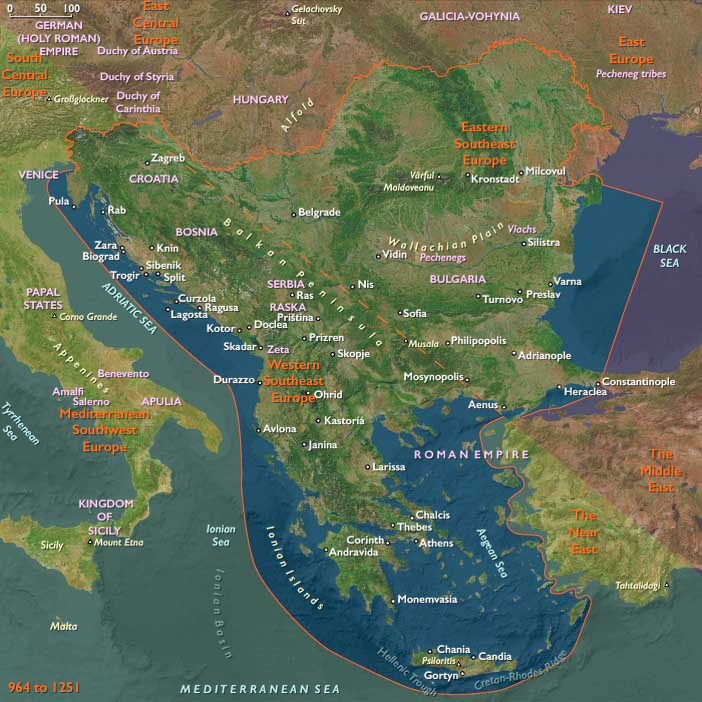
Raymond had led his followers, including a number of noncombatant pilgrims whom he supports at his own expense, across north Italy, around the head of the Adriatic, thence southward into imperial territory.
This large body had caused considerable trouble in Dalmatia and with imperial troops policing the area nearer the capital, where Raymond arrives on April 27.
The fourth army, under Robert of Flanders, had meanwhile crossed the Adriatic from Brindisi.
Accompanying Robert are his cousin Robert of Normandy (brother of King William II Rufus of England) and Stephen of Blois (the son-in-law of William I the Conqueror).
No king takes part in the First Crusade, and the predominantly French-speaking participants will come to be known as Franks.
The presence near Constantinople of massive military forces, numbering perhaps four thousand mounted knights and twenty-five thousand infantry, poses a serious problem for Alexios, and there is occasional disorder.
The size of the entire crusader army is difficult to estimate; various numbers are given by the eyewitnesses, and equally various estimates have been offered by modern historians.
Crusader military historian David Nicolle considers the armies to have consisted of about thirty thousand to thirty-five thousand crusaders, including five thousand cavalry.
Raymond has the largest contingent of about eighty-five hundred infantry and twelve hundred cavalry.
The princes have arrived in Constantinople with little food and expect provisions and help from Alexios.
Alexios is understandably suspicious after his experiences with the People's Crusade, and also because the knights include his old Norman enemy, Bohemond, who had invaded Imperial territory on numerous occasions with his father, Robert Guiscard, and may have even attempted to organize an attack on Constantinople while encamped outside the city.
The crusaders may have expected Alexios to become their leader, but he has no interest in joining them, and is mainly concerned with transporting them into Asia Minor as quickly as possible.
Since the crusade has to pass through Constantinople, however, the Emperor has some control over it.
Forced to consider the permanent imperial interests—which, it soon becomes evident, are different from the objective of the crusaders—the Emperor requires each Crusade leader to promise under oath to restore any conquered territory that had belonged to the empire before the Turkish invasions and to swear allegiance to him for any lands occupied beyond the former frontiers.
In return, he will give them guides and a military escort.
Still, the cost will be enormous, for the crusaders must be supplied with food or live off the land as they travel.
Godfrey is the first to take the oath, and almost all the other leaders follow him, although they do so only after warfare had almost broken out in the city between the citizens and the crusaders, who are eager to pillage for supplies.
Raymond alone avoids swearing the oath, instead pledging that he will simply cause no harm to the Empire, a modified form of oath common in southern France (and in the end he will remain of all the Crusade leaders the most loyal to Alexios).
Before ensuring that the various armies are shuttled across the Bosporus, Alexios advises the leaders on how best to deal with the Seljuq armies that they will soon encounter.
Locations
People
- Adhemar of Le Puy
- Al-Afdal Shahanshah
- Alexios I Komnenos
- Baldwin I of Jerusalem
- Bohemond I of Antioch
- Constantine I
- Danishmend Gazi
- Eustace III
- Fakhr al-Mulk Radwan
- Godfrey of Bouillon
- Guglielmo Embriaco
- Hugh I
- Iftikhar al-Dawla
- Kerbogha
- Kilij Arslan I
- Manuel Boutoumites
- Peter the Hermit
- Pope Urban II
- Raymond IV
- Robert Curthose
- Robert II, Count of Flanders
- Stephen
- Tancred
- Tatikios
- Yaghi-Siyan
Groups
- Arab people
- Persian people
- Armenian people
- Jews
- Kurdish people
- Germans
- Christians, Armenian Apostolic Orthodox
- Christians, Maronite
- Christians, Miaphysite (Oriental Orthodox)
- Coptic Orthodox Church of Alexandria
- Greeks, Medieval (Byzantines)
- Islam
- Egypt in the Middle Ages
- Muslims, Sunni
- Muslims, Shi'a
- Syrian people
- Toulouse, County of
- Flemish people
- Flanders, County of
- Abbasid Caliphate (Baghdad)
- Normandy, Duchy of
- Normans
- German, or Ottonian (Roman) Empire
- Turkmen people
- Cyprus, East Roman (Byzantine)
- Fatimid Caliphate
- French people (Latins)
- France, (Capetian) Kingdom of
- 'Uqaylid Dynasty of Mosul
- Hungary, Kingdom of
- Genoa, (Most Serene) Republic of
- Druze, or Druse, the
- Bulgaria, Theme of
- Lorraine (Lothier), Lower, (second) Duchy of
- Seljuq Empire (Isfahan)
- Christians, Roman Catholic
- Christians, Eastern Orthodox
- England, (Norman) Kingdom of
- Dalmatia region
- Danishmends
- Rum, Sultanate of
- Apulia, Norman Duchy of
- Aleppo, Seljuq Emirate of
- Armenia, Baronry of Little, or Lesser
- Roman Empire, Eastern: Komnenos dynasty, restored
Topics
Commodoties
Subjects
Regions
Subregions

Years: 1097 - 1097
April
Locations
People
- Adhemar of Le Puy
- Al-Afdal Shahanshah
- Alexios I Komnenos
- Baldwin I of Jerusalem
- Bohemond I of Antioch
- Constantine I
- Danishmend Gazi
- Eustace III
- Fakhr al-Mulk Radwan
- Godfrey of Bouillon
- Guglielmo Embriaco
- Hugh I
- Iftikhar al-Dawla
- Kerbogha
- Kilij Arslan I
- Manuel Boutoumites
- Peter the Hermit
- Pope Urban II
- Raymond IV
- Robert Curthose
- Robert II, Count of Flanders
- Stephen
- Tancred
- Tatikios
- Yaghi-Siyan
Groups
- Arab people
- Persian people
- Armenian people
- Jews
- Kurdish people
- Germans
- Christians, Armenian Apostolic Orthodox
- Christians, Maronite
- Christians, Miaphysite (Oriental Orthodox)
- Coptic Orthodox Church of Alexandria
- Greeks, Medieval (Byzantines)
- Islam
- Egypt in the Middle Ages
- Muslims, Sunni
- Muslims, Shi'a
- Syrian people
- Toulouse, County of
- Flemish people
- Flanders, County of
- Abbasid Caliphate (Baghdad)
- Normandy, Duchy of
- Normans
- German, or Ottonian (Roman) Empire
- Turkmen people
- Cyprus, East Roman (Byzantine)
- Fatimid Caliphate
- French people (Latins)
- France, (Capetian) Kingdom of
- 'Uqaylid Dynasty of Mosul
- Hungary, Kingdom of
- Genoa, (Most Serene) Republic of
- Druze, or Druse, the
- Bulgaria, Theme of
- Lorraine (Lothier), Lower, (second) Duchy of
- Seljuq Empire (Isfahan)
- Christians, Roman Catholic
- Christians, Eastern Orthodox
- England, (Norman) Kingdom of
- Dalmatia region
- Danishmends
- Rum, Sultanate of
- Apulia, Norman Duchy of
- Aleppo, Seljuq Emirate of
- Armenia, Baronry of Little, or Lesser
- Roman Empire, Eastern: Komnenos dynasty, restored
Topics
Commodoties
Subjects
Regions
Subregions