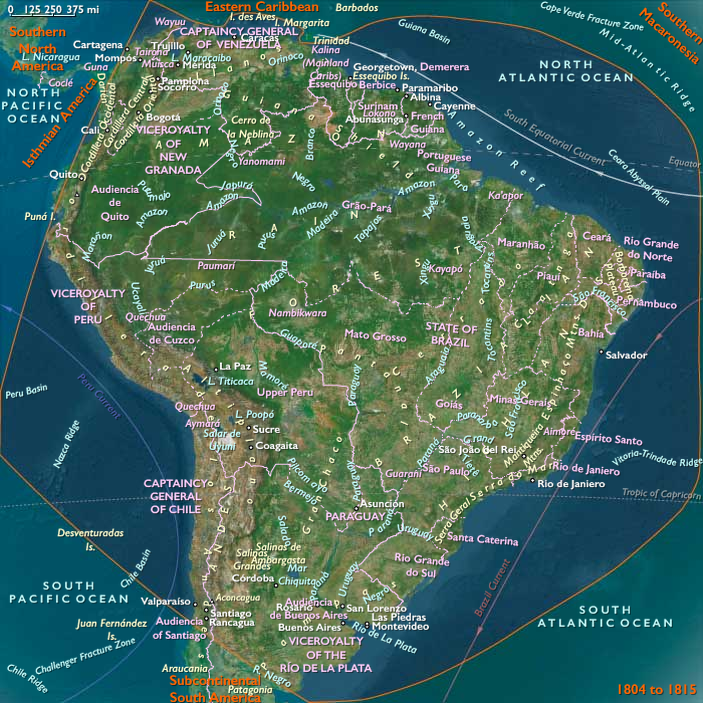
Traditional historians of Spanish America dub the…
1804 CE to 1815 CE
Elaborate declarations of citizens' rights, more on the French than the American model, are just one example, but a few of the measures are noteworthy: thus Antioquia Province begins the process of abolishing slavery with a law of free birth, and Cartagena, which has one of the headquarters of the Spanish Inquisition, closes it down.
Moreover, although political disunity is unfortunate, it faithfully reflects the fact that New Granada's population clusters, isolated by rugged topography and abysmal internal transportation, have really never had much to do with each other.
An outward appearance of unity is finally achieved in November-December 1814, when Bolivar, who owes the United Provinces a debt of gratitude for helping him militarily in Venezuela but is at the time a fugitive in New Granada, assumes command of an army that takes Santa Fe and compels Cundinamarca to join the confederation.
Unfortunately, Ferdinand VII, having been returned to his throne as king of Spain in March 1814, is determined to restore the colonial status quo.
Locations
People
Groups
Tairona
View →
Christians, Roman Catholic
View →
Muisca (Amerind tribe)
View →
Inquisition, Spanish
View →
Spaniards (Latins)
View →
Granada, New Kingdom of (Spanish colony)
View →
Peru, Viceroyalty of
View →
Spain, Habsburg Kingdom of
View →
Quito, Real Audiencia of
View →
Bogotá, Audiencia de Santa Fe de (Captaincy General of New Granada)
View →
Spain, Bourbon Kingdom of
View →
Britain, Kingdom of Great
View →
New Granada, Viceroyalty of
View →
New Granada, Viceroyalty of
View →
Venezuela, Captaincy General of
View →
Britain (United Kingdom of Great Britain and Ireland)
View →
Spain, Bonapartist Kingdom of
View →
Cundinamarca, Free and Independent State
View →
New Granada, United Provinces of
View →
Spain, Bourbon Kingdom (first restoration) of
View →
Topics
Commodities
Subjects
Regions
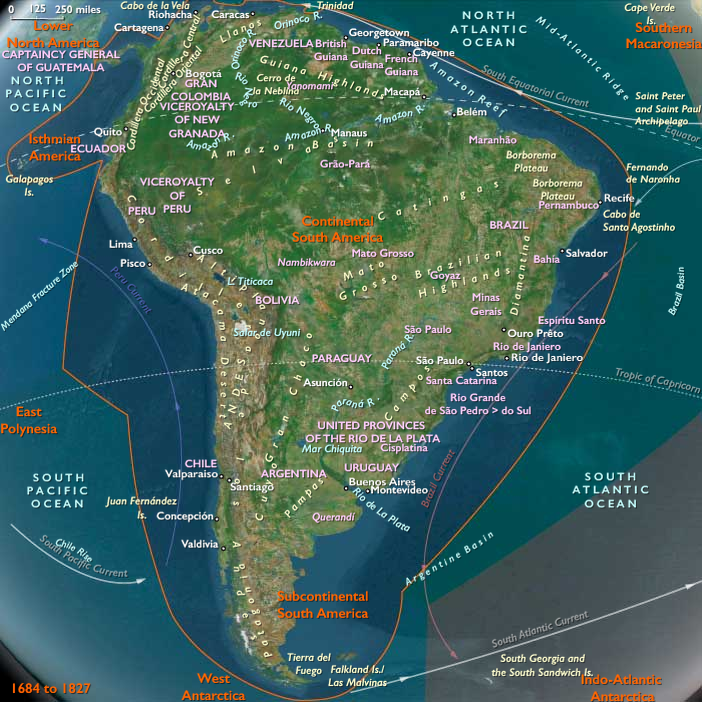
South America
View →Subregions