
Wallace resorts to guerilla warfare; Longshanks leaves…
1298 CE
Wallace resorts to guerilla warfare; Longshanks leaves Scotland to oppose his barons, who are incensed by the crown’s taxes on their estates.
The ambivalent Scottish nobles confer knighthood upon Wallace, making him guardian of the realm in the name of the imprisoned John de Baliol.
Many Scottish nobles, despite Wallace’s elevation to knightly guardian of the realm, do not support his rebellion; when King Edward invaded in 1298, their lack of support had aided his victory over Wallace at Falkirk.
The defeated Wallace escapes and goes to France in an unsuccessful bid for assistance.
Following Wallace’s defeat at Falkirk in 1298 and his subsequent flight to France in an unsuccessful bid for assistance, Robert the Bruce, Eighth earl of Carrick, is named one of four regents of Scotland, alongside his great rival for the Scottish throne, John Comyn, and William Lde amberton, Bishop of St. Andrews.
Bruce is descended from the Scoto-Norman and Gaelic nobilities; through his father, he is a fourth-great grandson of David I. Robert’s grandfather Robert de Brus, Fifth Lord of Annandale, was one of the claimants to the Scottish throne during the 'Great Cause'.
As Earl of Carrick, Robert the Bruce supports his family’s claim to the throne and takes part in William Wallace’s revolt against Edward I of England.
Locations
People
Groups
Topics
Commodities
Subjects
Regions
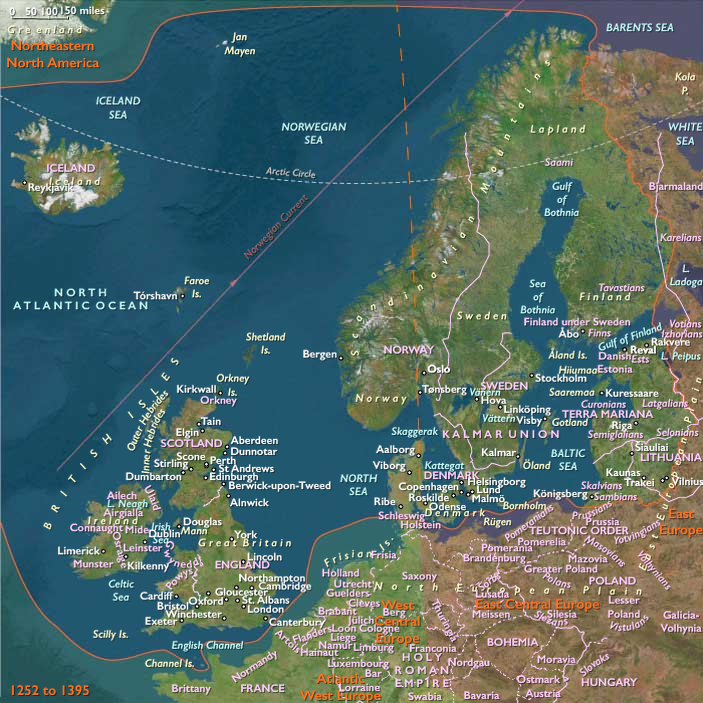
North Europe
View →Subregions
