Water wells discovered by archaeologists in western…
6093 BCE to 5950 BCE
Water wells discovered by archaeologists in western Cyprus are believed to be among the oldest in the world, dated at nine thousand to ten thousand five hundred years old, putting them in the Stone Age.
They are said to show the sophistication of early settlers, and their heightened appreciation for the environment.
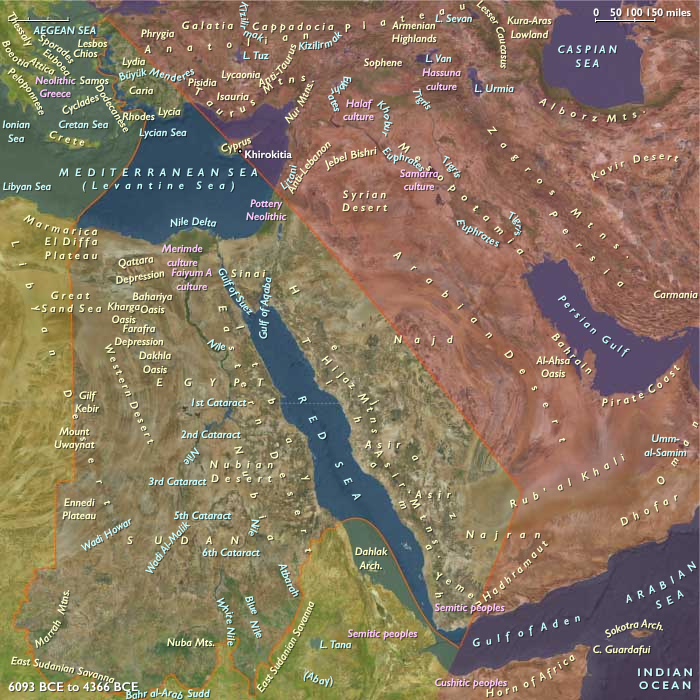
Khirokitia, an archaeological site on the island of Cyprus occupied from the seventh until the fourth millennia BCE, is known as one of the most important and best-preserved prehistoric sites of the eastern Mediterranean.
Much of its importance lies in the evidence of an organized functional society in the form of a collective settlement, with surrounding fortifications for communal protection.
The Neolithic aceramic period is represented by this settlement and around twenty other similar settlements spread throughout Cyprus.
Subsistence methods practiced by its Neolithic inhabitants included farming crops and herding cattle.
It is a closed village, cut off from the outside world, apart from by the river, by a strong wall of stones two and a half meters thick and three meters high at its highest preserved level.
Access into the village was probably via several entry points through the wall.
The buildings within this wall consist of round structures huddled close together.
The lower parts of these buildings are often of stone and attain massive proportions by constant additions of further skins of stones.
Their external diameter varies between 2.3 meters and 9.2 meters while the internal diameter is only between 1.4 meters and 4.8 meters.
A collapsed flat roof of one building found recently indicates that not all roofs were dome shaped as was originally believed.
The internal divisions of each hut were according to the purpose of its usage.
Low walls and platforms designated work, rest, or storage areas.
They had hearths presumably used for cooking and heating, benches, and windows; in many cases, there is evidence of piers to support an upper floor.
It is believed that the huts were like rooms several of which were grouped around an open courtyard and together formed the home.
The population of the village at any one time is thought not to have exceeded three hundred to six hundred inhabitants.
The people are rather short—the men about 1.61 meters on average and the women about 1.51 meters.
Infant mortality is very high and life expectancy is about twenty-two years.
On average adult men reach thirty-five years of age and women thirty-three.
The dead are buried in crouched positions just under the floors of the houses.
In some instances, provision was made for offerings, so presumably a form of ancestor cult existed inside households.
This, the earliest known culture in Cyprus, consists of a well-organized, developed society mainly engaged in farming, hunting and herding.
Farming is mainly of cereal crops.
They also pick the fruit of trees growing wild in the surrounding area such as pistachio nuts, figs, olives, and prunes.
The four main species of animals whose remains were found on the site are deer, sheep, goats, and pigs.
The aceramic civilization of Cyprus ends quite abruptly around 6000 BCE, when the village of Choirokoitia is suddenly abandoned for reasons unknown.
It seems that the island remains uninhabited for about fifteen hundred years until the next recorded entity, the Sotira group.
Locations
Topics
Commodities
Subjects
Regions
The Near and Middle East
View →Subregions