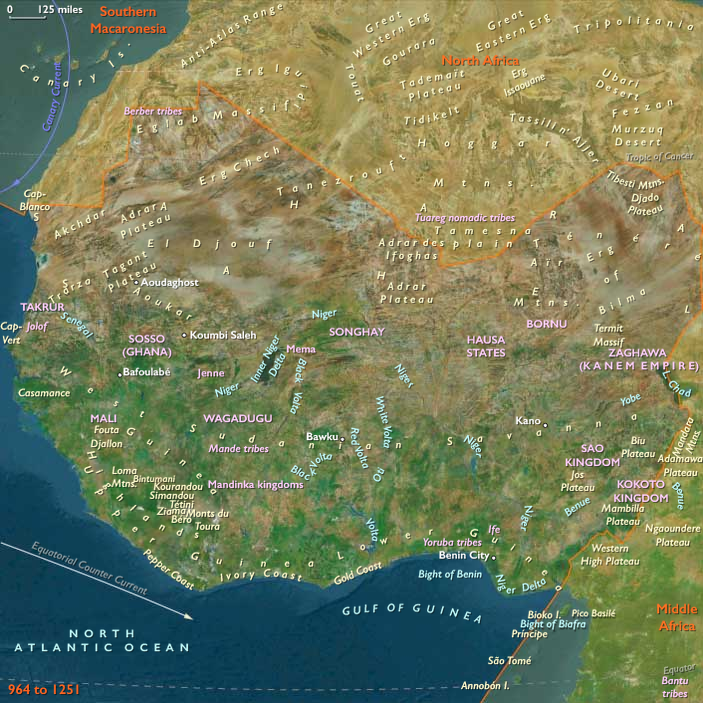
West Africa (1108 – 1251 CE): Ghana’s…
1108 CE to 1251 CE
West Africa (1108 – 1251 CE): Ghana’s Decline, Sundiata’s Revolution, and Benin’s Consolidation
Geographic and Environmental Context
West Africa includes Senegal, Mauritania, Mali, Burkina Faso, Niger, Guinea, Sierra Leone, Liberia, Côte d’Ivoire, Ghana, Togo, Benin, and Nigeria.
-
The Sahelian belt (Senegal–Niger valleys) anchored kingdoms like Ghana (Wagadu) and Takrur.
-
The Niger Bend and inner Niger delta supported riverine farming, fishing, and trade, with towns such as Gao rising to prominence.
-
The forest–savanna frontiers of modern Guinea, Côte d’Ivoire, and Ghana served as entry points for gold, kola, and ivory into Sahelian networks.
-
In the east, Hausaland (northern Nigeria) consolidated into a mosaic of town-based polities linked to desert and savanna routes.
Climate and Environmental Shifts
-
Generally favorable rains, with localized dry spells.
-
Flood-recession agriculture in the Inland Delta remained productive.
Societies and Political Developments
-
Ghana (Wagadu) declined under internal fissures, shifting trade, and pressure from nomads and rival states.
-
In the upper Niger, Sundiata Keita forged the Mali polity (crowned after the Battle of Kirina, c. 1235), uniting Mande chiefdoms and seizing the goldfields’ arteries.
-
Gao persisted as a Songhay kingdom; Takrur remained an Islamic river state.
-
Hausaland: city-states expanded walls, markets, and dynastic courts.
-
Benin region: Ogiso-era town clusters consolidated toward the early Oba monarchy.
Economy and Trade
-
Mali’s control of Bambuk–Buré gold routes shifted the balance from Ghana; salt from Taghaza/ Taoudenni supplied the Sahel.
-
Caravans: copper from Takedda, textiles from Ghadames–Ghat, and horses from the Maghreb flowed south; gold, slaves, ivory, and kola moved north.
-
Agriculture: Sahel grains; Inland Delta rice and fish; forest yams and oil palm.
Subsistence and Technology
-
Irrigation and floodplain management in Inland Delta; iron hoes and sickles increased yields.
-
Camel logistics refined; caravanserais multiplied along trunk routes.
Movement and Interaction Corridors
-
Upper Niger trunk (Niani–Kangaba) under Mali;
-
Gao–Air–Takedda copper axis;
-
Senegal–Takrur routes to the Atlantic edge;
-
Hausa corridors through Kano and Katsina toward the Sahara.
Belief and Symbolism
-
Islamic courts in Mali, Gao, Takrur sponsored mosques and jurists; indigenous rites persisted in rural hinterlands.
-
Griots preserved royal epics (e.g., Sundiata), legitimating rule.
Adaptation and Resilience
-
Political succession from Ghana to Mali preserved caravan security.
-
Ecological spread—Sahel grains + floodplain rice + forest kola—hedged climate risk.
Long-Term Significance
By 1251, Mali had supplanted Ghana; Gao, Takrur, Hausa, and Benin matured—setting up a 14th-century boom in gold, cities, and Islamic learning.
Images

West Africa (with civilization) ©2024-25 Electric Prism, Inc. All rights reserved.
People
Groups
Topics
Commodities
Subjects
Regions
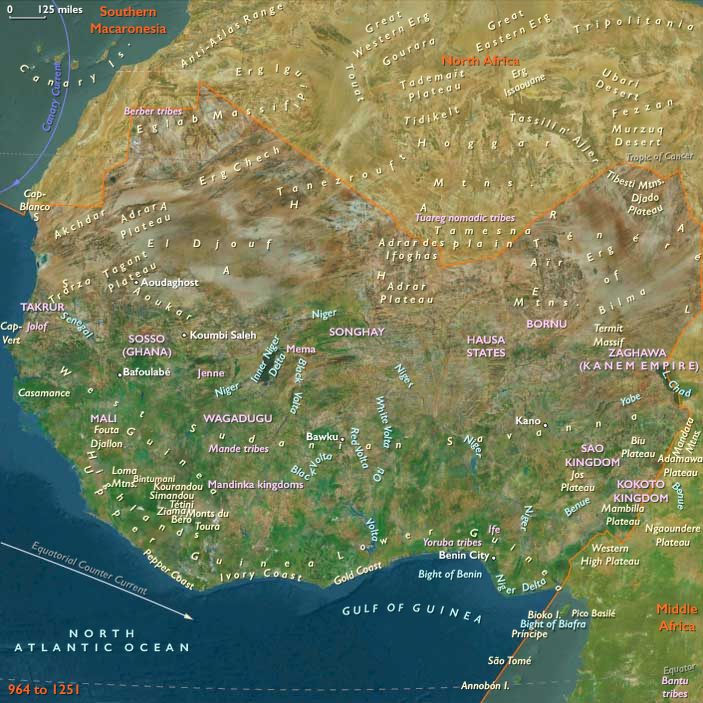
West Africa
View →Subregions