Central Europe (1684 – 1827 CE) Baroque…
1684 CE to 1827 CE
Central Europe (1684 – 1827 CE)
Baroque Thrones, Enlightened Reforms, and the Shock of Revolution
Geography & Environmental Context
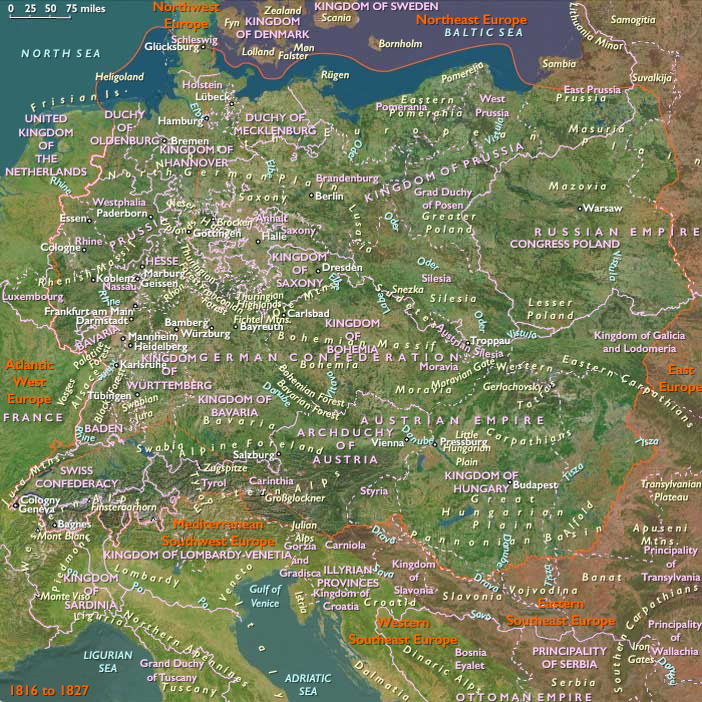
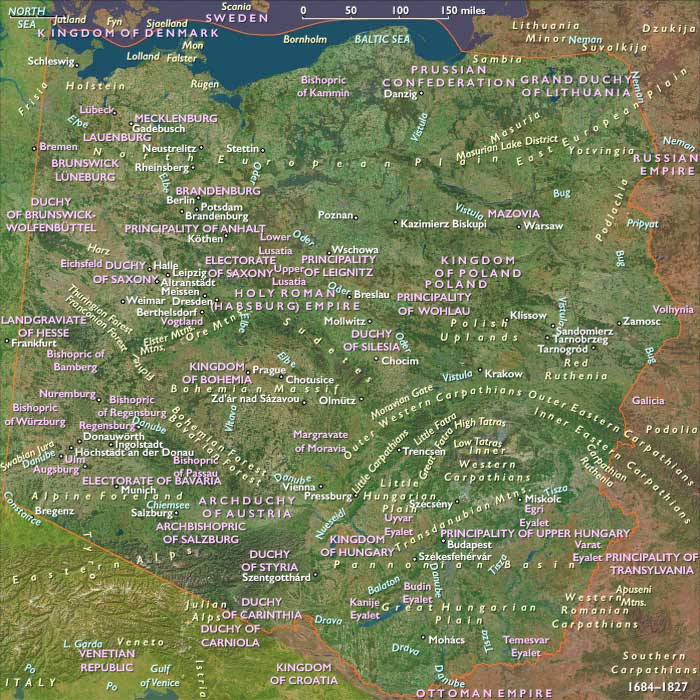
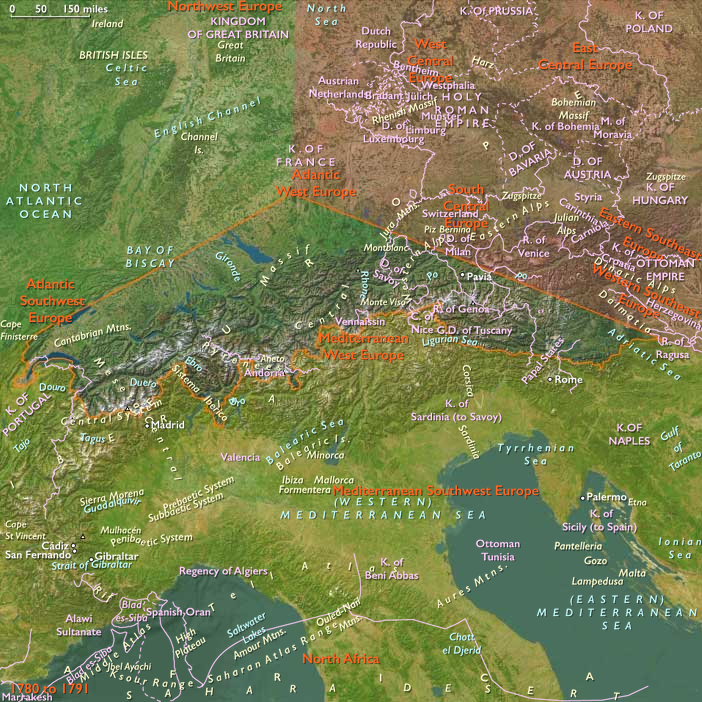
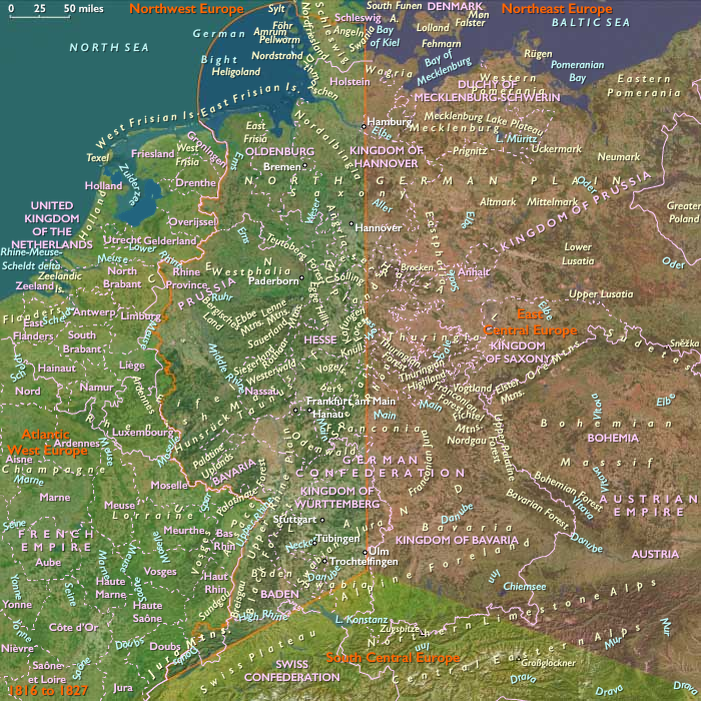
Central Europe extended from the Rhine to the Carpathians, encompassing the Austrian heartlands, Bohemia and Moravia, most of Germany, Switzerland, and Liechtenstein. Anchors included the Upper Danube basin, Elbe and Oder valleys, Alpine passes, and Rhine–Moselle wine slopes. The region’s rivers and passes tied the North Sea to the Adriatic and Black Sea, binding German, Austrian, and Swiss lands into the heart of continental Europe.
Climate & Environmental Shifts
The waning Little Ice Age brought alternating cold winters and drought summers. The Great Frost (1708–1709)devastated crops; floods along the Elbe, Oder, Rhine, and Danube damaged towns, while good harvest years followed. The gradual adoption of the potato and new fodder crops improved resilience. After the Tambora eruption (1815), famine and hardship struck again, but by the 1820s, agrarian innovation and demographic recovery were well underway.
Subsistence & Settlement
-
Agriculture: Rye, oats, and wheat formed the core diet; potatoes spread after mid-century. Vineyards revived along the Rhine, Danube, and Moravian hills. Sheep and cattle herding supplied meat, wool, and hides.
-
Urban centers:
-
Vienna grew into Europe’s cultural capital and Habsburg seat.
-
Prague and Dresden rebuilt in baroque splendor.
-
Berlin emerged as Prussia’s administrative heart.
-
Frankfurt and Leipzig thrived as fairs and publishing hubs.
-
Basel, Zurich, and Geneva anchored Swiss trade and printing.
-
-
Proto-industrial districts: Saxon textiles, Silesian mining, Austrian ironworks, and Swiss watchmakingforeshadowed 19th-century industrialization.
Technology & Material Culture
-
Transport: Riverine traffic along the Elbe, Danube, and Rhine carried grain and coal; post roads linked armies and markets.
-
Industry & crafts: Mining and metallurgy revived; Meissen porcelain (1710) became a global prestige item. Swiss textiles and banking spread their reach.
-
Architecture & design: Baroque monasteries, rococo palaces, and neoclassical civic buildings reflected both faith and reform.
-
Consumption & daily life: Coffee, sugar, and printed cottons symbolized new global linkages. Timber-framed villages, vineyard cooperatives, and guild halls preserved local continuity.
Movement & Interaction Corridors
-
Danube corridor: From Vienna to Budapest and Belgrade, the artery of trade and empire.
-
Elbe & Oder basins: Linked Saxony and Silesia to Baltic ports.
-
Rhine corridor: Carried commerce from Basel to Cologne and Rotterdam, anchoring West Central Europe to Atlantic markets.
-
Alpine passes: Gotthard, Brenner, and Splügen remained critical north–south routes.
-
Intellectual networks: Universities at Halle, Jena, Vienna, Prague, Basel, and Zurich transmitted Enlightenment and Romantic ideas across linguistic borders.
Cultural & Symbolic Expressions
-
Religion and learning:
-
Catholic Baroque revival under Habsburg patronage—Sumptuous monasteries and pilgrimage churches (Melk, St. Gallen).
-
Protestant Pietism and rationalist theology flourished in Saxony and Brandenburg.
-
-
Music and literature: The Viennese Classical School—Haydn, Mozart, Beethoven—transformed European music. German literature soared through Goethe and Schiller, while Czech and Slovak romanticism stirred cultural revival.
-
Art and philosophy: Baroque exuberance gave way to Enlightenment empiricism, then Romantic nationalism. Swiss presses and German universities circulated new scientific and political thought.
-
Civic identity: Urban guilds, parish communities, and salons fostered literacy and associational life—the seeds of a public sphere.
Environmental Adaptation & Resilience
-
Potato revolution: Reduced famine exposure after the 1770s.
-
Agricultural reforms: Enclosure, crop rotation, and estate rationalization under Maria Theresa and Joseph II(Austria) and Frederick the Great (Prussia).
-
Forest and water management: Regulated logging, sustained alpine pastures, and floodplain agriculture.
-
Crisis management: Parish granaries, charitable orders, and municipal relief stabilized food supply during the famines of 1709 and 1816–1817.
Political & Military Shocks
-
Ottoman Wars: The 1683 siege of Vienna and subsequent Habsburg advance into Hungary secured Central Europe’s southeastern flank.
-
War of the Spanish Succession (1701–1714): Austria gained Italy and the Low Countries.
-
War of the Austrian Succession (1740–1748) and Silesian Wars (1740–1763): Prussia’s seizure of Silesia rebalanced regional power.
-
Seven Years’ War (1756–1763): A global conflict with Saxony, Bohemia, and Silesia as major theaters.
-
Reform and Enlightenment (1760s–1780s): Centralizing monarchs pursued codified law, religious toleration, and education reform.
-
French Revolutionary & Napoleonic Wars (1792–1815): Occupations, dissolutions, and reforms—the Holy Roman Empire ended (1806); Confederation of the Rhine rose under Napoleon; Vienna (1815) redrew Europe.
-
Postwar reaction: Carlsbad Decrees (1819) censored universities and press, stifling liberalism but failing to halt nationalist ferment.
Transition
Between 1684 and 1827 CE, Central Europe evolved from a confessional battlefield into a crucible of reform and culture. Vienna’s salvation (1683) marked the Ottoman retreat; Silesia’s loss (1740) heralded Prussia’s rise; and Napoleon’s conquests dissolved the Holy Roman Empire, replacing it with modern statehood.
Economic modernization, Enlightenment governance, and cultural brilliance reshaped daily life even amid war and famine. By 1827, the region stood united by river trade and divided by ideology—its princes restored but its peoples awakened to the possibilities of nation and revolution that would define the century to come.
Images

West Central Europe (with civilization) ©2024-25 Electric Prism, Inc. All rights reserved.
Groups
Topics
Commodities
Subjects
Regions