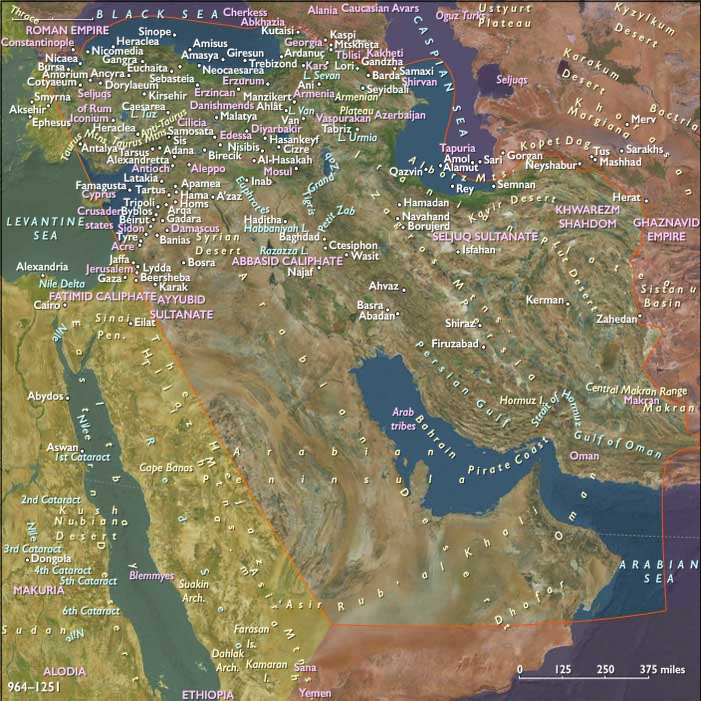
Antioch, lying on the slopes of the…
September 1097 CE
Antioch, lying on the slopes of the Orontes valley, in 1097 covers more than three-and-a-half square miles (none square kilometers) and is encircled by walls studded by four hundred towers.
The river runs along the city's northern wall before entering Antioch from the northwest and exiting east through the northern half of the city.
Mount Silpius, crested by a citadel, is Antioch's highest point and rises some one thousand feet (three hundred meters) above the valley floor.
There are six gates through which the city can be entered: three along the northern wall, and one on each of the south, east, and west sides.
The valley slopes make approaching from the south, east, or west difficult, so the most practical access route for a large number of people is from the north across flatter ground.
The city's defenses date from the reign of the Emperor Justinian I in the sixth century.
Though Antioch has changed hands twice between then and the arrival of the crusaders in 1097, each time it had been the result of betrayal rather than inadequacy of the defenses.
After the Empire reconquered Antioch in 969, a program of fortification building had been undertaken in the surrounding area to secure the gains.
As part of this, a citadel high enough to be separate from the city below had been built on Mount Silpius.
At its fall to Seljuq Turks in 1085, Antioch had been the last imperial fortification in Syria.
Yaghi-Siyan, made governor of Antioch in 1087, holds the position when the crusaders arrive in 1097.
Yaghi-Siyan is aware of the approaching crusader army as it marches through Anatolia in 1097; the city stands between the crusaders and Palestine.
Though under Muslim control, the majority of Antioch's inhabitants are Christians.
Yaghi-Siyan had previously been tolerant of the Christian populace, however that changes as the crusaders approach.
To prepare for their arrival, he imprisons the Orthodox Patriarch of Antioch, John the Oxite, turns St. Paul's Cathedral into a stable and expels many leading Christians from the city.
Yaghi-Siyan now sends out appeals for help: his request is turned down by Ridwan of Aleppo because of personal animosity; however, Yaghi-Siyan is more successful in his approaches to other nobles in the region and Duqaq of Damascus, Toghtekin, Kerbogha, the sultans of Baghdad and Persia, and the emir of Homs all agree to send reinforcements.
Meanwhile, back in Antioch, Yaghi-Siyan has begun stockpiling supplies in anticipation of a siege.
Locations
People
Groups
Topics
Commodities
Subjects
Regions
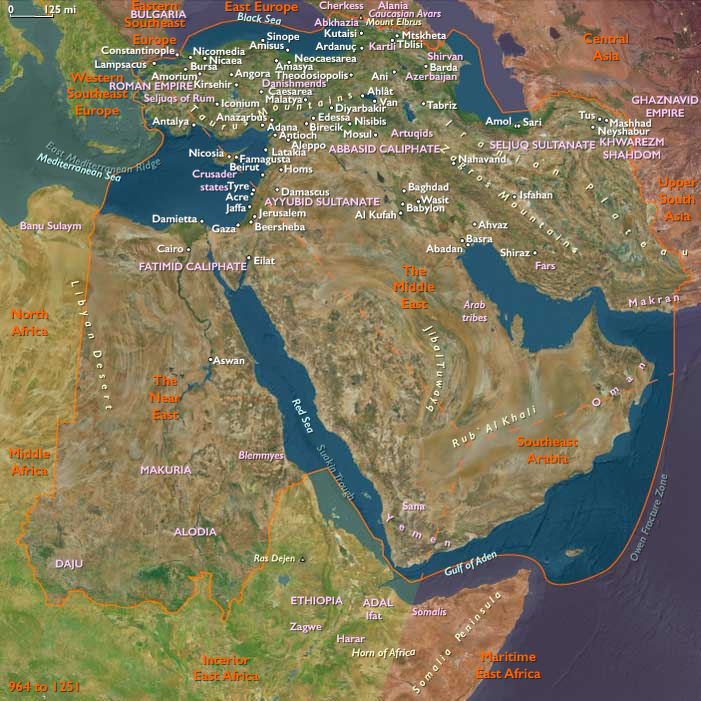
The Near and Middle East
View →Subregions