
As they had in 87/88, the Dacians…
101 CE
As they had in 87/88, the Dacians resist the Roman offensive at Tapae, near the present Romanian village of Bucova, but as a storm breaks out, the Dacians, believing it a sign from the gods, decide to withdraw.
Locations
People
Groups
Topics
Commodities
Subjects
Regions
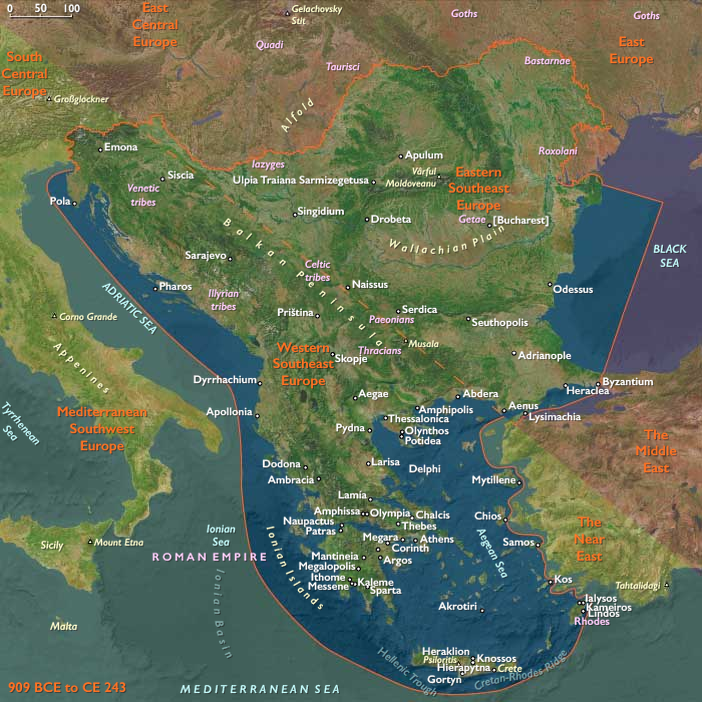
Southeast Europe
View →Subregions
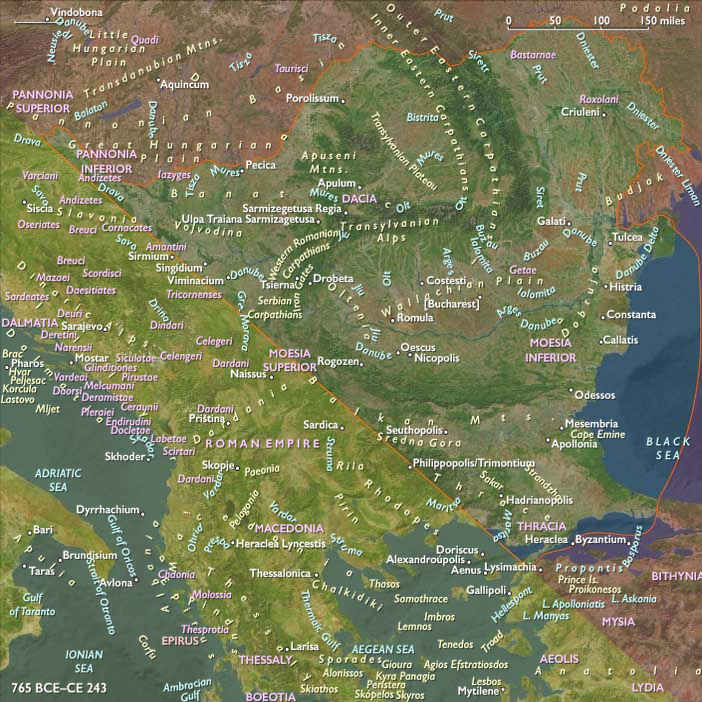
Eastern Southeast Europe
View →Related Events
No active filters.
Showing 10 events out of 61317 total
China and Rome had progressively inched closer with the embassies of Zhang Qian in 130 BCE and the military expeditions of China to Central Asia, until general Ban Chao’s attempt to send an envoy to Rome.
Chinese military ambassador Gan Ying, who had been sent on a mission to Rome in CE 97 by Ban Chao, had been part of Ban Chao's expeditionary force of seventy thousand, which had traveled as far west to the western border of Parthia.
Gan Ying leaves a detailed account of western countries, although he apparently only reached as far as Mesopotamia.
While he intended to sail to Rome through the Black Sea, some Parthian merchants, interested in maintaining their profitable role as the middleman in the trade between China and Rome, falsely told him the dangerous trip would take two years at the least (when it was actually closer to two months).
Although Gan Ying, who dies in 101, probably never reached Rome, he is, at least in the historical records, the Chinese who had gone the furthest west during antiquity and gathered what information he could.
The Dacians, or Getae, had been left independent after Domitian’s Dacian Wars in the late 80s, their king, Decebalus, having received the status of "king client to Rome", receiving from Rome military instructors, craftsmen and even money.
Instead of using the money as Rome intended, Decebalus had elected to build new citadels in the mountains in important strategic points and to reinforce the existing ones.
Trajan, determined to stamp out the Getian menace, expand the glory of his reign, end a treaty perceived as humiliating, and take over the gold and silver mines of Transylvania, has decided to strengthen the dangerous Danube frontier by converting Dacia into a salient of Roman territory north of the river.
This would also dismember the Sarmatian tribes and remove the risk of large, hostile combinations to a safer distance.
Labeling Decebalus a menace to the security of Rome’s provinces to the south across the Danube, Trajan assumes personal command of a punitive expedition of the Dacian kingdom and, with a force of one hundred thousand men, launches his first campaign in 101.
The Romans lay down a road along the Danube and cross the river at Viminacium, slowly making their way into Dacia.
Jewish migration to Rome has continued since the conquest of Rome by Pompey.
Around 100, a synagogue (the oldest known synagogue in Western Europe) is established in Ostia, the port of Rome, to serve the resident Jewish community, as well as transient sailors.
The works of Josephus, who has become known, in his capacity as a Roman citizen, as Titus Flavius Josephus, and who had survived and recorded the Destruction of Jerusalem in 70, give an important insight into first-century Judaism.
He dies sometime after 100.
In 93, Josephus had published his work Antiquities of the Jews.
The extant copies of this work, which all derive from Christian sources, even the recently recovered Arabic version, contain two passages about Jesus.
The one directly concerning Jesus has come to be known as the Testimonium Flavianum.
Its authenticity will bee disputed beginning in the seventeenth century, and by the mid-eighteenth century the consensus view will be that it is a forgery.
This conclusion will be questioned in the twentieth century and the intellectual controversy will probably never be resolved.
The other passage mentions Jesus as the brother of James, also known as James the Just.
The authenticity of this latter passage has been disputed by Emil Schürer as well by several recent popular writers.
The first known usage of the term ‘Christian’ can be found in the New Testament of the Bible, in Acts 11:26: "the disciples were called Christians first in Antioch."
The term was thus first used to denote those known or perceived to be disciples of Jesus.
Similarly, in the two other New Testament uses of the word (Acts 26:28 and 1 Peter 4:16), it refers to the public identity of those who follow Jesus.
Outside scripture, the earliest recorded use of the term would not be until 116, when Tacitus recorded that Empero Nero had blamed the "Christians" for the Great Fire of Rome in CE 64 and initiated the first known persecution of early Christians by the Romans.
The first Christian dogma and formulas regarding morality appear around 100, around the time that Christians introduce the column sarcophagus style, derived from Greek versions, to Rome from Asia Minor.
Concurrently, the Romans begin to prefer burial to cremation.
Chinese general Ban Chao, cavalry commander in charge of the administration of the "Western Regions" (Central Asia) during the Eastern Han dynasty, has repelled the Xiongnu and secured Chinese control over the Tarim Basin region, and led a military expedition to the heart of Central Asia.
Having fought for thirty-one years to successfully organize the territories of the Tarim Basin, he has retired to Luoyang, where he dies shortly thereafter in 102.
Empress Yin, the daughter of Yin Gang, the grandson of Emperor Guangwu's wife Empress Yin Lihua's brother Yin Shi, had become an imperial consort in 92 and quickly became a favorite of Emperor He.
In 96, Emperor He had created her empress, and the following year had created her father Yin Gang the Marquess of Wufang.
She is described as beautiful but short and clumsy, and often unable to carry out the ceremonies that empresses are to perform with physical grace.
She is also described as arrogant due to her noble heritage.
As the years passed, Empress Yin had begun to lose Emperor He's favor, particularly because she was jealous of another favorite of his, Consort Deng Sui, who had come from a noble lineage herself, being the granddaughter of Emperor Guangwu's prime minister Deng Yu.
Compared to Empress Yin's arrogance, Consort Deng was described as humble and always trying to maintain peaceful relations with other consorts and ladies in waiting.
She, concerned that Emperor He was continually losing sons in young age, often would recommend other consorts for Empress He to have sexual relations with, while Empress Yin did not.
She therefore became more and more popular.
Once, when Emperor He was ill, Empress Yin made the remark that if she became empress dowager, the Dengs would be slaughtered.
Consort Deng, upon hearing that remark, considered committing suicide, and one of her ladies in waiting saved her by falsely telling her that the emperor had recovered.
However, as the emperor did indeed soon recover, Consort Deng and her family escaped a terrible fate.
In 102, Empress Yin and her grandmother, Deng Zhu, are accused of using witchcraft to curse imperial consorts (probably including Consort Deng).
Lady Deng and her sons, as well as Empress Yin's brother Yin Fu, die under interrogation and torture.
Empress Yin is deposed, Consort Deng is created empress to replace her, and Yin Gang commits suicide.
The rest of Yin’s family is exiled.
She herself dies in sorrow, probably in 102 as well.
Trajan, overcoming vigorous opposition from the Dacians in the second year of his campaign, penetrates the kingdom’s center and captures its fortress-capital, Sarmizegetusa, erected on top of a crag twelve hundred meters high as the core of the strategic defensive system of six citadels in the Oraste Mountains of present western Romania.
Decebalus, forced to conclude an unfavorable peace, agrees to recognize the emperor as Dacia’s overlord, to accept Roman garrisons, and to render military service to Rome.
A reaction against the radical experimental style of early Silver Age poetry had set in by the end of the first century, and Tacitus, Quintilian and Juvenal all testify to the resurgence of a more restrained, classicizing style under Trajan and the Antonine emperors.
The work of Publius (or Gaius) Cornelius Tacitus, a senator and a historian of the Roman Empire writing in the latter part of the Silver Age of Latin literature, is distinguished by a boldness and sharpness of wit, and a compact and sometimes unconventional use of Latin.
The surviving portions of his two major works—the Annals and the Histories span the history of the Roman Empire from the death of Augustus in 14 to (presumably) the death of emperor Domitian in 96, examining the reigns of the Roman Emperors Tiberius, Claudius, Nero and those that reigned in the Year of the Four Emperors.
There are significant lacunae in the surviving texts.
The date of composition of his Dialogue on Orators on the art of rhetoric.
is unknown, though its dedication to Fabius Iustus places its publication around 102.
The dialogue itself, set in the year 75 or 77, follows the tradition of Cicero's speeches on philosophical and rhetorical arguments.
The beginning of the work is a speech in defense of eloquence and poetry.
It then deals with the decadence of oratory, for which the cause is said to be the decline of the education, both in the family and in the school, of the future orator.
The education is not as accurate as it once was; the teachers are not prepared and a useless rhetoric often takes the place of the general culture.
After an incomplete section, the Dialogue ends with a speech reporting Tacitus's opinion that great oratory was possible with the freedom from any power, more precisely in the anarchy, that characterized the Roman Republic during the civil wars but that it became anachronistic and impracticable in the quiet and ordered society that resulted from the institution of the Roman Empire.
The peace, warranted by the Empire, should be accepted without regret for a previous age that was more favorable to the wide spread of literacy and the growth of great personality.
At the base of all of Tacitus's work is the acceptance of the Empire as the only power able to save the state from the chaos of the civil wars.
The Empire reduced the space of the orators and of the political men, but there is no viable alternative to it.
Nevertheless, Tacitus does not accept the imperial government apathetically, and he shows, as in the Agricola, the remaining possibility of making choices that are dignified and useful to the state.
Legio X Equestris had been one of the four legions used by Julius Caesar in 58 BCE, for his invasion of Gaul.
They had remained faithful to Caesar in the civil war against Pompey, being present in the battles of Pharsalus (49 BCE) and Munda (45 BCE).
In 45 BCE, Caesar had disbanded the legion, giving the veterans farmlands near Narbonne.
The legion had been reconstituted in 42 BCE and fought for Augustus (then Octavian), Lepidus and Mark Antony in the Battle of Philippi against the murderers of Caesar.
After this, they had followed Mark Antony in his campaign against Parthia and were defeated with him at Actium.
Augustus then took control of the legion and settled the veterans in Patras.
The legion rebelled and lost its cognomen Equestris as punishment.
Reinforcements had been added from other legions, and the Tenth was rebaptized Gemina.
The newly formed X Gemina had been relocated to Hispania Tarraconensis, where Augustus was preparing a campaign against the Cantabrians.
They stayed in Hispania for many years and their veterans were among the first inhabitants of modern Zaragoza.
In 70, after the Batavian rebellion had been suppressed by Vespasian, X Gemina was sent to Batavia in Germania Inferior to police the lands and prevent new revolts.
From 71 to 103, the legion has been stationed at the base built by II Adiutrix at Oppidum Batavorum, the present day Dutch city of Nijmegen.
As part of the army of Germania Inferior, X Gemina had fought against the rebellion of the governor of Germania Superior, L. Antonius Saturninus, against Emperor Domitian.
For this reason, the Tenth — as well as the other legions of the army, I Minervia, VI Victrix, and XXII Primigenia — had received the title Pia Fidelis Domitiana, "faithful and loyal to Domitian", with the reference to the Emperor dropped at his death.
In 103, it is moved to Aquincum and later to …
…Vindobona (modern Vienna), in Pannonia Superior, which will be the legion's camp until the fifth century.
Palmyra, a wealthy and elegant city located along the caravan routes linking Persia with the Mediterranean ports of Roman Syria and Phoenicia, had come under Roman control during the reign of Roman Emperor Tiberius (14–37).
Made part of the Roman province of Syria dt has steadily grown in importance as a trade route linking Persia, India, China, and the Roman empire.
During the ensuing period of great prosperity, the Arab citizens of Palmyra have adopted customs and modes of dress from both the Iranian Parthian world to the east and the Graeco-Roman west.
Rome's original harbor was Ostia.
Claudius had constructed the first harbor on the Portus site, four kilometers (two-and-a-half miles) north of Ostia, enclosing an area of sixty-nine hectares (one hundred and seventy acres), with two long curving moles projecting into the sea, and an artificial island, bearing a lighthouse, in the center of the space between them.
The foundation of this lighthouse was provided by filling a massive ship, used to transport an obelisk from Egypt to adorn the spina of Vatican Circus, built under Caligula.
The harbor thus opened directly to the sea on the northwest and communicated with the Tiber by a channel on the southeast.
The object was to obtain protection from the prevalent southwest wind, to which the river mouth was exposed.
Though Claudius, in the inscription which he caused to be erected in CE 46, boasted that he had freed the city of Rome from the danger of inundation, his work was only partially successful, for in 62 Tacitus speaks of a number of grain ships sinking within the harbor during a violent storm.
Nero had given the harbor the name of "Portus Augusti".
It was probably Claudius who had constructed the new direct road from Rome to Portus, the Via Portuensis which is 24 km (15 miles) long.
The Via Portuensis runs over the hills as far as the modern Ponte Galeria, and then straight across the plain.
An older road, the Via Campana, runs along the foot of the hills, following the right bank of the Tiber, and passing the grove of the Arval Brothers at the sixth mile, to the Campus salinarum romanarum, the salt marsh on the right bank from which indeed it derives its name.
In 103, Trajan constructs another harbor farther inland—a hexagonal basin enclosing an area of 39 hectares (97 acres), and communicating by canals with the harbor of Claudius, with the Tiber direct, and with the sea, the last now forming the navigable arm of the Tiber (reopened for traffic by Gregory XIII and again by Paul V).
It bears the name Fossa trajana, though its origin is undoubtedly due to Claudius.
The basin itself is still preserved, and is now a reedy lagoon.
It was surrounded by extensive warehouses, remains of which may still be seen: the fineness of the brickwork of which they are built is remarkable.
The Romans make use of fired bricks, which now become the primary building material in the Roman Empire, and the Roman legions, which operate mobile kilns, introduce bricks to many parts of the empire.
Roman bricks are often stamped with the mark of the legion that supervised its production.
The use of bricks in Southern and Western Germany, for example, can be traced back to traditions already described by the Roman architect Vitruvius.