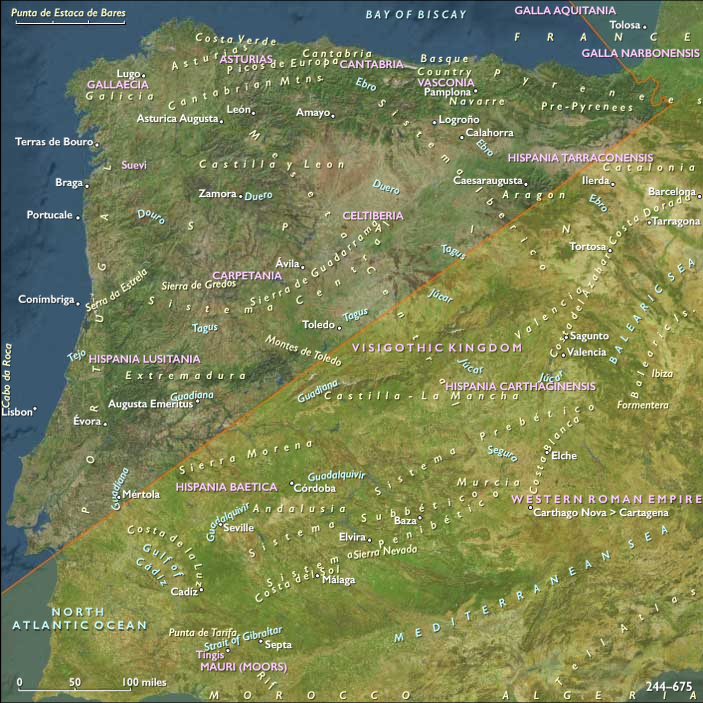
Atlantic Southwest Europe (400–411 CE): Imperial Fragmentation,…
400 CE to 411 CE
Atlantic Southwest Europe (400–411 CE): Imperial Fragmentation, Germanic Invasions, and Shifting Regional Dynamics
Between 400 and 411 CE, Atlantic Southwest Europe—including northern and central Portugal, Galicia, Asturias, Cantabria, and northern Spain south of the Franco-Spanish border (43.05548° N, 1.22924° W)—entered a profoundly transformative period marked by the collapse of centralized Roman authority and the sudden influx of Germanic peoples. As Rome struggled with escalating frontier pressures and internal fragmentation, the region witnessed major demographic shifts, the weakening of traditional Roman institutions, and significant changes in local governance, culture, and economy, heralding a new historical era for the Iberian Peninsula.
Political and Military Developments
Collapse of Centralized Roman Authority
-
By the early 5th century, the weakening of imperial control became dramatically evident. Following the death of Emperor Theodosius I (395 CE), the empire divided permanently between East and West, significantly diminishing effective oversight over distant provinces like Hispania. Centralized governance eroded rapidly, leaving local elites to increasingly assume responsibility for defense, administration, and governance.
Arrival and Settlement of Germanic Peoples
-
In 409 CE, several Germanic tribes—including the Suebi, Vandals, and Alans—crossed into Hispania, dramatically altering regional political dynamics. The Suebi swiftly established control in the northwestern region of Gallaecia (modern Galicia and northern Portugal), marking the beginning of permanent Germanic settlement and a new political order.
-
Roman defensive structures and auxiliary forces in northern territories, already depleted and overstretched, were unable to prevent these settlements. Provincial governance fragmented rapidly, with former Roman authority limited mostly to isolated urban centers or fortified estates.
Economic and Technological Developments
Economic Disruption and Resilience
-
The arrival of Germanic tribes caused significant initial disruptions to commerce, agriculture, and production, particularly in Lusitania and Gallaecia. Gold and silver mining operations in Asturias and Galicia experienced interruptions, though some production continued under Germanic oversight.
-
Despite these disruptions, localized economies persisted, adapting quickly to new political realities. Coastal cities like Olissipo (Lisbon) and Bracara Augusta (Braga) experienced short-term setbacks due to disrupted Mediterranean and Atlantic trade but remained economically active through resilient internal networks and regional exchanges.
Acceleration of Ruralization and Villa Economies
-
The decline of traditional Roman urban centers accelerated, as smaller towns faced increasing instability. Fortified rural estates (villae) emerged even more prominently as primary centers of economic activity, governance, and defense, significantly advancing the shift toward localized, proto-feudal economic systems characteristic of subsequent centuries.
Cultural and Religious Developments
Christianity Amid Social and Political Turmoil
-
Despite the severe political upheavals, Christianity remained firmly established throughout Atlantic Southwest Europe, deeply embedded in local society. Churches, monasteries, and influential bishoprics, particularly those at Bracara Augusta, Emerita Augusta, and Asturica Augusta, provided social continuity and stability amid broader disruptions.
-
Bishops and clergy emerged as primary community leaders, serving both spiritual and civic functions. This strengthened Christianity’s influence, further solidifying its central role within emerging Germanic kingdoms and the evolving regional social order.
Germanic Settlements and Cultural Syncretism
-
With the Suebi’s settlement in Gallaecia, a process of cultural syncretism began. Indigenous Roman, Iberian, and Celtic traditions gradually integrated with Germanic cultural elements, creating a distinctive new regional identity. While Christianity dominated among local populations, the newly arrived Germanic tribes initially retained many traditional pagan practices before slowly adopting local Christian customs.
Civic Identity and Regional Transformation
-
Civic identity transformed significantly during this era, moving decisively away from traditional Roman imperial structures toward localized, community-based identities defined by regional, tribal, and religious affiliations. The presence of Germanic tribes and the erosion of Roman authority accelerated this transformation, reshaping regional cultural identities and administrative practices.
Notable Tribal Groups and Settlements
-
Suebi: Established permanent settlement and political control in Gallaecia, marking a fundamental turning point in regional history.
-
Lusitanians, Vettones, and Vaccaei: Adapted to the new political landscape, often blending into Germanic-controlled territories or fortifying local autonomy through independent leadership structures.
-
Gallaeci, Astures, Cantabri: Experienced increased pressure and disruption due to Germanic settlements, adapting economically and socially to new realities.
-
Vascones: Maintained territorial autonomy, neutrality, and internal stability, largely unaffected by the initial wave of Germanic migrations due to their isolated and defensible location.
Long-Term Significance and Legacy
Between 400 and 411 CE, Atlantic Southwest Europe:
-
Experienced the rapid collapse of centralized Roman authority, leading to dramatic shifts in political governance, economic structures, and social organization.
-
Saw the establishment of the first permanent Germanic kingdoms (notably the Suebi in Gallaecia), fundamentally altering regional demographics, governance, and cultural identities.
-
Maintained resilience through established Christian institutions, which provided continuity, stability, and the foundations for subsequent medieval society.
This era marked a decisive turning point, as Atlantic Southwest Europe transitioned from Late Antiquity toward the Early Middle Ages, profoundly reshaping the historical, cultural, and political trajectories of the region for centuries to come.
People
Groups
Commodities
Subjects
Regions
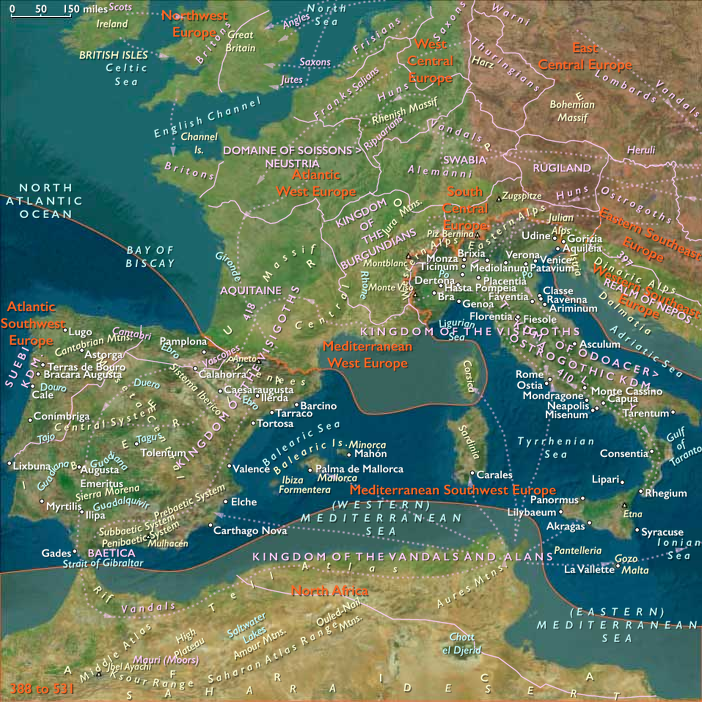
Southwest Europe
View →Subregions