
Atlantic Southwest Europe (448–459 CE): Peak of…
448 CE to 459 CE
Atlantic Southwest Europe (448–459 CE): Peak of Suebic Power, Roman Decline, and the Maturation of Christian Society
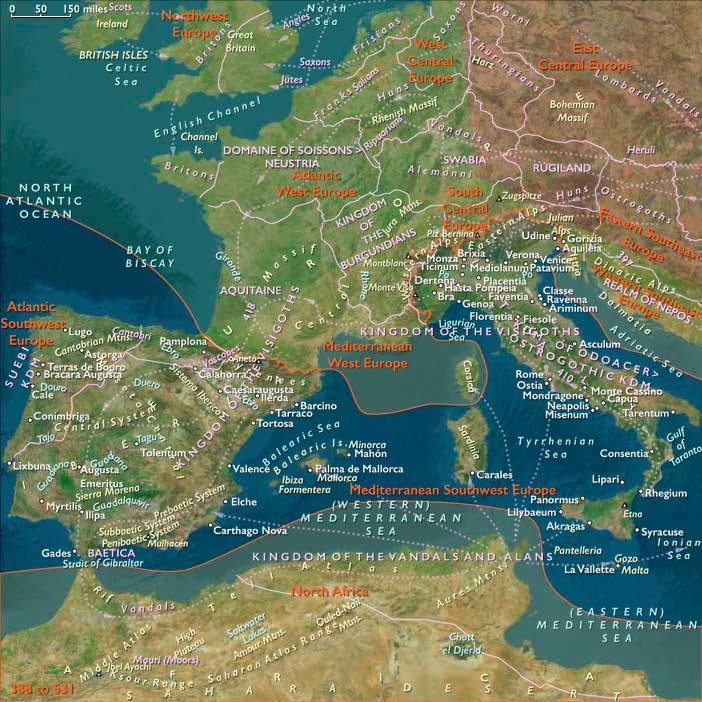
Between 448 and 459 CE, Atlantic Southwest Europe—encompassing northern and central Portugal, Galicia, Asturias, Cantabria, and northern Spain south of the Franco-Spanish border (43.05548° N, 1.22924° W)—reached a critical juncture, characterized by the height of the Suebic kingdom under King Rechiar and the near-total erosion of Roman imperial authority. This period marked the region’s decisive transformation into a predominantly post-Roman society, deeply shaped by Germanic political structures, the persistence of localized governance, and a mature, institutionalized Christian culture.
Political and Military Developments
Suebic Power under Rechiar and Regional Domination
-
Under King Rechiar (r. 448–456 CE), the Suebi attained their greatest territorial extent and political influence, expanding southward into Lusitania and asserting control over strategic territories, including the city of Emerita Augusta (Mérida). Rechiar's reign represented a peak in the Suebic Kingdom’s power, characterized by ambitious military campaigns and political alliances.
-
The Suebi engaged in diplomatic relations with other emerging Germanic kingdoms, notably the Visigoths to their east. This period was marked by relative internal stability within the Suebic-controlled territories, despite external threats and periodic border conflicts.
Decline of Roman Authority and Localized Autonomy
-
The already weak and distant Roman imperial authority disintegrated further, effectively vanishing from regional governance structures. The collapse of centralized control accelerated the emergence of fragmented, localized political entities, governed by influential local elites, bishops, and tribal chiefs who managed their communities independently or in cooperation with the Suebi.
-
Northern communities, particularly the Astures, Cantabri, and Vascones, remained largely autonomous, maintaining local traditions, distinct identities, and political neutrality.
Economic and Technological Developments
Regional Economic Stability Amid Fragmentation
-
Despite ongoing political fragmentation, the regional economy demonstrated considerable resilience. Mining (especially gold and silver from Galicia and Asturias) remained economically important, along with continued agricultural productivity (grain, olive oil), livestock farming, pottery, textiles, and metalwork.
-
Coastal settlements such as Olissipo (Lisbon) and Bracara Augusta (Braga) maintained modest trade relations with the Mediterranean, North Africa, and Gaul, though economic activity increasingly relied on local networks rather than broader imperial trade.
Ruralization and Proto-Feudal Economic Patterns
-
Urban centers continued their decline as economic and demographic focal points, though cities such as Bracara Augusta, Emerita Augusta, and Asturica Augusta remained vital as administrative and ecclesiastical hubs.
-
Rural fortified villa estates emerged as increasingly dominant centers of local power, agricultural production, and defense. These estates, typically managed by local elites or influential ecclesiastical figures, clearly prefigured medieval feudal structures.
Cultural and Religious Developments
Institutionalization and Maturation of Christianity
-
Christianity reached a level of deep institutional maturity during this era. Regional bishoprics and monastic communities—particularly those centered in Bracara Augusta, Emerita Augusta, and Asturica Augusta—played central roles in governance, education, social welfare, and cultural continuity. Bishops exercised considerable civic authority, often mediating between local populations and Germanic rulers.
-
The Council of Braga, though occurring slightly later (561 CE), would be anticipated by developments in this era, reflecting growing ecclesiastical centrality in regional affairs.
Syncretism and Cultural Integration
-
Germanic populations, particularly the Suebi, continued their steady adoption of Christianity, reinforcing their integration with local Romanized and indigenous populations. Syncretic cultural practices became increasingly normalized, blending Roman, indigenous Iberian, Celtic, and Germanic traditions into a coherent regional identity.
-
Rural communities in Galicia and northern Portugal continued to practice distinctive regional forms of Christianity, often mingling older pagan rituals and beliefs with Christian observances, establishing enduring cultural patterns.
Civic Identity and Local Governance
-
Civic identities shifted decisively away from traditional Roman models toward localized affiliations defined by religious institutions, tribal loyalties, and regional traditions. Communities increasingly organized around churches, monasteries, and local administrative leaders rather than distant imperial institutions.
Notable Tribal Groups and Settlements
-
Suebi: Reached their zenith under Rechiar, firmly establishing a powerful and influential kingdom that profoundly reshaped the regional political and cultural landscape.
-
Lusitanians, Vettones, Vaccaei: Continued their localized autonomy, adapting pragmatically to Suebic expansion and broader regional fragmentation.
-
Gallaeci, Astures, Cantabri: Maintained strong indigenous traditions and local autonomy, balancing adaptation to Germanic influences with traditional cultural continuity.
-
Vascones: Successfully preserved territorial autonomy, diplomatic neutrality, cultural distinctiveness, and internal stability, largely untouched by Suebic expansion.
Long-Term Significance and Legacy
Between 448 and 459 CE, Atlantic Southwest Europe:
-
Witnessed the political peak of the Suebic kingdom, which significantly reshaped future medieval governance structures and ethnic composition in northwestern Iberia.
-
Experienced sustained economic stability and profound ruralization, solidifying the villa-based economic structures that defined subsequent medieval economic systems.
-
Saw the full institutionalization and maturation of Christianity, embedding religious institutions deeply into regional governance, culture, and social cohesion.
This era represented a critical culmination of post-Roman transformation, decisively shaping the medieval trajectory of Atlantic Southwest Europe.
People
Groups
Commodities
Subjects
Regions
Southwest Europe
View →Subregions
