
Atlantic Southwest Europe (460–471 CE): Visigothic Dominance, …
Years: 460 - 471
Atlantic Southwest Europe (460–471 CE): Visigothic Dominance, Suebic Decline, and Regional Realignment
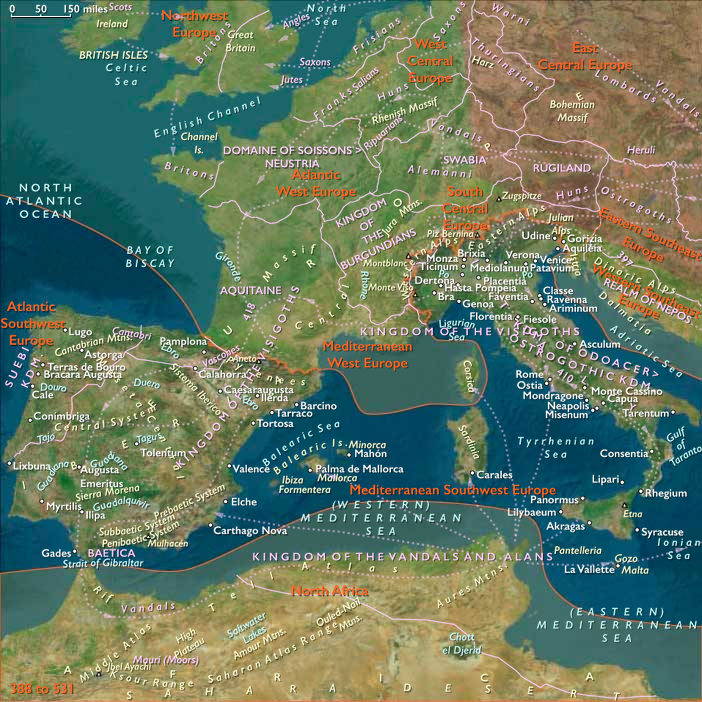
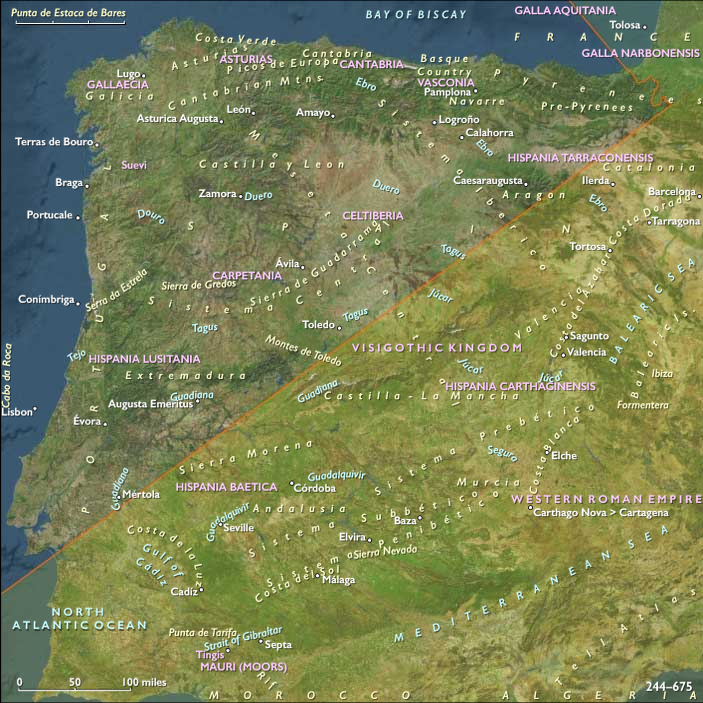
Between 460 and 471 CE, Atlantic Southwest Europe—covering northern and central Portugal, Galicia, Asturias, Cantabria, and northern Spain south of the Franco-Spanish border (43.05548° N, 1.22924° W)—underwent significant political realignment as Visigothic power displaced Suebic dominance. The defeat and weakening of the Suebic kingdom following the decisive intervention of the Visigothic king Theodoric II in 456 CE dramatically altered regional dynamics. Despite political turbulence, local economic resilience, the deepening institutional strength of Christianity, and enduring regional identities allowed Atlantic Southwest Europe to successfully adapt to these substantial shifts.
Political and Military Developments
Visigothic Ascendancy and Suebic Fragmentation
-
The Suebic kingdom entered a rapid decline following King Rechiar’s defeat by the Visigothic king Theodoric II in 456 CE at the Battle of Órbigo, near Astorga. After this decisive battle, the Suebi lost significant territories, retreating primarily to their original base in Gallaecia and northern Portugal, and fragmenting politically into smaller, competing factions.
-
Between 460 and 471 CE, the Visigoths extended their influence significantly into Atlantic Southwest Europe, exerting overlordship over Lusitania and parts of central Hispania, though direct Visigothic administrative control remained limited. Instead, their regional presence was characterized by alliances and client relationships with local elites and Romanized urban centers.
Local Autonomy and Regional Resilience
-
Amid these larger shifts, local elites, influential bishops, and tribal chiefs increasingly assumed direct governance responsibilities. In regions less directly impacted by Visigothic influence—such as Asturias, Cantabria, and Vasconia—autonomous structures persisted with little interference.
-
The Vascones, in particular, continued successfully preserving their independence, internal stability, and diplomatic neutrality, maintaining a distinct regional identity largely unaffected by Visigothic or Suebic conflicts.
Economic and Technological Developments
Continued Economic Stability Amid Political Transition
-
Despite political disruptions, the regional economy displayed resilience and adaptability. Economic activity continued in mining sectors (particularly gold and silver from Galicia and Asturias), agriculture (grain, olives, vineyards), livestock farming, pottery, textiles, and local metalwork.
-
Coastal settlements, notably Olissipo (Lisbon) and Bracara Augusta (Braga), maintained modest trade networks with Mediterranean, Gallic, and North African markets, though commerce continued shifting toward increasingly localized, regional exchanges.
Fortified Villas and Proto-Feudal Economics
-
The economic landscape remained dominated by fortified rural estates, which served as autonomous centers of agricultural production, local governance, and defense. Managed by local elites or ecclesiastical leaders, these estates clearly prefigured medieval feudal arrangements.
-
Urban centers such as Emerita Augusta, Bracara Augusta, and Asturica Augusta persisted as administrative and religious hubs, albeit with diminished populations and less extensive economic influence than in earlier periods.
Cultural and Religious Developments
Deepening Institutional Christianity
-
Around 466 CE, King Remismund unified the fractured Suebic Kingdom, significantly strengthening diplomatic ties with the Visigothic kingdom. A Visigothic cleric named Ajax, sent by Visigothic king Theodoric II, successfully converted the predominantly pagan Suebi to Arian Christianity, establishing lasting Arian ecclesiastical structures. This conversion marked a major religious shift and deepened the region's diplomatic and cultural integration with the Visigoths.
-
Christianity continued its decisive institutional expansion and influence throughout the region. Bishoprics, notably at Braga, Emerita Augusta, and Asturica Augusta, further consolidated their roles as key spiritual, civic, and administrative institutions, mediating between local populations and shifting political authorities.
-
The prominence of monastic communities expanded, providing social services, education, and cultural preservation. This monastic influence increasingly shaped the region's social and cultural character, embedding Christianity deeply into daily life.
Syncretism and Germanic Integration
-
The weakened Suebi, many of whom increasingly embraced Christianity in the latter half of the 5th century, became progressively integrated into broader Romanized Iberian society. This cultural integration, facilitated by religious conversion, reinforced the distinctive regional identity marked by Iberian, Celtic, Roman, and Germanic traditions.
-
Rural and tribal populations continued practicing distinctive local forms of Christianity mixed with older pagan rituals, particularly evident in Galicia, Asturias, and northern Portugal, solidifying the region’s enduring syncretic traditions.
Civic Identity and Local Governance
-
Civic identity continued evolving toward strongly localized affiliations and community-based governance structures. The weakening of centralized authority and the rise of Visigothic power encouraged communities to rely heavily on local leaders, bishops, and tribal alliances, deepening regional identities and administrative autonomy.
Notable Tribal Groups and Settlements
-
Suebi: Significantly weakened by Visigothic intervention, fragmented into smaller political units in Galicia and northern Portugal but maintained some degree of localized influence.
-
Lusitanians, Vettones, Vaccaei: Effectively managed political transitions by maintaining autonomy through strategic alliances with Visigothic rulers or strengthened local governance.
-
Gallaeci, Astures, Cantabri: Continued resilient indigenous traditions and local governance, pragmatically adapting to political shifts and the decline of Suebic power.
-
Vascones: Successfully preserved their autonomy, neutrality, and cultural distinctiveness, unaffected directly by Visigothic expansion or Suebic decline.
Long-Term Significance and Legacy
Between 460 and 471 CE, Atlantic Southwest Europe:
-
Experienced a critical shift from Suebic to Visigothic dominance, marking a significant step toward the broader integration of Iberia into the Visigothic kingdom.
-
Demonstrated robust economic resilience and adaptability, laying foundations for medieval feudal economies rooted in localized agricultural estates.
-
Solidified Christianity’s dominant social and cultural role, creating institutional structures essential to medieval regional identities and governance.
This period significantly advanced the region’s transformation from a fragmented late Roman society to one defined by Germanic political authority, strong local governance, and deeply embedded Christian institutions—core elements of its enduring medieval character.
People
Groups
- Polytheism (“paganism”)
- Vascones
- Lusitanians, or Lusitani
- Vettones
- Cantabri (Celtic tribe)
- Gallaeci
- Vaccaei
- Astures (Celtic tribe)
- Alans (Sarmatian tribal grouping)
- Vandals (East Germanic tribe)
- Hispania Tarraconensis (Roman province)
- Lusitania (Roman province)
- Hispania Baetica (Roman province)
- Gallaecia (Roman province)
- Christianity, Nicene
- Roman Empire: Theodosian dynasty (Constantinople)
- Roman Empire, Western (Ravenna)
- Suebic Kingdom of Galicia
- Visigothic Kingdom of Toulouse
- Tarraconensis (Visigothic province)
Commodoties
- Oils, gums, resins, and waxes
- Grains and produce
- Textiles
- Ceramics
- Strategic metals
- Salt
- Beer, wine, and spirits
- Lumber
Subjects
Regions
Subregions
Related Events
Showing 10 events out of 21 total
Years: 460 - 471
People
Groups
- Polytheism (“paganism”)
- Vascones
- Lusitanians, or Lusitani
- Vettones
- Cantabri (Celtic tribe)
- Gallaeci
- Vaccaei
- Astures (Celtic tribe)
- Alans (Sarmatian tribal grouping)
- Vandals (East Germanic tribe)
- Hispania Tarraconensis (Roman province)
- Lusitania (Roman province)
- Hispania Baetica (Roman province)
- Gallaecia (Roman province)
- Christianity, Nicene
- Roman Empire: Theodosian dynasty (Constantinople)
- Roman Empire, Western (Ravenna)
- Suebic Kingdom of Galicia
- Visigothic Kingdom of Toulouse
- Tarraconensis (Visigothic province)
Commodoties
- Oils, gums, resins, and waxes
- Grains and produce
- Textiles
- Ceramics
- Strategic metals
- Salt
- Beer, wine, and spirits
- Lumber
Subjects
Regions
Subregions