Atlantic Southwest Europe (472–483 CE): Visigothic Influence,…
472 CE to 483 CE
Atlantic Southwest Europe (472–483 CE): Visigothic Influence, Suebic Resurgence, and Strengthening of Local Institutions
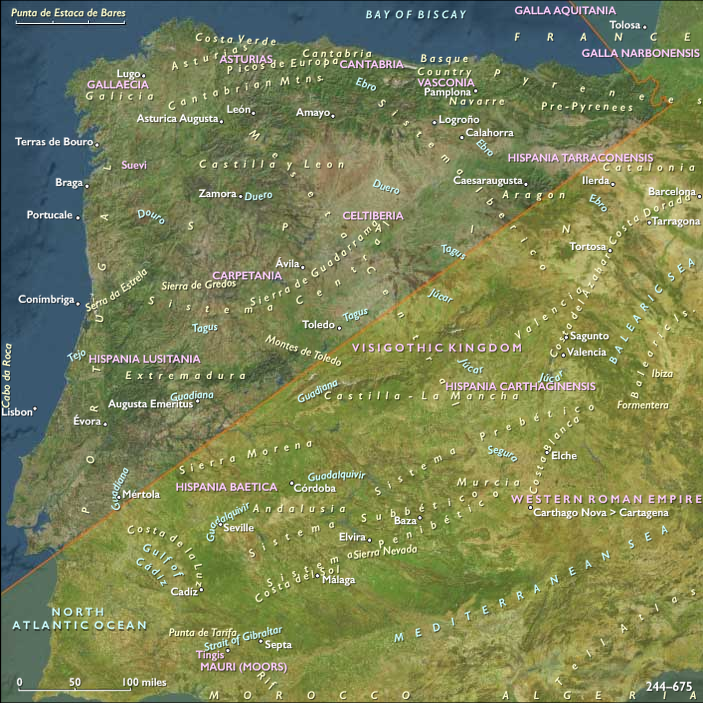
Between 472 and 483 CE, Atlantic Southwest Europe—covering northern and central Portugal, Galicia, Asturias, Cantabria, and northern Spain south of the Franco-Spanish border (43.05548° N, 1.22924° W)—experienced further realignments marked by a partial resurgence of Suebic political strength, tempered Visigothic dominance, and deepening local and ecclesiastical authority. Although broader Hispania saw significant Visigothic consolidation under King Euric, Atlantic Southwest Europe maintained considerable political complexity and autonomy, defined by regional resilience, localized governance structures, and further institutional maturity of Christianity.
Political and Military Developments
Partial Suebic Revival and Visigothic Consolidation
-
After years of political fragmentation, the Suebi regained a measure of cohesion under King Remismund (r. c. 464–469 CE), whose reign briefly revived the kingdom’s unity and political authority in Galicia and northern Portugal. Although more limited than their mid-century peak, the Suebi regained effective regional governance, rebuilding diplomatic and military strength.
-
Concurrently, Visigothic authority under King Euric (r. 466–484 CE) extended decisively into central and southern Hispania. However, direct Visigothic control over Atlantic Southwest Europe remained relatively limited and indirect, typically established through alliances, client relationships, and local elites, rather than overt conquest and direct administration.
Increased Local Autonomy and Governance
-
The weakening of centralized authority further entrenched local governance. Influential families, bishops, tribal chiefs, and civic leaders exerted growing administrative power, managing security, taxation, infrastructure, and community welfare independently. This period marked a further shift toward decentralized political structures, anticipating medieval patterns of local autonomy.
-
Northern territories, especially Asturias, Cantabria, and the Vascones, maintained effective independence, cultural distinctiveness, and internal stability, largely unaffected by external Visigothic or Suebic struggles.
Economic and Technological Developments
Regional Economic Continuity and Local Prosperity
-
The regional economy demonstrated resilience and adaptability, sustaining modest prosperity through localized trade, agricultural productivity (grains, olives, vineyards), livestock farming, and continued mining activities (silver and gold in Galicia and Asturias).
-
Coastal cities such as Olissipo (Lisbon) and Bracara Augusta (Braga) maintained limited but stable commercial exchanges with Mediterranean, Gallic, and North African markets. However, trade increasingly focused on regional and local economies rather than extensive imperial networks.
Consolidation of Villa-Based Economies
-
Rural villa economies continued their dominance as fortified rural estates emerged as core centers of production, defense, and local governance. Managed by powerful elites or ecclesiastical leaders, these villa estates clearly anticipated medieval feudal structures.
-
Urban centers—especially Bracara Augusta, Emerita Augusta, and Asturica Augusta—retained their administrative and ecclesiastical significance, despite declining populations and reduced economic centrality.
Cultural and Religious Developments
Institutional Expansion and Dominance of Christianity
-
Christianity reached new institutional heights, firmly embedded within regional society, governance, and daily life. Prominent bishoprics, notably in Braga, Emerita Augusta, and Asturica Augusta, played decisive civic roles, frequently mediating local disputes, managing social welfare, and maintaining cultural continuity.
-
Monastic communities expanded further, becoming influential centers of education, agriculture, cultural preservation, and local welfare. This monastic influence significantly shaped regional cultural identity, deepening Christianity’s central role in local life.
Syncretism and Regional Cultural Integration
-
Cultural integration continued as the Suebi and other Germanic groups deepened their conversion to Christianity, integrating culturally with local Romanized Iberian, Celtic, and indigenous communities. This process reinforced distinctive regional identities defined by religious and cultural syncretism.
-
Rural populations in Galicia, Asturias, and northern Portugal maintained blended practices, integrating traditional indigenous and pagan rituals with Christian observances, creating enduring local religious identities.
Civic Identity and Local Governance
-
Civic identity became increasingly localized and community-focused, shaped by religious affiliations, tribal traditions, and local political structures rather than broader imperial or distant royal allegiances. Bishops, local elites, and tribal leaders governed communities directly, creating strong regional autonomy and identity.
Notable Tribal Groups and Settlements
-
Suebi: Partially restored their regional cohesion and governance under Remismund, stabilizing their territory in Galicia and northern Portugal.
-
Lusitanians, Vettones, Vaccaei: Adapted pragmatically, retaining autonomy through strategic alliances and robust local governance structures.
-
Gallaeci, Astures, Cantabri: Maintained traditional indigenous identities, cultural resilience, and internal stability, adapting economically and politically to changing external influences.
-
Vascones: Continued successfully preserving territorial autonomy, neutrality, and cultural distinctiveness, largely unaffected by wider regional political shifts.
Long-Term Significance and Legacy
Between 472 and 483 CE, Atlantic Southwest Europe:
-
Experienced a partial revival of the Suebic kingdom alongside growing Visigothic influence, establishing political complexity and regional autonomy that defined subsequent historical developments.
-
Demonstrated robust economic resilience and further consolidation of localized, villa-based economies, laying critical foundations for medieval economic structures.
-
Further entrenched Christianity as the dominant institutional force, significantly influencing regional governance, cultural identities, and social structures into the medieval era.
This period reinforced Atlantic Southwest Europe’s transformation from fragmented Roman provinces into a distinctively medieval region, characterized by resilient local governance, economic adaptability, cultural syncretism, and the maturation of influential ecclesiastical institutions.
People
Groups
Commodities
Subjects
Regions
Southwest Europe
View →Subregions