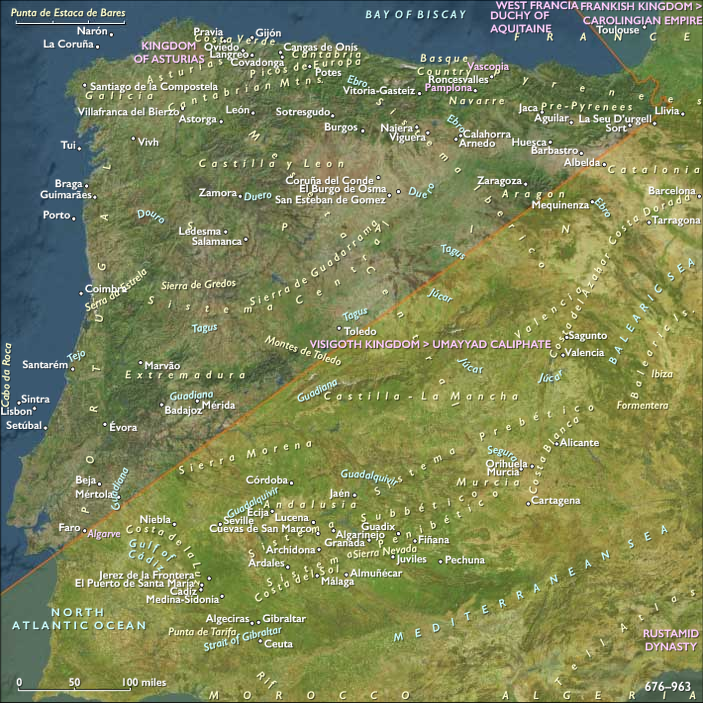
Atlantic Southwest Europe (892–903 CE): Consolidation of…
892 CE to 903 CE
Atlantic Southwest Europe (892–903 CE): Consolidation of Asturian Power, Defensive Strengthening, and Cultural Continuity
Between 892 and 903 CE, Atlantic Southwest Europe—encompassing Galicia, northern and central Portugal, Asturias, Cantabria, and northern Spain south of the Franco-Spanish border (43.05548° N, 1.22924° W)—experienced a period of consolidated political stability, strategic territorial management, and sustained cultural prosperity under King Alfonso III ("the Great," 866–910 CE). The Asturian kingdom maintained effective frontier defenses, reinforced internal governance, and witnessed a continuation of economic resilience. Ecclesiastical authority and the pilgrimage tradition of Santiago de Compostela remained central to regional identity, while the Basques in the Kingdom of Pamplona continued to strengthen their political autonomy and distinctive cultural identity.
Political and Military Developments
Stability and Frontier Consolidation under Alfonso III
King Alfonso III successfully maintained Asturian territorial gains, focusing on fortifying and repopulating settlements along the Duero River frontier. His effective leadership ensured secure defenses against Islamic al-Andalus, minimizing significant incursions. Alfonso’s administration strategically promoted stable settlement policies, enhancing internal cohesion and governance across Galicia, Asturias, Cantabria, and northern Lusitania.
Diplomatic Alliances and Regional Cooperation
Alfonso III maintained productive diplomatic alliances with regional aristocrats, ecclesiastical leaders, and neighboring territories, notably the Kingdom of Pamplona. His careful diplomatic engagement reinforced regional unity, allowing Asturias to function effectively as the central Iberian Christian authority.
Basque Political Autonomy and Strengthening of Pamplona
Under Fortún Garcés (882–905 CE), the Basque kingdom maintained stable independence, skillfully navigating relations with Asturias, al-Andalus, and the Frankish kingdoms. This period solidified Basque political identity, establishing lasting autonomy and further shaping Iberian regional dynamics.
Economic Developments
Continued Regional Economic Stability and Prosperity
Asturian territorial stability and frontier defense supported sustained economic prosperity. Villa-based agriculture (grain, vineyards, olive orchards), livestock husbandry, artisanal industries, and mining—especially gold and silver extraction in Galicia and Asturias—continued flourishing, underpinning regional wealth and economic resilience.
Stable Maritime and Regional Trade Networks
Coastal towns, particularly Bracara Augusta (Braga) and smaller ports along Galicia and northern Portugal, maintained consistent maritime trade. These resilient trading networks continued connecting the region to wider Atlantic and Mediterranean markets, sustaining economic vitality.
Cultural and Religious Developments
Continued Prominence of Santiago de Compostela
Santiago de Compostela maintained its central position as a pilgrimage site, solidifying its religious and cultural importance across Iberia and Europe. The pilgrimage’s continued growth brought substantial economic benefits, fostered broader cultural exchanges, and deeply embedded the Santiago tradition into regional cultural identity.
Robust Ecclesiastical Influence and Civic Leadership
Bishoprics—including Braga, Lugo, Asturica Augusta, and Santiago de Compostela—continued to provide significant social cohesion, moral authority, educational initiatives, and local governance. Ecclesiastical institutions remained pivotal in daily community life, further integrating orthodox Christianity into regional identity and civic governance.
Monastic Cultural Preservation and Scholarly Flourishing
Monastic communities remained vibrant centers of cultural, educational, and economic activity, notably in manuscript preservation, literacy, scholarship, agricultural improvements, and social welfare. These monasteries significantly enriched the region’s cultural heritage and promoted educational continuity.
Persistent Cultural Syncretism
The integration of orthodox Christianity with indigenous Celtic and Iberian traditions continued robustly, particularly in rural Galicia, Asturias, and northern Portugal, reinforcing regional identity and social cohesion.
Civic Identity and Governance
Balanced Royal and Ecclesiastical Centralization
Asturian governance under Alfonso III effectively balanced centralized royal and ecclesiastical authority with local autonomy, maintaining robust internal governance and territorial integrity. Civic identity remained centered around allegiance to Asturian royal authority, ecclesiastical leadership, and the pilgrimage tradition of Santiago de Compostela, consolidating Asturias as the symbolic heartland of Iberian Christian resistance.
Distinctive Basque Political and Cultural Identity
The Basques, under Fortún Garcés, continued asserting distinct territorial independence, civic governance, and cultural autonomy, shaping their distinctive medieval political identity.
Notable Tribal Groups and Settlements
-
Astures and Cantabri: Continued providing political stability and military strength, decisively shaping the Asturian kingdom’s regional identity and defensive strategies.
-
Galicians and Lusitanians: Retained resilient local governance, economic prosperity, and cultural autonomy, pragmatically cooperating with Asturian central authority.
-
Basques: Firmly established politically and culturally, maintained distinct territorial independence and governance under the Kingdom of Pamplona.
Long-Term Significance and Legacy
Between 892 and 903 CE, Atlantic Southwest Europe:
-
Reinforced political stability, territorial security, and economic prosperity under Alfonso III, decisively shaping regional medieval governance and societal structures.
-
Continued strengthening ecclesiastical authority, pilgrimage traditions, and cultural vitality, profoundly influencing regional identity and historical continuity.
-
Further consolidated Basque political autonomy and identity, decisively influencing subsequent regional political dynamics.
This era represented a period of enduring consolidation, significantly shaping Atlantic Southwest Europe's long-term historical trajectory and medieval identity.
Groups
Commodities
Subjects
Regions

Southwest Europe
View →Subregions