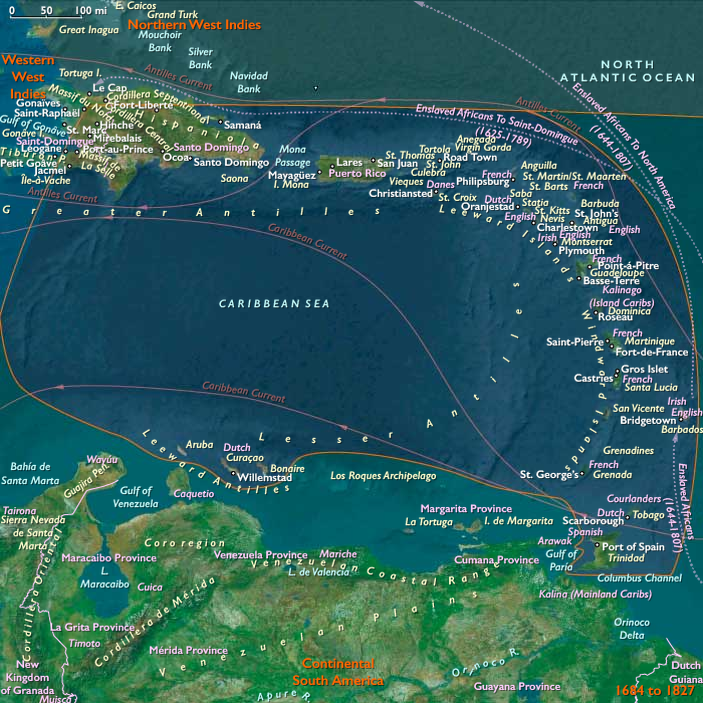
St. Domingue, France's wealthiest producing colony, produces…
1789 CE
St. Domingue, France's wealthiest producing colony, produces two-thirds of all of France's colonial trade by 1789, and more than one third of all of France's foreign trade.
The richest colony in the West Indies it is arguably the richest colony in the history of the world.
The beneficiaries of the wealth, which is created by a particularly brutal plantation system based on the labor of enslaved people imported from Africa, are mainly French planters and gens de couleur of African and French descent.
A small number of middle class Europeans (artisans, merchants, shop keepers) and a lesser number of lower-class Europeans (mechanics, overseers, sailors and soldiers) fill the third and fourth positions of the colony's stratified class system.
At the bottom are the approximately half-million enslaved Africans and African-Americans, outnumbering all others by about ten to one.
The composition of the colony's free populace is roughly thirty-two thousand European colonists, and twenty-four thousand affranchis (free mulattoes or blacks).
The society is deeply fragmented by skin color, class, and gender.
The European population comprises grands blancs (elite merchants and landowners, often of royal lineage), petits blancs (overseers, craftsmen, and artisans), and blancs menants (laborers and peasants).
The affranchis, who are primarily mulattoes, are sometimes slave owners themselves.
While the affranchis aspire to the economic and social levels of the Europeans, and fear and spurn the slave majority, whites generally discriminate against them.
The enslaved population, most of which is bosal (African-born), is an admixture of West African ethnic groups.
The great majority are field workers; more specialized groups include household servants, boilermen (at the sugar mills), and slave drivers.
Saint-Domingue's enslaved people, like those throughout the Caribbean, endure protracted, labor-intensive workdays and often die from injuries, infections, and tropical diseases.
Malnutrition and starvation also are common; plantation owners fail to plan adequately for food shortages, drought, and natural disasters, and slaves are permitted scarce time to tend their own crops.
Some slaves contrive to escape into the mountainous interior, where they become known as Maroons and fight guerrilla battles against colonial militia.
Great numbers of slaves, Maroons, and affranchis find solace in voudou, a syncretic religion incorporating West African belief systems.
Others have become fervent Roman Catholics, and many gave begun to practice both religions.
When news of the July 14 storming of the royal prison known as the Bastille reaches Saint Domingue, conflict breaks out between the petit blancs and the land-and-slave-owning grand blancs.
The former ally with the Revolution, the latter with the French monarchy.
In the political context of the unfolding French Revolution, les gens de couleur, the mulatto people of Saint Domingue, petition for full rights in the colony.
Locations
Groups
Topics
Commodities
Subjects
Regions
West Indies
View →Subregions