
Russia's population, resources, international diplomacy, and military…
1816 CE to 1827 CE
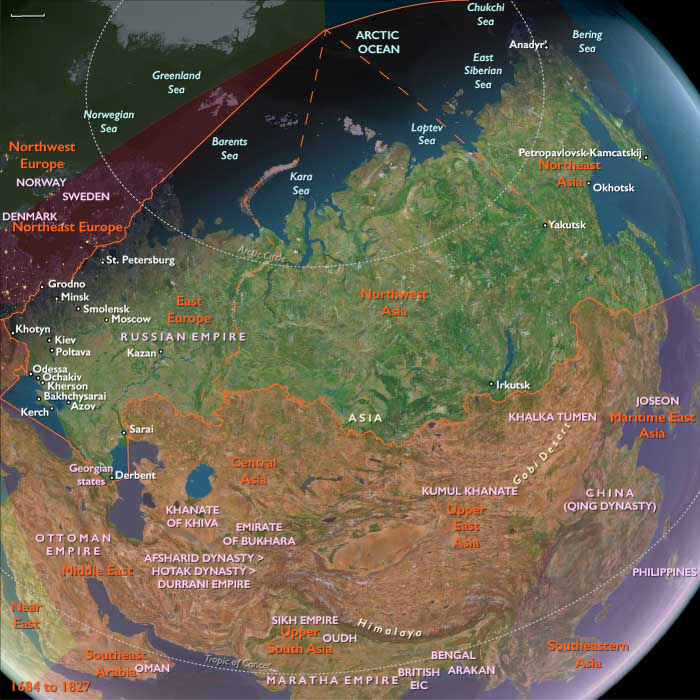
Russia's population, resources, international diplomacy, and military forces during the early nineteenth century make it one of the most powerful states in the world.
Its power enables it to play an increasingly assertive role in Europe's affairs.
This role draws the empire into a series of wars against Napoleon, which have far-reaching consequences for Russia and the rest of Europe.
After a period of enlightenment, Russia becomes an active opponent of liberalizing trends in Central and Western Europe.
Internally, Russia's population has grown more diverse with each territorial acquisition.
The population includes Lutheran Finns, Baltic Germans, Estonians, and some Latvians; Roman Catholic Lithuanians, Poles, and some Latvians; Orthodox and Uniate Belorussians and Ukrainians; Muslim peoples along the empire's southern border; Orthodox Greeks and Georgians; and members of the Armenian Apostolic Church.
As Western influence and opposition to Russian autocracy mounts, the regime reacts by creating a secret police and increasing censorship in order to curtail the activities of persons advocating change.
The regime remains committed to its serf-based economy as the means of supporting the upper classes, the government, and the military forces, but Russia's backwardness and inherent weakness will be revealed in the middle of the century, when several powers force the surrender of a Russian fortress in Crimea.
People
Groups
Topics
Commodities
Subjects
Regions
Northeastern Eurasia
View →Subregions
