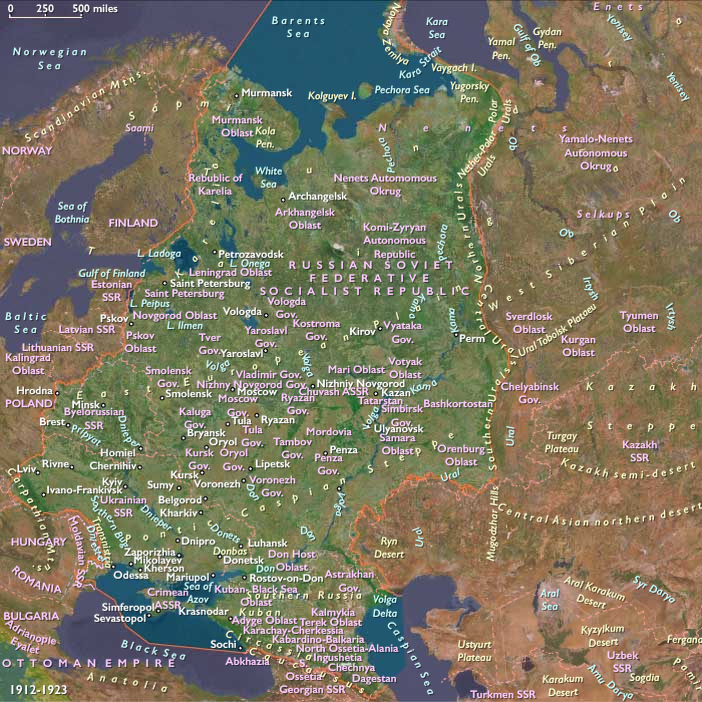
East Europe (1912–1923 CE): Wars, Revolutions, and…
1912 CE to 1923 CE
East Europe (1912–1923 CE): Wars, Revolutions, and the Collapse of Empires
Political and Military Developments
Balkan Wars (1912–1913)
Eastern Europe faced intense geopolitical turmoil starting with the Balkan Wars, significantly reshaping the regional power dynamics. Russia's involvement as protector of Slavic nations amplified tensions, further straining relations with Austria-Hungary.
World War I (1914–1918)
Russia’s entry into World War I intensified internal and external challenges. Initial military setbacks, resource shortages, and internal dissent weakened the state, eventually contributing to the collapse of the monarchy and leading to profound political shifts.
Russian Revolution (1917)
The devastating impacts of the war culminated in the Russian Revolution of 1917, comprising the February Revolution that overthrew Tsar Nicholas II and the Bolshevik-led October Revolution, resulting in the establishment of Soviet rule under Vladimir Lenin.
Economic and Technological Developments
War-Time Industrial Mobilization
Economic policies during World War I shifted dramatically towards war-time production, stretching industrial capabilities to their limits. Despite significant strain, war-time demands accelerated technological innovation and industrial expansion in certain sectors.
Economic Dislocation and Reconstruction Efforts
Post-war economic dislocation severely impacted infrastructure and production. Early Soviet policies, including War Communism and later New Economic Policy (NEP) initiated in 1921, aimed at economic recovery, balancing centralized control with limited market freedoms.
Cultural and Artistic Developments
Revolutionary Culture and Modernism
Cultural life during this turbulent period witnessed revolutionary fervor and significant artistic innovation. Avant-garde movements flourished, with figures like Kazimir Malevich and Vladimir Mayakovsky pioneering new artistic directions that aligned with revolutionary ideals.
Educational and Intellectual Restructuring
Under the Soviet regime, significant efforts were directed towards restructuring education along socialist lines. Educational access expanded rapidly, emphasizing scientific and technical education to support industrial modernization and ideological alignment.
Settlement Patterns and Urban Development
Wartime Urban Strain and Reconstruction
World War I placed severe strain on urban infrastructure, exacerbated by revolutionary upheaval. Major cities like Moscow, Saint Petersburg (renamed Petrograd, later Leningrad), and Kyiv faced immense challenges, prompting post-war reconstruction and socialist-driven urban planning.
Strategic Military and Border Fortifications
Military conflicts intensified the focus on strategic fortifications and defense infrastructure, particularly along the shifting frontiers. These developments were critical for national security amidst ongoing international threats and internal upheaval.
Social and Religious Developments
Social Upheaval and Revolutionary Change
Social dynamics underwent profound transformation, marked by the abolition of the monarchy, the establishment of Soviet power, and radical changes in social class structures. The revolution's egalitarian rhetoric profoundly reshaped societal norms and aspirations.
Church-State Conflict and Secularization
Under Bolshevik rule, the Russian Orthodox Church faced intense persecution and secularization policies. Church property was nationalized, religious practices curtailed, and secular, atheistic ideologies promoted aggressively as the state sought to eliminate religious influence from public life.
Long-Term Consequences and Historical Significance
The period from 1912 to 1923 CE was transformative for Eastern Europe, defined by extensive geopolitical realignments, devastating warfare, revolutionary upheaval, and the dramatic collapse of empires. These changes established new political ideologies and structures, setting the stage for the 20th-century geopolitical landscape and shaping the region's historical trajectory profoundly.
People
Groups
Topics
Commodities
Subjects
Regions
Northeastern Eurasia
View →Subregions