
The Visigoths’ Settlement in Aquitania Following the…
418 CE
The Visigoths’ Settlement in Aquitania
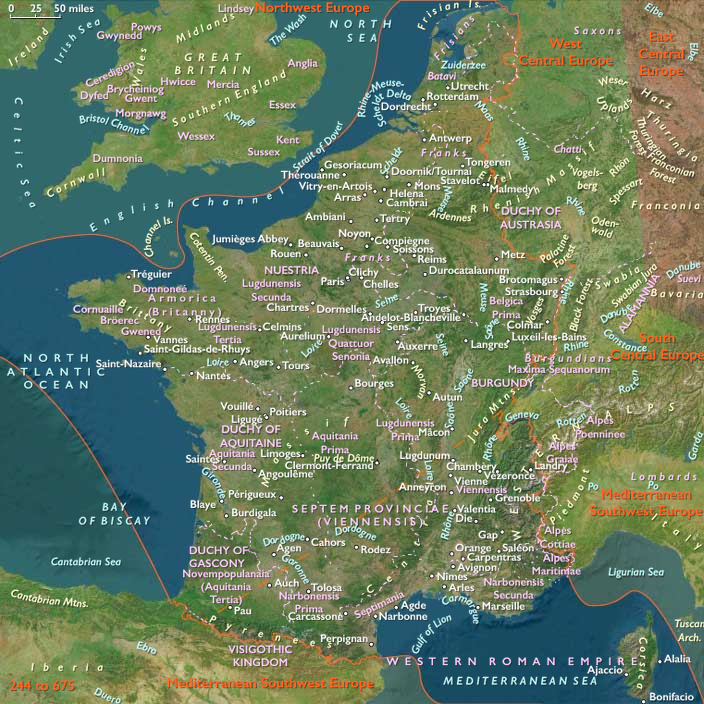
Following the Germanic invasions and internal civil wars, Emperor Honorius rewards his Visigothic federates by granting them land in Aquitania Secunda, a province stretching between the lower Garonne and Loire rivers. This settlement, likely arranged under the hospitalitas system—the Roman practice of billeting soldiers on civilian landowners—provides the Visigoths with a permanent foothold in Gaul.
Centered near Poitou, this territory allows the Visigoths to recover from their long migrations and conflicts, while also serving as a buffer against further barbarian incursions into Roman lands.
The Visigoths as Roman Allies
By 418 CE, Constantius, the powerful Roman general and future co-emperor, formally acknowledges the Visigoths as allies (foederati). In return, they are encouraged to campaign against other barbarian groups—the Vandals, Alans, and Suebi—who had overrun the Iberian Peninsula.
The Birth of the Visigothic Kingdom
While technically still under Roman authority, the Visigothic realm in Gaul operates as a self-governing entity, with its own leadership and internal administration. Though required to provide troops for the empire, the Visigoths effectively establish what will become the Visigothic Kingdom, a political structure that will soon expand beyond Aquitania and play a crucial role in the post-Roman transformation of Western Europe.
Locations
Groups
Topics
Commodities
Subjects
Regions
West Europe
View →Subregions
