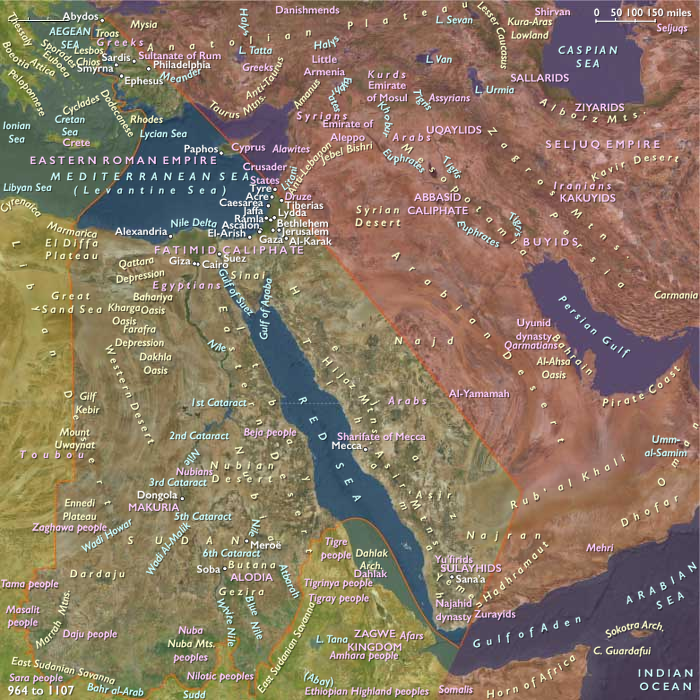
Genoese crossbowmen led by Guglielmo Embriaco act…
July 1099 CE
Genoese crossbowmen led by Guglielmo Embriaco act as support units against Jerusalem’s defenders.
Siege towers are brought up to the walls on July 13-14, and on July 15, Godfrey's men take a sector of the walls, and others follow on scaling ladders.
When the nearest gate is opened, Tancred and Raymond enter, and the Muslim governor surrenders to the latter in the Tower of David.
The governor along with his bodyguard is escorted out of the city.
Tancred offers quarter to those who had taken refuge on the al-Aqsa roof, doubtless hoping to ransom them, but in the morning, and much to his anger, they too are massacred.
All Muslims, men, women, and children, as well as Jews, perish in the general slaughter that follows.
Godfrey, after driving all the Jews into the synagogue, sets it afire while he marches around the synagogue singing, “Christ, we adore thee”.
Muslim losses are unknown; an estimated twenty thousand to thirty thousand Jews are massacred or captured and sold as slaves in Italy.
As to the city's Muslim population, the eyewitness testimony of Raymond D'Aguilers recounts, “Some of our men cut off the heads of our enemies; others shot them with arrows; others tortured them longer by casting them into the flames. Piles of heads, hands and feet were to be seen in the streets; men rode in blood up to their knees and bridle reins; it was a just and splendid judgment of God that this place should be filled with the blood of the unbelievers.”
The eyewitness accounts from the crusaders themselves leave little doubt that there was great slaughter in the aftermath of the siege.
Some historians propose nevertheless that the scale of the massacre has been exaggerated in later medieval sources, partly as a result of influence from Muslim sources, and partly as a result of the misinterpretation of the Crusaders' resort to apocalyptic language to describe the scenes.
Some scholars believe that these later medieval sources were not meant to be taken seriously and that is the fault of modern people because they cannot tell the difference.
Contemporary Muslim reactions to the massacre are muted when compared to later polemics on the subject.
People
Groups
Commodities
Subjects
Regions
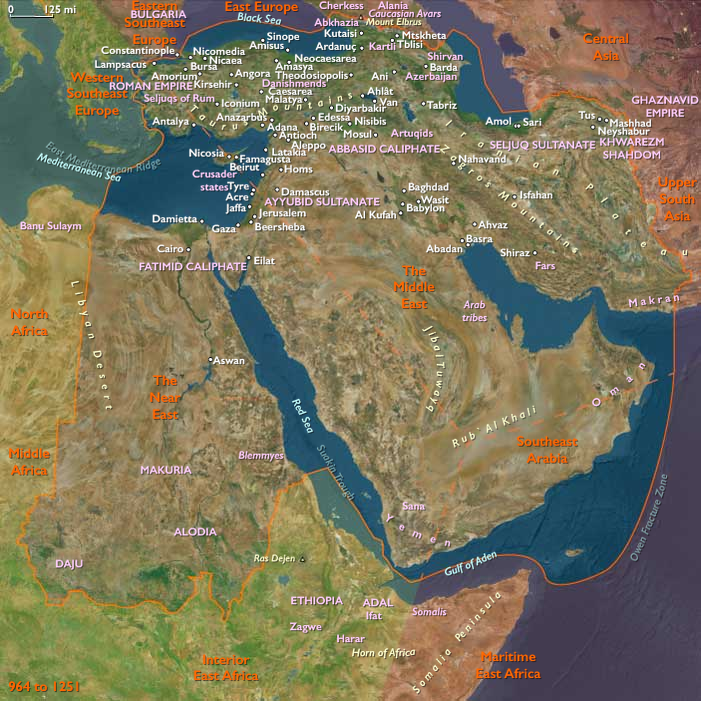
The Near and Middle East
View →Subregions