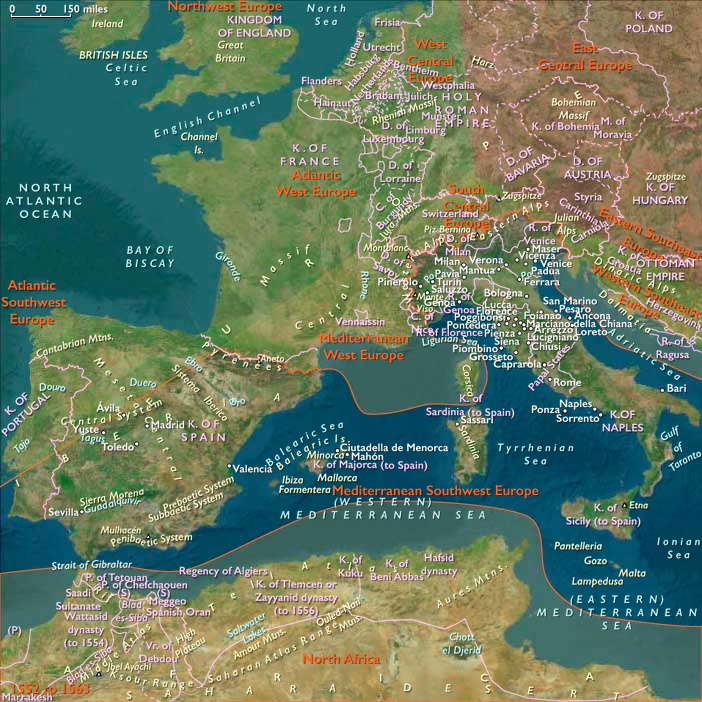
Habsburg Spain has been established as the…
April 1559 CE
Habsburg Spain has been established as the premier power of Europe, to the detriment of France, by the end of the Italian Wars in 1559; the states of Italy, which had wielded power disproportionate to their size during the Middle Ages and the Renaissance, are reduced to second-rate powers or destroyed entirely.
The wars have seen the introduction of many significant advances in military technology and tactics, including field artillery, muskets, and combined arms tactics.
Infantry has undergone profound developments during the Italian Wars, evolving from a primarily pike- and halberd-wielding force to a more flexible arrangement of arquebusiers, pikemen, and other troops.
While the early part of the Wars had continued to see landsknechts and Swiss mercenaries dominate, the Italian War of 1521 had demonstrated the power of massed firearms, leading to their increasingly widespread adoption as the basis of all infantry formations.
Heavy cavalry—the final evolution of the fully armored medieval knight—had remained major players on the battlefields of the Italian Wars.
Here, the French gendarmes were generally successful against other nations' mounted troops, owing significantly to their excellent horses.
The Italian Wars have seen artillery—particularly field artillery—become an indispensable part of any first-rate army.
Charles VIII, during his invasion of Italy, had brought with him the first truly mobile siege train: culverins and bombards mounted on wheeled carriages, which could be deployed against an enemy stronghold immediately after arrival.
Much of the fighting during the Italian Wars has taken place during sieges.
Successive invasions had forced Italy to adopt increasing levels of fortification, using such new developments as detached bastions, that could withstand sustained artillery fire.
France in the Peace of Cateau-Cambrésis also manages to retain five fortresses in Savoy, including Turin, ...
Locations
Groups
Topics
Commodities
Subjects
Regions
Southwest Europe
View →Subregions