Event
South Asia (6,093–4,366 BCE): Monsoon Rivers, Emerging…
South Asia (6,093–4,366 BCE): Monsoon Rivers, Emerging Northwest Farming, and Southern Forager Worlds
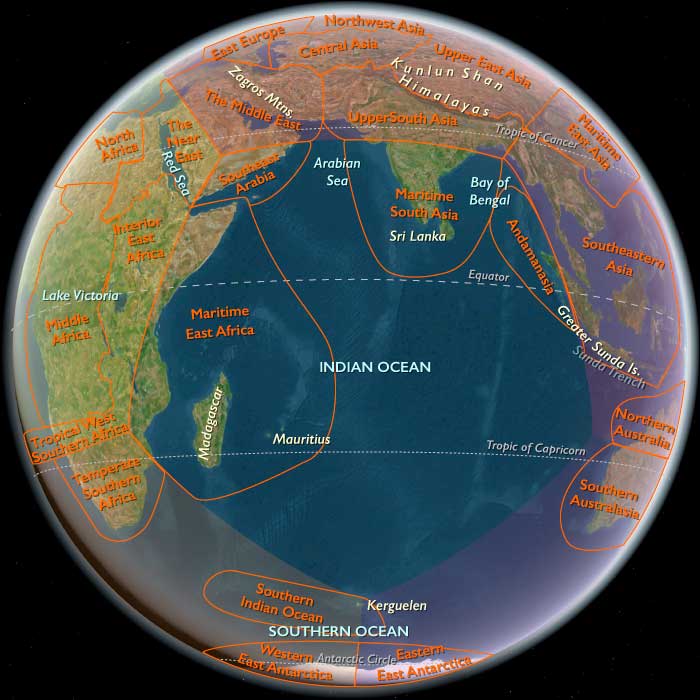
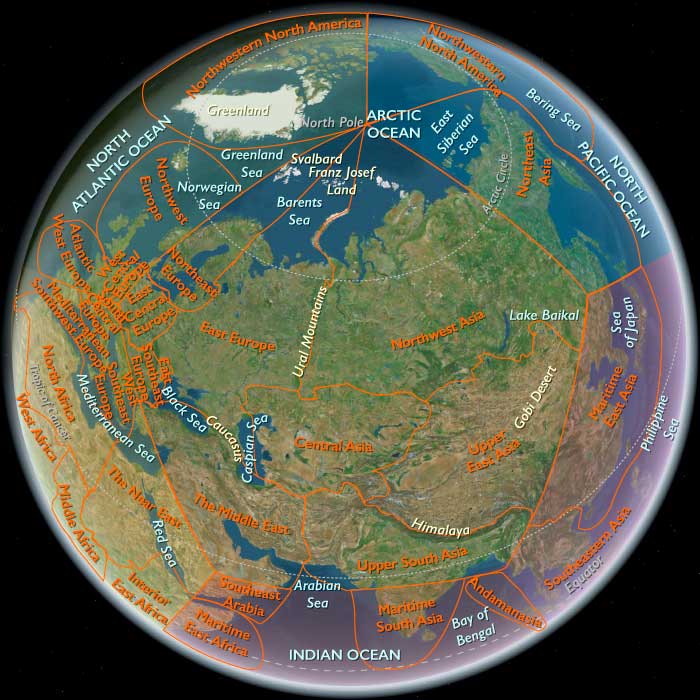
South Asia during the Middle Holocene encompassed two contrasting regions: Upper South Asia, extending across Afghanistan, Pakistan, northern India, Nepal, Bhutan, and Bangladesh; and Maritime South Asia, comprising the Deccan and peninsular south, Sri Lanka, and the central Indian Ocean island groups.
Across this immense area, monsoon systems, river basins, tropical and subtropical forests, dry plateaus, mountain margins, coastal wetlands, and changing shorelines supported highly varied human lifeways. Farming became securely established in only a limited part of the northwest during the later portion of the epoch, while most of the region remained dominated by hunting, gathering, fishing, and intensive use of wild plants.
The climate was generally warmer and in many areas wetter than during later arid phases, but there was no single stable monsoon regime. Rainfall strength and seasonality varied between the Indus basin, Ganges plains, Himalayan foothills, Deccan interior, western coast, eastern coast, and Sri Lanka.
Rivers responded continually to these shifts. The Indus and its tributaries changed channels across broad alluvial plains, while the Ganges and Brahmaputra systems developed through extensive wetlands, flood basins, levees, and shifting river courses. Coastal deltas and estuaries were still adjusting to postglacial sea-level change.
In northwestern South Asia, the Kachi Plain and neighboring Baluchistan formed the clearest zone of emerging agriculture. At Mehrgarh, the earliest securely redated aceramic farming occupation began only around the end of the sixth or beginning of the fifth millennium BCE.
These communities already practiced a developed farming economy when they appeared. Wheat and barley were cultivated, sheep and goats were kept, and cattle—including local zebu—became increasingly important.
Mehrgarh therefore represents a genuine farming community within this epoch, but only during its later centuries. It should not be projected backward across the entire period or used to characterize all of the Indus basin.
The earliest Mehrgarh occupation remained aceramic. Pottery became established only toward the middle of the fifth millennium BCE, near the closing portion of this epoch.
Settlement included mudbrick architecture, storage, grinding equipment, stone tools, ornaments, and burials. Yet farming remained concentrated in favorable piedmont and valley environments rather than spread continuously across northwestern South Asia.
Beyond this zone, much of the Indus plain remained much more lightly occupied. River margins, seasonal wetlands, grasslands, scrub, and upland foothills supported hunting, gathering, fishing, and plant collecting alongside limited contacts with farming communities.
Afghan and Baluchistan mountain corridors connected South Asia with the Iranian plateau and Central Asia. Stone, shells, ornaments, livestock, and cultivated plants could move through these networks, but no single long-distance trade system united the region.
The Ganges basin followed a different trajectory. Lakes, marshes, river channels, wooded plains, grasslands, and seasonal wetlands supported communities exploiting fish, turtles, game, fruits, nuts, seeds, roots, and aquatic plants.
Lahuradewa preserves evidence for early rice exploitation during this broad period. Whether the earliest rice was fully cultivated or represented intensive management and harvesting of wild stands remains debated.
This distinction is important. Middle-Holocene Ganges communities may have been experimenting with rice-rich wetland environments without yet practicing the fully developed rice agriculture known from later periods.
Other cultivated plants cannot be generalized across the basin at this stage. Permanent farming villages, wet-rice fields, irrigation systems, and dense agricultural settlement belong largely to later developments.
The Himalayan foothills and uplands formed another diverse zone. Communities used river valleys, forest edges, caves, alpine margins, and foothill environments for hunting, gathering, fishing, and seasonal movement.
Nepal, Bhutan, and adjoining highland regions should not be reconstructed as established farming landscapes during this epoch. Archaeological evidence remains sparse and strongly regional.
Bangladesh and the lower Ganges–Brahmaputra region contained extensive floodplains, wetlands, river channels, forests, and coastal environments. These dynamic landscapes supported aquatic and forest resources but leave limited evidence for settled agriculture this early.
Maritime South Asia remained overwhelmingly a forager world.
Across the Deccan Plateau, human communities occupied river valleys, rock shelters, granite uplands, grasslands, woodland, and seasonal water sources. Microlithic technologies remained widespread, supporting hunting, plant collecting, and flexible movement.
Ground stone and grinding equipment demonstrate intensive plant processing but do not indicate cultivation by themselves. Wild grasses, seeds, roots, fruits, nuts, and tubers could be gathered and processed in substantial quantities.
The cattle pastoralism, millet agriculture, villages, and ashmound traditions characteristic of the later South Indian Neolithic had not yet appeared. These developments begin only around the third millennium BCE.
The Deccan should therefore not be reconstructed as a proto-pastoral or proto-horticultural landscape. No cattle pens, cultivated millet fields, permanent villages, or giant dung-burning sites belong in this epoch.
Along the western coast and Western Ghats, heavy monsoon rainfall supported evergreen and semi-evergreen forest, rivers, estuaries, lagoons, rocky shores, and mangrove environments.
Coastal communities exploited fish, shellfish, crustaceans, wild plants, forest animals, and riverine resources. Movement between coast and uplands was possible through river valleys and mountain passes, but there is no evidence for a dense organized exchange network.
The eastern peninsular coast likewise contained lagoons, estuaries, river mouths, sandy barriers, mangroves, and dry tropical woodland. Fishing, shellfish gathering, hunting, and plant use formed locally important economies.
No widespread pottery horizon defines Maritime South Asia during this epoch. Ceramic traditions associated with settled Neolithic communities in southern India belong much later.
Sri Lanka possessed one of the region’s deepest continuous forager traditions. Rainforest and cave sites such as Fa-Hien Lena and other rockshelters preserve long histories of hunting, plant use, bone technology, and microlithic tools extending far earlier than the Middle Holocene.
During this epoch, Sri Lankan communities continued to exploit rainforest, dry woodland, rivers, wetlands, coastlines, and uplands. Wild mammals, fish, shellfish, fruits, nuts, tubers, and other plant resources supported flexible regional economies.
Sri Lanka should not yet be reconstructed with cereal fields, horticultural villages, tanks, irrigation systems, or orchard agriculture.
Lakshadweep remained entirely human-free. Its coral islands, reefs, lagoons, beaches, seabird colonies, and sparse terrestrial vegetation evolved without settlement, gardening, or introduced animals.
The Maldives likewise remained human-free during this period. Reef platforms, lagoons, sand cays, groundwater lenses, vegetation, turtles, seabirds, and marine ecosystems developed solely through natural processes.
The Chagos Archipelago was also entirely uninhabited. Its low coral islands and reef systems were shaped by currents, storms, sea-level change, carbonate sedimentation, and biological colonization.
There was therefore no Middle-Holocene maritime network linking southern India, Sri Lanka, the Maldives, Lakshadweep, and Chagos. Coastal and short-range water transport undoubtedly existed where useful, but long-distance island voyaging should not be assumed.
Material culture across South Asia remained strongly regional. Chipped stone, microliths, ground stone, grinding equipment, bone, wood, shell, basketry, cordage, hides, and other organic materials formed the technological base.
Pottery appeared in the northwest only toward the later portion of the epoch and remained absent from many other regions. Its presence cannot serve as a general marker of South Asian cultural development.
Shell ornaments, stone beads, pigments, and other small objects moved beyond their immediate sources in some regions, but craft specialization remained limited and locally variable.
Burial practices differed widely and should not be interpreted through a generalized ancestor cult. Some communities buried their dead near habitation areas or within cemeteries, while others leave little surviving mortuary evidence.
There is likewise no secure basis for Middle-Holocene shrines at tanks, river confluences, or irrigation systems. The hydraulic and ritual landscapes of later South Asian history belong to very different periods.
Human environmental modification was real but generally localized. Repeated burning, hunting, gathering, plant processing, shell accumulation, occupation of rockshelters, and limited cultivation in the northwest altered particular places without producing continent-wide managed landscapes.
Legacy of the Age
By 4,366 BCE, South Asia remained a region of sharply contrasting economic systems. In the northwest, farming had only recently become securely established at Mehrgarh, where wheat, barley, sheep, goats, and cattle formed part of a developed but geographically restricted agricultural economy. In parts of the Ganges basin, communities were exploiting and perhaps cultivating rice-rich wetland environments, although the transition from managed wild rice to domesticated agriculture remained incomplete and debated. Across the Deccan and peninsular south, microlithic hunter-gatherer societies continued to dominate, with the cattle pastoralism and millet farming of the South Indian Neolithic still thousands of years away. Sri Lanka remained a deeply rooted forager world, while Lakshadweep, the Maldives, and Chagos remained entirely human-free. The defining development of the age was therefore not a continent-wide Neolithic transition, but the emergence of a late northwest farming frontier alongside persistent riverine, forest, plateau, coastal, and island forager worlds.
-
{# Image navigates to the detail page; the magnifying-glass chip is the only Fancybox lightbox trigger (kept a separate sibling — anchors can't nest). #}
 The Indian Ocean Lands
World
The Indian Ocean Lands
World
-
{# Image navigates to the detail page; the magnifying-glass chip is the only Fancybox lightbox trigger (kept a separate sibling — anchors can't nest). #}
 The Great Crossroads
World
The Great Crossroads
World
-
{# Image navigates to the detail page; the magnifying-glass chip is the only Fancybox lightbox trigger (kept a separate sibling — anchors can't nest). #}
 South Asia
Region
South Asia
Region
-
{# Image navigates to the detail page; the magnifying-glass chip is the only Fancybox lightbox trigger (kept a separate sibling — anchors can't nest). #}
 Upper South Asia
Subregion
Upper South Asia
Subregion
-
{# Image navigates to the detail page; the magnifying-glass chip is the only Fancybox lightbox trigger (kept a separate sibling — anchors can't nest). #}
 Maritime South Asia
Subregion
Maritime South Asia
Subregion