One Peter Bartholomew, an otherwise poor and…
June 1098 CE
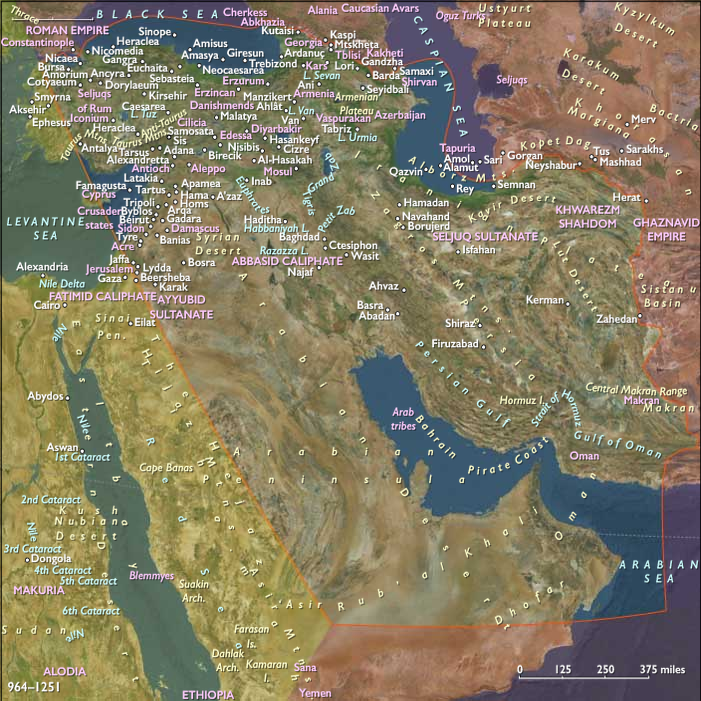
One Peter Bartholomew, an otherwise poor and insignificant monk of Provençal, comes forward in Antioch on June 10 claiming to have had visions of St. Andrew, who has told him that inside the city is the Holy Lance that, according to the Gospels, had pierced the side of Christ when he hung on the cross.
The starving crusaders are prone to visions and hallucinations, and another monk named Stephen of Valence reports visions of Christ and the Virgin Mary.
On June 14, a meteor is seen landing in the enemy camp, interpreted as a good omen.
Although Adhemar is suspicious, as he had seen a relic of the Holy Lance in Constantinople, Raymond believes Peter.
Raymond, Raymond of Aguilers, William, Bishop of Orange, and others begin to dig in the cathedral of Saint Peter on June 15, and when they come up empty, Peter goes into the pit, reaches down, and produces a spear point.
Raymond takes this as a divine sign that they will survive and thus prepares for a final fight rather than surrender.
Peter now reports another vision, in which St. Andrew had instructed the crusader army to fast for five days (although they are already starving), after which they will be victorious.
Bohemond is skeptical of the Holy Lance as well, but there is no question that its discovery has increased the morale of the crusaders.
It is also possible that Peter was reporting what Bohemund wanted (rather than what St. Andrew wanted) as Bohemond knows, from spies in Kerbogha's camp, that the various factions frequently argue with each other.
Kerbogha of Mosul is indeed suspected by most emirs to yearn for sovereignty in Syria and often considered as a bigger threat to their interests than the Christian invaders.
On June 27, Peter the Hermit is sent by Bohemond to negotiate with Kerbogha, but this proves futile and battle with the Turks is thus unavoidable.
Bohemond draws up six divisions: he commands one himself, and the other five are led by Hugh of Vermandois and Robert of Flanders, Godfrey, Robert of Normandy, Adhemar, and Tancred and Gaston IV of Béarn.
Raymond, who has fallen ill, remains inside to guard the citadel with two hundred men, now held by Ahmed Ibn Merwan, an agent of Kerbogha.
The crusaders emerge from the city gate on Monday, June 28, with Raymond of Aguilers carrying the Holy Lance before them.
Kerbogha hesitates against his generals' pleadings, hoping to attack them all at once rather than one division at a time, but he underestimates their size.
He pretends to retreat to draw the crusaders to rougher terrain, while his archers continuously pelt the advancing crusaders with arrows.
A detachment is dispatched to the crusader left wing, which is not protected by the river, but Bohemond quickly forms a seventh division and beats them back.
The Turks are inflicting many casualties, including Adhemar's standard-bearer, and Kerbogha sets fire to the grass between his position and the crusaders, but this does not deter them: they have visions of three saints riding along with them, led by St. George, St. Demetrius, and St. Maurice.
The battle is short.
Before the crusaders reach Kerbogha's line, Duqaq and many other emirs have already betrayed Kerbogha and are taking their armies back to their own lands, this desertion considerably reducing the numerical advantage the mighty army had over its Christian opponents.
Soon the remaining Muslim troops have to retreat.
As Kerbogha flees, the citadel under command of Ahmed ibn Merwan finally surrenders, but only to Bohemond personally, rather than to Raymond; this seems to have been arranged beforehand without Raymond's knowledge.
As expected, Bohemond claims the city as his own, although Adhemar and Raymond disagree.
Locations
People
Groups
Commodities
Subjects
Regions
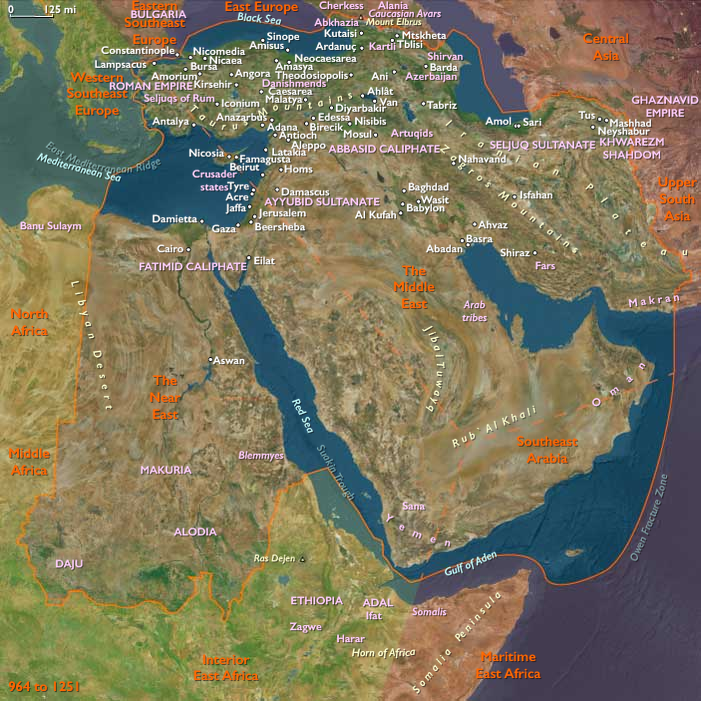
The Near and Middle East
View →Subregions