
Mediterranean Southwest Europe (1252 – 1395 CE):…
1252 CE to 1395 CE
Mediterranean Southwest Europe (1252 – 1395 CE): Aragonese Thalassocracy, Venetian Hegemony, and Castilian–Portuguese Consolidation
Geographic and Environmental Context
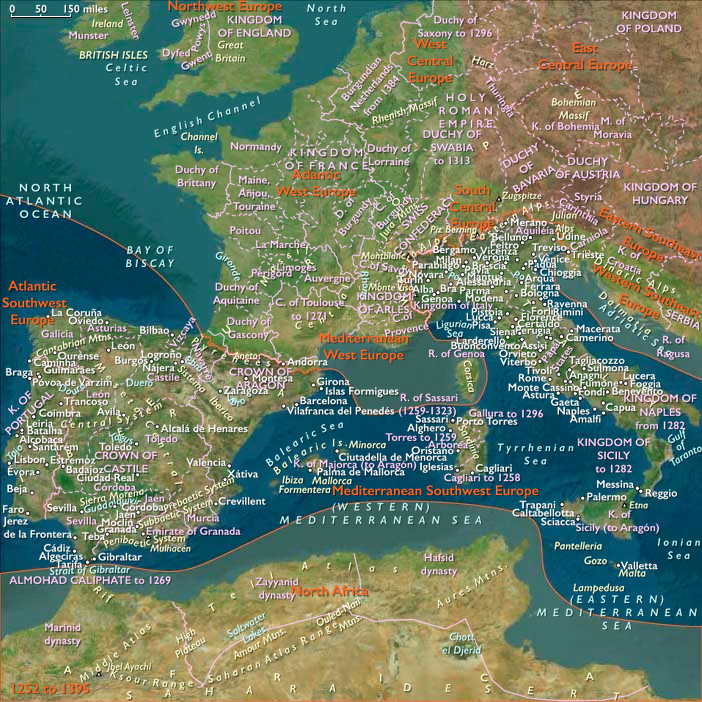
Mediterranean Southwest Europe includes Portugal’s Algarve and Alentejo, Spain’s Extremadura, Andalusia, Murcia, Valencia, Castile/La Mancha, southeastern Castile and León, Madrid, southeastern Rioja, southeastern Navarra, Aragon, Catalonia, the Balearic Islands, Andorra, and all of Italy (peninsula, Sicily, Sardinia, Venice), plus Malta.
-
Anchors: the Guadalquivir Valley (Seville–Granada frontier), the Tagus–Alentejo/Algarve under Portugal, Madrid–La Mancha–Extremadura consolidated in Castile, the Valencia/Murcia huertas, the Ebro–Barcelona–Aragon–Andorra corridor, the Balearics under Aragon, Venice as Adriatic hegemon, Genoa and Florence as rivals in Liguria and Tuscany, the Kingdom of Naples/Angevin South, Sicily in Aragonese orbit, Sardinia, and Malta as naval outposts.
Climate and Environmental Shifts
-
Little Ice Age onset (~1300) brought cooler, wetter variability; irrigation kept Valencia, Murcia, Andalusia, Sicily productive.
-
Black Death (1348–1352) devastated Barcelona, Valencia, Genoa, Venice, Naples, with partial demographic recovery by the 1390s.
Societies and Political Developments
-
Crown of Aragon: James I’s conquests of Valencia (1238) and Balearics (1229–35) were integrated; Sardinia conquered (from 1320s); Sicily entered Aragonese orbit after the Sicilian Vespers (1282); Catalonia projected power across the western Med.
-
Castile consolidated Andalusia; Granada survived as the last Nasrid emirate; Madrid matured under Castilian administration; La Mancha became a grain–sheep heartland.
-
Portugal stabilized Alentejo/Algarve and built Atlantic–Med linkages.
-
Italy: Venice dominated Adriatic–Aegean routes; Genoa contested Tyrrhenian and western lanes; the Angevin Kingdom of Naples and Aragonese Sicily rivaled in the south; Sardinia held by Aragon; Malta under Sicilian–Aragonese control.
-
Andorra remained a Pyrenean co-principality (Counts of Foix/Bishop of Urgell).
Economy and Trade
-
Venetian hegemony in the Adriatic–Aegean; Genoese finance and Ligurian shipping; Barcelona–Valencia–Majorca fleets knit the western basin.
-
Exports: grain (Sicily/Apulia), olive oil/wine (Iberia/Italy), sugar/citrus (Sicily/Valencia), salt (Ibiza, Trapani);
-
Imports: spices/silks via Levant; wool from La Mancha and Aragon fed Italian and Catalan looms.
-
Banking: Venetian and Genoese firms, Catalan–Majorcan cartography and credit.
Subsistence and Technology
-
Canal estates and huertas in Valencia/Murcia/Andalusia; Venetian Arsenal mass-produced galleys; Rialto and Piazza San Marco symbolized mercantile power.
Movement and Interaction Corridors
-
Strait of Gibraltar linked Atlantic–Med flows; Messina straits managed Sicily transit; Po–Venetian lagoon fed Adriatic convoys; Ebro–Pyrenees, Tajo–Guadiana corridors fed Iberian ports.
Belief and Symbolism
-
Avignon Papacy (outside region yet influential) shaped Provençal–Italian–Aragonese politics;
-
Mendicant orders (Franciscans, Dominicans) in Barcelona, Valencia, Venice, Naples;
-
Cathedrals and civic loggias embodied urban identities.
Adaptation and Resilience
-
Irrigation + maritime redundancy cushioned climatic stress;
-
Plural city-republics and crowns allowed merchants to shift flags, ports, and credit;
-
Guilds and statutes stabilized labor and prices post-plague.
Long-Term Significance
By 1395, Mediterranean Southwest Europe was a dual maritime engine—Venice in the east, Crown of Aragon in the west—nested with Castile–Portugal consolidation on land. The subregion underwrote the late-medieval Mediterranean economy, setting the stage for 15th-century imperial and commercial expansion.
Images

Mediterranean Southwest Europe (with civilization) ©2024-25 Electric Prism, Inc. All rights reserved.
Groups
Topics
Commodities
Subjects
Regions
Southwest Europe
View →Subregions
