
West Europe (1108 – 1251 CE): Capetian …
Years: 1108 - 1251
West Europe (1108 – 1251 CE): Capetian Consolidation, Angevin Empire, and the Medieval Maritime Axis
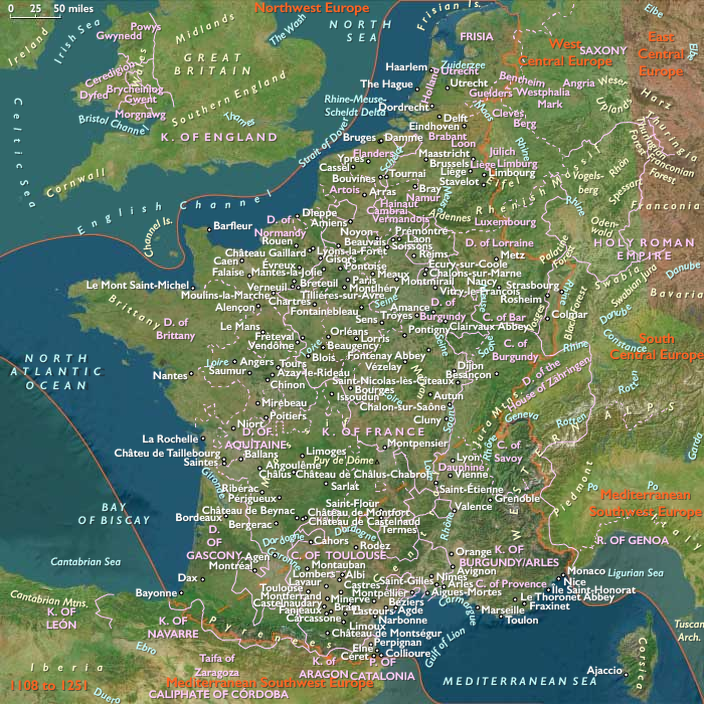
Between 1108 and 1251 CE, Western Europe entered a transformative century of expansion and consolidation.
From the vineyards of Provence to the harbors of Flanders, the Capetians, Angevins, and their rivals knit together a dynamic web of kingdoms, communes, and trade corridors.
It was an age of Gothic cathedrals and fortified towns, of heresy and crusade, and of merchants whose routes stretched from Bordeaux and Marseille to Bruges and Venice.
The Capetian monarchy solidified the French heartland, the Angevin Empire linked England and Aquitaine, and the Low Countries’ cloth towns forged the commercial arteries of medieval Europe.
Geographic and Environmental Context
West Europe encompassed two great zones of medieval civilization:
-
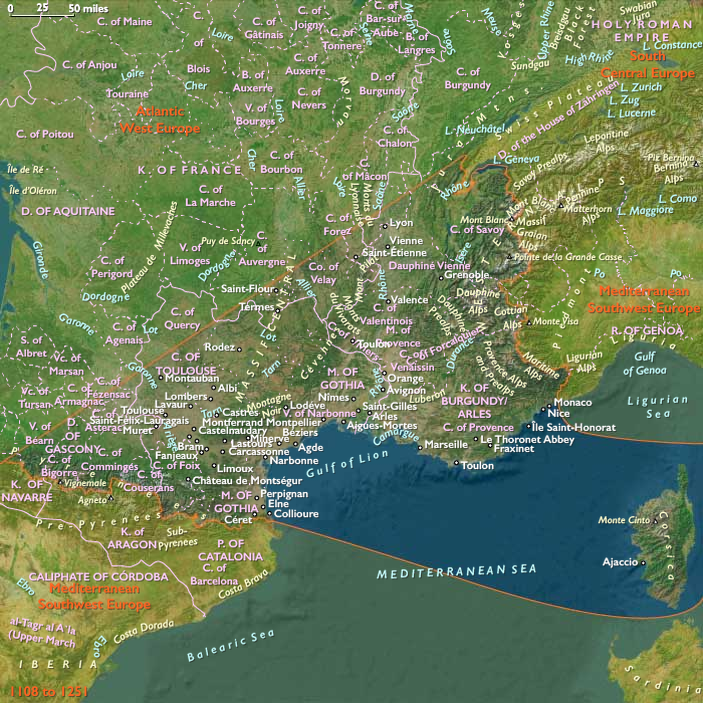
The Mediterranean south—Provence, Languedoc, and Roussillon—anchored on the Rhône Valley and the ports of Marseille, Narbonne, and Montpellier; and
-
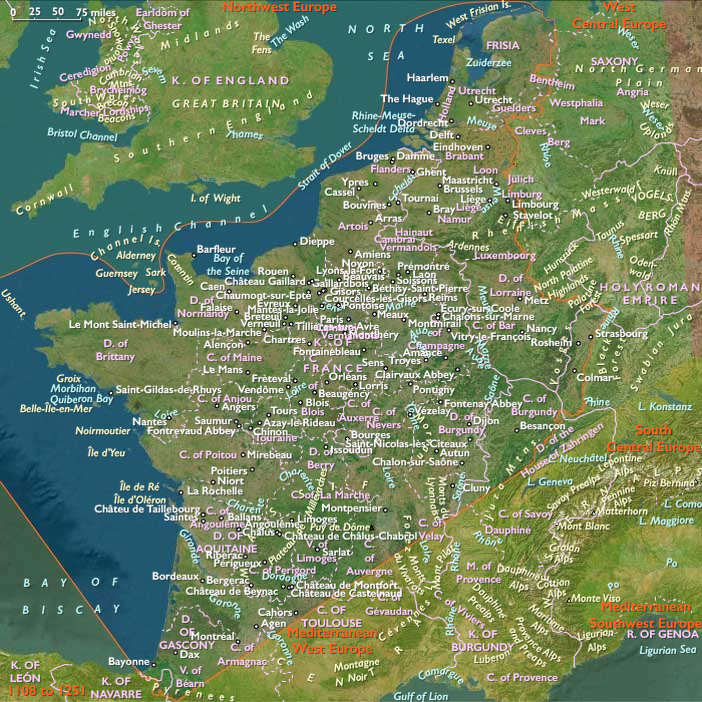
The Atlantic north—the Loire, Seine, and Gironde basins, stretching to the Low Countries’ river deltas and Flemish ports.
This landscape of rivers and coasts was threaded by trade routes: the Rhône–Saône corridor connecting Italy to the North Sea; the Loire and Seine valleys linking Paris to the ports; and the Champagne and Flanders fairs, the pulse of continental commerce.
From the Pyrenean passes to the dunes of Bruges, urbanization and royal consolidation remade Western Europe.
Climate and Environmental Shifts
The High Medieval climatic optimum fostered prosperity.
Longer growing seasons and stable weather supported vineyards, grain harvests, and demographic growth.
The Rhône and Loire valleys became agricultural heartlands, while Flanders and Champagne capitalized on river transport and grain imports.
Forests retreated before expanding farmland, and irrigation improved lowland productivity.
By the mid-13th century, subtle signs of variability—especially in southern viticulture—heralded the coming end of the climatic golden age.
Political and Dynastic Developments
Capetian France and the Angevin Challenge:
The Capetians of Paris gradually consolidated power against their Angevin and Plantagenet rivals.
Eleanor of Aquitaine, through her marriages to Louis VII (1137) and Henry II Plantagenet (1152), bound and then divided France’s destiny.
The resulting Angevin Empire, stretching from Normandy to Aquitaine and England, dominated Western Christendom.
Philip II Augustus (r. 1180–1223) decisively ended Angevin supremacy with the conquest of Normandy (1204) and victory at Bouvines (1214), establishing France’s royal hegemony.
Southern France and the Albigensian Crusade:
In the Languedoc, the Counts of Toulouse and Trencavel viscounts presided over wealthy, urbanized polities where the dualist Cathar heresy gained followers among townspeople and nobles.
The Albigensian Crusade (1209–1229), sanctioned by Pope Innocent III, crushed the movement and destroyed the independence of southern France.
The Treaty of Paris (1229) brought Languedoc under Capetian control; inquisitorial institutions and Dominican preaching followed in its wake.
Provence and the Mediterranean Crown:
Provence, a thriving courtly center of troubadour culture, passed under Angevin control in the 1240s, linking it politically to Naples and Sicily.
The Kingdom of Arles faded into papal and imperial diplomacy, while Lyon rose as both mercantile hub and ecclesiastical council seat.
Corsica, long contested, fell securely under Genoese influence, and Monaco emerged within the Genoese–Provençal maritime rivalry.
The Low Countries and the Northern Trade Axis:
In Flanders, Bruges, Ghent, and Ypres became industrial centers producing cloth for English wool, exported via the Channel ports.
The Champagne fairs connected northern Europe to Italy, bringing Lombard bankers into the royal orbit.
These northern markets financed monarchies and drew Italian capital into France’s emerging commercial infrastructure.
Economy and Trade
Agrarian Prosperity:
-
The Mediterranean south specialized in vineyards, olives, and pastoralism.
-
The Atlantic plains cultivated grain and exported surplus through Bordeaux, La Rochelle, and Nantes.
-
The Jura and Pyrenean uplands produced salt, wool, and cheese for local trade.
Urban and Maritime Commerce:
-
Marseille, Montpellier, and Narbonne served as Mediterranean entrepôts for Italian silks, Levantine spices, and woolen exports from the north.
-
Lyon’s fairs linked the Rhône basin to the Champagne circuits.
-
Bordeaux’s claret became the staple of Anglo-Gascon commerce, exported en masse to England.
-
Flanders processed English wool into high-value textiles, while Bruges evolved into Europe’s early banking and maritime hub.
Monetary Integration:
New royal mints and Italian financiers stabilized coinage; the Capetian monarchy and northern communes advanced systems of credit and toll regulation that integrated regional markets.
Religion and Intellectual Life
Heresy and Orthodoxy:
The Cathar challenge in Languedoc provoked the Inquisition (post-1229) and the rise of the Dominican Order.
In northern France, Cistercians and Franciscans expanded monastic reform.
Chartres, Paris, and Toulouse grew into centers of scholastic learning, blending faith with emerging rationalism.
Art and Architecture:
-
Gothic architecture matured with Chartres Cathedral (begun 1194) and Reims, epitomizing theological harmony in stone.
-
Romanesque churches persisted in southern Provence and the Pyrenees.
-
Troubadour lyric poetry in Occitan expressed secular and courtly ideals.
Movement and Interaction Corridors
-
Rhône–Saône valley: Lyon ⇄ Avignon ⇄ Marseille — key artery for Mediterranean–Rhine commerce.
-
Loire and Seine valleys: Paris ⇄ Tours ⇄ Orléans ⇄ Rouen ⇄ Channel ports — backbone of royal administration.
-
Aquitaine coast: Bordeaux ⇄ La Rochelle ⇄ Bayonne ⇄ Bristol — English–French maritime link.
-
Flanders–Champagne axis: Bruges ⇄ Ghent ⇄ Reims ⇄ Troyes ⇄ Genoa — Europe’s commercial hinge.
-
Pyrenean passes and Provençal ports: Perpignan ⇄ Toulouse ⇄ Arles ⇄ Genoa — cross-Mediterranean exchange.
These corridors integrated agrarian hinterlands with an increasingly international maritime economy.
Adaptation and Resilience
-
Feudal pluralism in France allowed local autonomy within royal consolidation.
-
Urban communes balanced royal and seigneurial power, protecting civic liberties.
-
Agrarian specialization diversified production between northern grain, southern wine, and maritime salt.
-
Trade redundancy—multiple ports and inland routes—ensured recovery from warfare and crusade.
-
Religious orders and urban guilds provided stability amid social change.
By adapting economically and institutionally, West Europe turned diversity into strength.
Long-Term Significance
By 1251 CE, Western Europe had crystallized into the framework of later France and the Low Countries:
-
Capetian monarchy secured southern expansion and royal bureaucracy.
-
The Angevin realm remained powerful but fractured, defining Franco-English rivalry.
-
Flanders and Champagne stood at the forefront of international finance.
-
Marseille, Montpellier, and Bordeaux embodied the Mediterranean–Atlantic continuum that would later power European exploration.
The region’s synthesis of royal centralization, mercantile networks, and cultural flowering marked the zenith of the High Middle Ages—and prepared France and its neighbors for the global age to come.

Mediterranean West Europe (with civilization) ©2024-25 Electric Prism, Inc. All rights reserved.
Groups
- Corsica, Medieval
- Septimania
- Islam
- Naples, Duchy of
- Papal States (Republic of St. Peter)
- Toulouse, County of
- Aquitaine, (Angevin) Duchy of
- France, (Capetian) Kingdom of
- Savoy, County of
- Genoa, (Most Serene) Republic of
- Arles, Kingdom of
- Christians, Roman Catholic
- Trencavel
- Roman Empire, Eastern: Komnenos dynasty, restored
- Provence, County of
- Cistercians, Order of the (White Friars)
- Catharism (Albigenses)
- Roman Empire, Eastern: Angelid dynasty
- Dominicans, or Order of St. Dominic
- Ifriqiya, Hafsid (Banu Hafs) (first) Caliphate of
- Inquisition, papal
Topics
Commodoties
Subjects
Regions
Subregions
Related Events
Showing 10 events out of 49873 total
Years: 1108 - 1251
Mediterranean West Europe (with civilization) ©2024-25 Electric Prism, Inc. All rights reserved.
Groups
- Corsica, Medieval
- Septimania
- Islam
- Naples, Duchy of
- Papal States (Republic of St. Peter)
- Toulouse, County of
- Aquitaine, (Angevin) Duchy of
- France, (Capetian) Kingdom of
- Savoy, County of
- Genoa, (Most Serene) Republic of
- Arles, Kingdom of
- Christians, Roman Catholic
- Trencavel
- Roman Empire, Eastern: Komnenos dynasty, restored
- Provence, County of
- Cistercians, Order of the (White Friars)
- Catharism (Albigenses)
- Roman Empire, Eastern: Angelid dynasty
- Dominicans, or Order of St. Dominic
- Ifriqiya, Hafsid (Banu Hafs) (first) Caliphate of
- Inquisition, papal
Topics
Commodoties
Subjects
Regions
Subregions