
Mediterranean West Europe (1828–1971 CE): Phylloxera, …
Years: 1828 - 1971
Mediterranean West Europe (1828–1971 CE): Phylloxera, Port Cities, and the Riviera’s Reinvention
Geography & Environmental Context
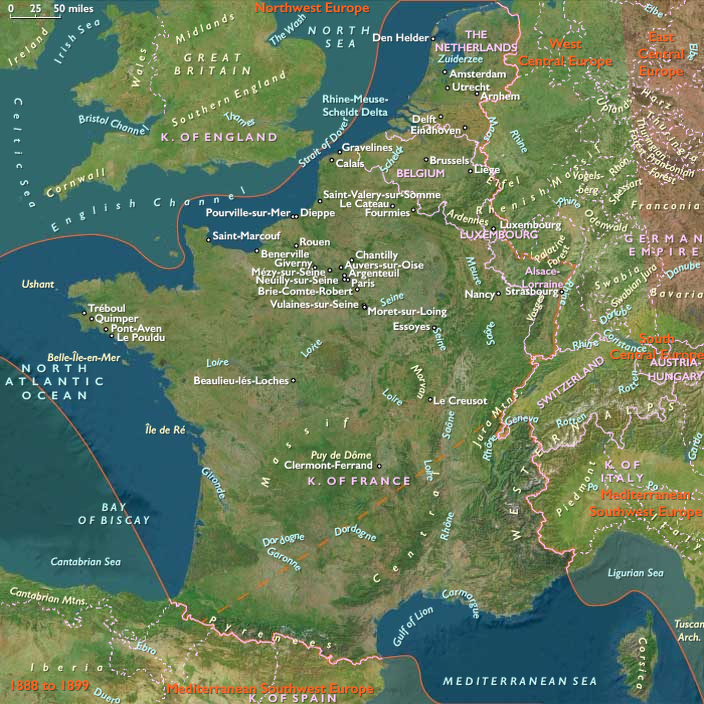
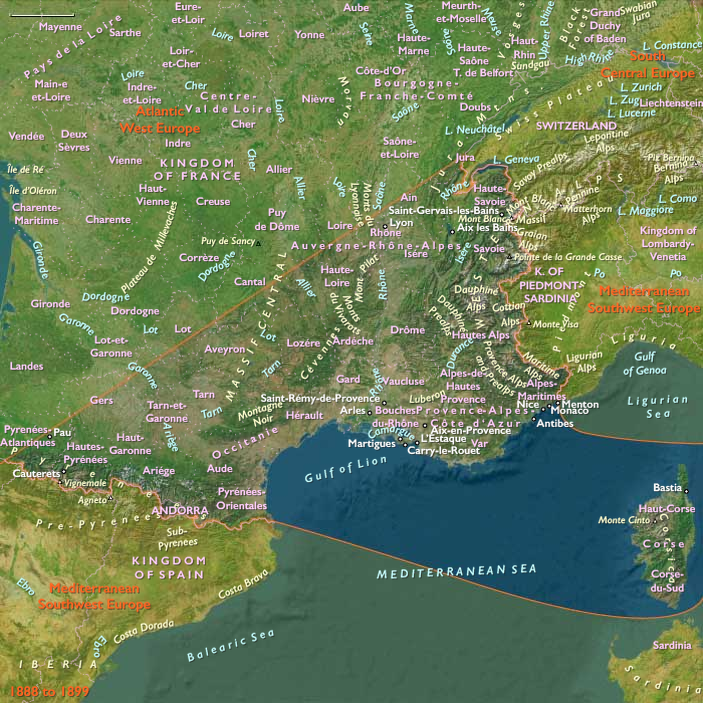
Mediterranean West Europe comprises southern France only: the French Pyrenees and Languedoc–Roussillon, the Provence–Côte d’Azur littoral including Marseille and Nice, Monaco, Corsica, and the Rhône Valley from the Camargue delta up to Lyon. It is a mosaic of limestone massifs and alluvial plains, saline lagoons and rice paddies (Camargue), vineyard belts, and deep seaports. Seasonal mistral winds, episodic Rhône floods, and long summer droughts framed land use.
Climate & Environmental Shifts
A Mediterranean regime—wet winters, dry summers—prevailed. The Rhône periodically flooded lowlands; droughts and heat waves stressed vines and olives. Coastal marsh reclamation and Camargue rice schemes (late 19th–mid 20th c.) altered wetlands, while timber and chestnut decline in uplands shifted rural ecologies. After 1950, river regulation and reservoirs tempered extremes; in 1970, the Camargue Regional Park formalized wetland conservation.
Subsistence & Settlement
-
Vine, olive, grain: The Languedoc became Europe’s bulk-wine engine, while Provence mixed olives, fruit, and vegetables for urban markets. The phylloxera crisis (c. 1860s–1890s) devastated vineyards; American rootstock grafting rebuilt them, but pushed the south toward mass-production wines.
-
Rice & salt: The Camargue expanded rice and salt after mid-century; sheep and bulls remained iconic on the delta pastures.
-
Ports & cities: Marseille (soap, oilseed crushing, flour, canning, later petrochemicals), Sète and Port-Vendres (wine and fruit export), Toulon (naval base), Nice–Cannes–Antibes–Monaco (resort and service economies). Lyon anchored Rhône commerce and chemicals upstream.
-
Corsica: Chestnut groves, transhumant herding, olives, and later citrus and tourism underpinned a fragile island economy.
Technology & Material Culture
-
Transport revolutions: Railways of the PLM (Paris–Lyon–Méditerranée) tied vineyards and olive belts to northern markets; the Canal du Midi remained a grain–wine artery. After 1950, the Autoroute du Soleil and modernized port basins (Fos–Étang de Berre) re-routed flows; early containerization arrived at Marseille by the late 1960s.
-
Industry: From savon de Marseille and milling to fertilizers, glass, shipbuilding (La Ciotat), and finally petrochemicals (Berre/Fos). Cold storage and bottling transformed horticultural exports.
-
Everyday life: Stone farmhouses and terraces gave way to mechanized presses, tractors, cooperative wineries, scooters, radios, then televisions; after 1952, Le Corbusier’s Unité d’Habitation in Marseille signaled modern urban living.
Movement & Interaction Corridors
-
Migration: 19th-century Italian laborers and seasonal Spanish workers fed farms and quarries; Spanish Republican refugees arrived after 1939; the 1962 Algerian war’s end brought pieds-noirs and North-African migrants into Marseille and the Rhône corridor.
-
Trade & empire: Marseille funneled colonial staples (oils, cereals, phosphates) and re-exported wine and soap; Sète shipped Languedoc bulk wine north.
-
Tourism: From aristocratic winters on the Riviera (Nice annexed to France in 1860; Monaco’s casino 1863) to mass tourism in the 1950s–60s (airfields at Nice and Marignane; Cannes Film Festival from 1946), the coast reinvented itself as a leisure economy.
Cultural & Symbolic Expressions
-
Artistic capitals: Aix-en-Provence (Cézanne), Arles (Van Gogh), Nice and Antibes (Matisse, Picasso) fixed the south in modern art’s imaginary. Marcel Pagnol and Jean Giono cast Provençal speech and landscapes into literature and film.
-
Wine politics: The 1907 Languedoc wine revolts (Narbonne, Béziers) protested fraud and low prices, birthing powerful cooperatives and quality-control regimes.
-
Urban iconography: Basilica Notre-Dame de la Garde over Marseille, Belle-Époque promenades at Nice and Cannes, and Corsican polyphony sustained regional identities.
Environmental Adaptation & Resilience
-
Phylloxera response: Grafting onto American rootstocks, replanting on drought-tolerant stocks, and fermentation upgrades stabilized output; cooperatives spread costs and technology.
-
Water & land: Canalization, levees, and rice irrigation in the Camargue diversified income; windbreaks and soil conservation protected orchards and vines.
-
Urban health: Port sanitation and housing reforms followed cholera waves; post-WWII zoning and green belts began to tackle sprawl and pollution.
Political & Military Shocks
-
1848 and the Second Empire: Rail expansion and port modernization accelerated.
-
Franco-Prussian War (1870–71): Economic dislocation, but ports recovered quickly.
-
World War I: Rhône industries mobilized; ports funneled colonial troops and supplies.
-
World War II: Occupation and Vichy repressions; the Allied landings in Provence (Operation Dragoon, 1944) liberated the littoral and Rhône axis; postwar rebuilding re-started shipping and industry.
-
Decolonization (1950s–60s): Traffic and people shifted: Marseille absorbed pieds-noirs, and petro-zones at Fos–Berre recast the waterfront economy.
Transition
From 1828 to 1971, Mediterranean West Europe moved from vineyard–olive smallholdings and artisanal ports through phylloxera, mass wine politics, and artistic reinvention to a landscape of modern ports, petrochemicals, and Riviera tourism. The Rhône became an industrial spine; Marseille pivoted from empire’s granary to a polyglot metropolis; the Riviera evolved from winter refuge to mass beach culture. By 1971, the subregion anchored France’s Mediterranean identity—its vines and wetlands protected (Camargue), its ports re-engineered, and its coast globally branded as a stage for art, cinema, and sea-sun modernity.
People
Groups
- Monaco, Principality of
- Nice, County of
- Corsica (Province of France)
- Sardinia, Kingdom of
- France, constitutional monarchy of
- Savoy, (restored) Duchy of
- France, Second Republic of
- France, Second Empire of
- France (French republic); the Third Republic
- France, Free
- France, German-occupied (Vichy)
- France (French republic); the Fourth Republic
- France (French republic); the Fifth Republic
Topics
Commodoties
Subjects
Regions
Subregions
Related Events
Showing 10 events out of 19829 total
Years: 1828 - 1971
People
Groups
- Monaco, Principality of
- Nice, County of
- Corsica (Province of France)
- Sardinia, Kingdom of
- France, constitutional monarchy of
- Savoy, (restored) Duchy of
- France, Second Republic of
- France, Second Empire of
- France (French republic); the Third Republic
- France, Free
- France, German-occupied (Vichy)
- France (French republic); the Fourth Republic
- France (French republic); the Fifth Republic
Topics
Commodoties
Subjects
Regions
Subregions