Northwestern North America (1828–1971 CE): Industrial Corridors,…
1828 CE to 1971 CE
Northwestern North America (1828–1971 CE): Industrial Corridors, Indigenous Renewal, and the Modern Pacific Northwest
Geographic Parameters
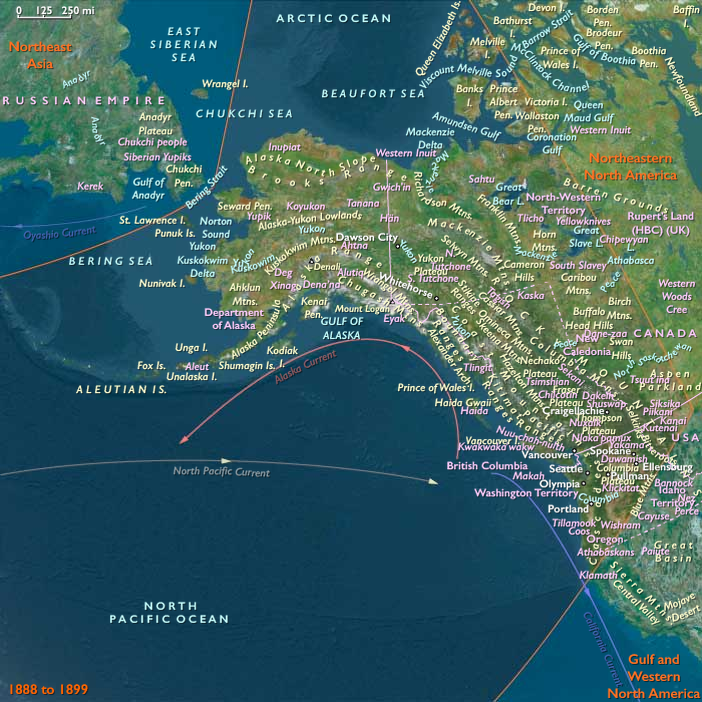
Northwestern North America comprised Alaska, the Yukon, British Columbia, Washington, northern Idaho, northwestern Montana, Oregon, and the far northern Pacific coast of California. The subregion encompassed the Gulf of Alaska, the Aleutian chain, the Alexander Archipelago, Haida Gwaii, Vancouver Island, the Salish Sea, the Fraser and Columbia river systems, the interior plateaus, the Coast and Cascade Mountains, and the western slopes of the Rockies.
The immense environmental framework of temperate rainforests, fjords, salmon rivers, boreal forests, mountain ranges, and Arctic coastlines continued to define the region, even as industrial development became increasingly concentrated along major transportation corridors and deep-water harbors.
Environmental Continuity
Industrialization altered selected portions of the landscape, but environmental continuity remained the defining characteristic of the subregion. Vast conifer forests still dominated the Pacific coast, mountain systems remained largely undeveloped, and extensive river basins continued connecting interior and coastal environments.
Logging, commercial fishing, mining, agriculture, hydroelectric development, and urban growth became concentrated primarily within favorable river valleys, coastal lowlands, and sheltered harbors rather than spreading uniformly across the landscape.
Salmon continued to anchor both ecological systems and cultural life, although dams, habitat modification, commercial harvests, and pollution increasingly reduced many historic runs during the twentieth century.
Human Adaptation
Indigenous communities adapted to profound political and economic transformation while maintaining enduring relationships with their ancestral landscapes.
Commercial employment in fisheries, forestry, shipping, mining, transportation, and canneries increasingly complemented traditional fishing, hunting, gathering, carving, weaving, and food harvesting. Seasonal use of salmon rivers, shellfish beaches, berry grounds, and hunting territories persisted despite growing legal restrictions and expanding settler occupation.
Settler communities likewise adapted their economies to the environmental opportunities of the region. Agriculture expanded primarily within fertile valleys, while maritime industries remained closely tied to productive coastal waters and protected harbors.
Economic Organization
Resource industries reshaped the regional economy during this age.
Commercial salmon fisheries expanded dramatically through canneries, refrigeration, steam-powered vessels, and later mechanized fleets. Logging became one of the dominant industries of the Pacific Northwest, supplying lumber, pulp, and paper to international markets. Mining developed in British Columbia, Alaska, and the Yukon, while gold rushes accelerated settlement along selected river corridors.
Hydroelectric development transformed portions of the Columbia River system, providing electrical power for manufacturing, aluminum production, and rapidly growing metropolitan regions. Railways, highways, steamship routes, and later aviation integrated Pacific ports with continental and global markets.
Despite these developments, industrial activity remained geographically concentrated, leaving much of the subregion's forests, mountains, fjords, and Arctic landscapes ecologically dominant.
Institutions
Colonial and later national governments increasingly expanded administrative authority throughout the region. Municipal governments, schools, churches, ports, courts, railways, and commercial corporations became permanent components of regional organization.
At the same time, Indigenous institutions demonstrated remarkable resilience. House societies, clans, hereditary leadership traditions, tribal governments, ceremonial practices, carving schools, language communities, and subsistence networks adapted to changing legal and economic conditions rather than disappearing.
During the twentieth century, cultural revitalization accelerated. Public carving, canoe building, ceremonial gatherings, language preservation, and renewed artistic traditions increasingly reaffirmed Indigenous continuity despite generations of assimilationist policies.
Political Systems
This period witnessed the consolidation of modern political authority.
Russian America was transferred to the United States in 1867, while British Columbia entered Canadian Confederation in 1871. American and Canadian governments extended transportation systems, administrative institutions, military infrastructure, and resource management throughout the region.
Colonial expansion displaced many Indigenous communities through reserves, reservations, land appropriation, fisheries regulation, and restrictions upon traditional governance. Residential and boarding schools attempted to suppress Indigenous languages and cultural institutions, while legal prohibitions targeted important ceremonial traditions in parts of the subregion.
Yet Indigenous political organization persisted. Tribal governments, hereditary leadership, regional organizations, legal advocacy, and intercommunity cooperation increasingly challenged colonial policies, laying the foundations for the political and cultural resurgence that would become more visible after 1971.
Legacy of the Age
Between 1828 and 1971, Northwestern North America underwent its greatest transformation since the beginning of the medieval sequence. Industrial forestry, commercial fisheries, mining, hydroelectric development, railways, modern ports, and expanding metropolitan regions created new economic landscapes along selected corridors, while American and Canadian political institutions became firmly established across the subregion.
Nevertheless, the deeper structure of Northwestern North America remained remarkably continuous. Salmon rivers still connected mountains to the Pacific. Cedar forests continued to dominate much of the coastline. Fjords, glaciers, boreal forests, and Arctic shorelines remained the enduring environmental framework within which modern society developed.
Equally enduring were the Indigenous nations whose histories extended across the entire sequence. Despite epidemic disease, territorial dispossession, assimilation policies, and industrial transformation, they preserved fundamental relationships with their lands, waters, languages, artistic traditions, and systems of governance. By 1971, the region stood not at the end of its Indigenous history but at the threshold of a new era in which environmental stewardship, cultural renewal, and renewed assertions of Indigenous rights would increasingly shape the future of Northwestern North America.
Images

Northwestern North America in the Late Modern age
People
Groups
Topics
Commodities
Subjects
Regions
Northern North America
View →Subregions