
North Africa (333–190 BCE) Carthaginian Dominance, …
Years: 333BCE - 190BCE
North Africa (333–190 BCE)
Carthaginian Dominance, Conflict, Reconstruction, Cyrenaic Stability, and Berber Continuity
Carthage’s Strategic Adaptation and the Punic Wars
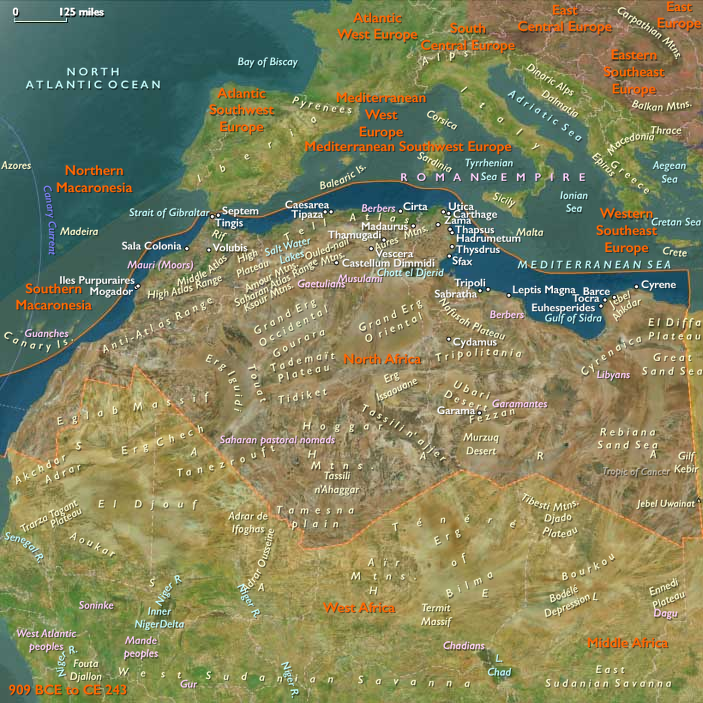
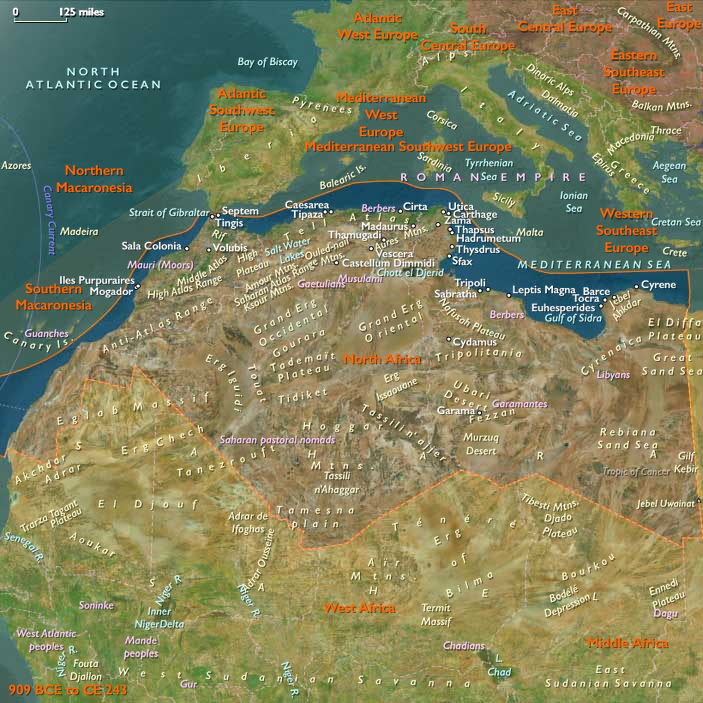
From 333 to 190 BCE, North Africa experiences profound shifts driven by Carthage’s evolving geopolitical ambitions and subsequent military conflicts. Initially dominant, Carthage extends its hegemony significantly, maintaining naval supremacy and securing crucial Mediterranean trade routes, particularly around strategic colonies such as Leptis and Oea (modern Tripoli). The Punic civilization flourishes, integrating Berber communities economically and culturally through robust trade networks and sophisticated agricultural practices.
However, Carthage faces immense challenges during the First Punic War (264–241 BCE), triggered by rivalry with Rome over Sicily. Although initially holding its ground, Carthage ultimately succumbs, losing Sicily and paying heavy indemnities. The subsequent Mercenary War (241–237 BCE), arising from unpaid mercenary forces—including Berber soldiers who successfully seize control of much of Carthage’s North African territory and mint coins labeled "Libyan"—further destabilizes Carthage. Under the decisive leadership of Hamilcar Barca, Carthage regains control, yet its recovery is marred by Roman opportunism, notably Rome’s seizure of Sardinia and Corsica.
The Second Punic War (218–201 BCE), spearheaded by Hannibal Barca, significantly impacts Carthage’s geopolitical standing. Despite remarkable military campaigns in Italy, Hannibal’s eventual defeat at the Battle of Zama (202 BCE) severely cripples Carthaginian power, forcing it into substantial post-war reconstruction and diplomatic realignment.
Post-War Reconstruction and Diplomatic Realignment
Post-war Carthage faces heavy penalties, including loss of territories, naval limitations, and severe indemnities. Nevertheless, it demonstrates remarkable resilience by focusing intensely on agricultural and economic recovery, particularly in the productive North African hinterland. Key cities, especially Leptis and Oea, remain central to economic revitalization. Diplomatically, Carthage adopts cautious pragmatism, strategically repositioning itself to maintain stable relations with Rome and neutrality in broader Mediterranean affairs.
Cyrenaica’s Consistent Economic and Diplomatic Stability
Throughout this turbulent period, the Greek Pentapolis—Cyrene, Barce (Al Marj), Euhesperides (Benghazi), Teuchira (Tukrah), and Apollonia (Susah)—retains significant economic stability. Initially, the region welcomes Alexander the Great in 331 BCE, and after his death in 323 BCE, Cyrenaica is absorbed into the territories ruled by Ptolemy, a general under Alexander. The Pentapolis forms a federation typically ruled by a Ptolemaic king, bringing political stability through imposed constitutions due to internal governance challenges.
Economic and cultural prosperity remains robust despite political turbulence. Cyrenaica becomes wealthy through grain, wine, wool, stockbreeding, and notably Silphium, an herb unique to the region. Cyrene emerges as a prominent intellectual and artistic hub, renowned for its medical school, learned academies, and distinctive Hellenistic architecture. Additionally, the philosophical Cyrenaics, proponents of a doctrine equating happiness with human pleasure, flourish here.
Berber Economic Integration and Cultural Continuity
Berber communities—Caucasoid peoples speaking variations of a single Hamito-Semitic language, who identify themselves as “Amazigh” or "free men"—remain economically integrated within Carthaginian and Greek trade networks throughout these conflicts. Continuously adopting advanced agricultural, maritime, and artisanal techniques, Berbers sustain economic vitality in coastal hubs such as Oea (Tripoli). Inland Berber tribes preserve their autonomy, benefiting indirectly from prosperous coastal trade, reinforcing regional stability and cultural resilience.
Vibrant Cultural Exchange and Religious Syncretism
The interactions among Berber, Carthaginian, and Greek populations continue to flourish, fostering vibrant artistic developments in pottery, textiles, and metalwork. Religious syncretism deepens significantly, harmoniously blending indigenous Berber traditions with Phoenician and Greek religious practices, enriching regional cultural diversity.
Foundations for Sustained Regional Stability
By 190 BCE, despite significant military setbacks and geopolitical disruptions, North Africa achieves considerable political resilience and sustained economic vitality. Carthage’s strategic adaptation and diplomatic caution, Cyrenaica’s unwavering stability, and the ongoing integration and cultural continuity among the Berbers collectively secure regional cohesion and enduring prominence within the Mediterranean.
People
Groups
- Berber people (also called Amazigh people or Imazighen, "free men", singular Amazigh)
- Carthage, Kingdom of
- Greeks, Classical
- Syracuse, Corinthian city-state of
- Cyrene
- Roman Republic
- Libu (Libyans)
Topics
Commodoties
Subjects
Regions
Subregions
Related Events
Showing 10 events out of 64522 total
Years: 333BCE - 190BCE
People
Groups
- Berber people (also called Amazigh people or Imazighen, "free men", singular Amazigh)
- Carthage, Kingdom of
- Greeks, Classical
- Syracuse, Corinthian city-state of
- Cyrene
- Roman Republic
- Libu (Libyans)
Topics
Commodoties
Subjects
Regions
Subregions