
North Africa (400–411 CE) Political Instability, Religious…
400 CE to 411 CE
North Africa (400–411 CE)
Political Instability, Religious Conflicts, and the Fall of Roman Control
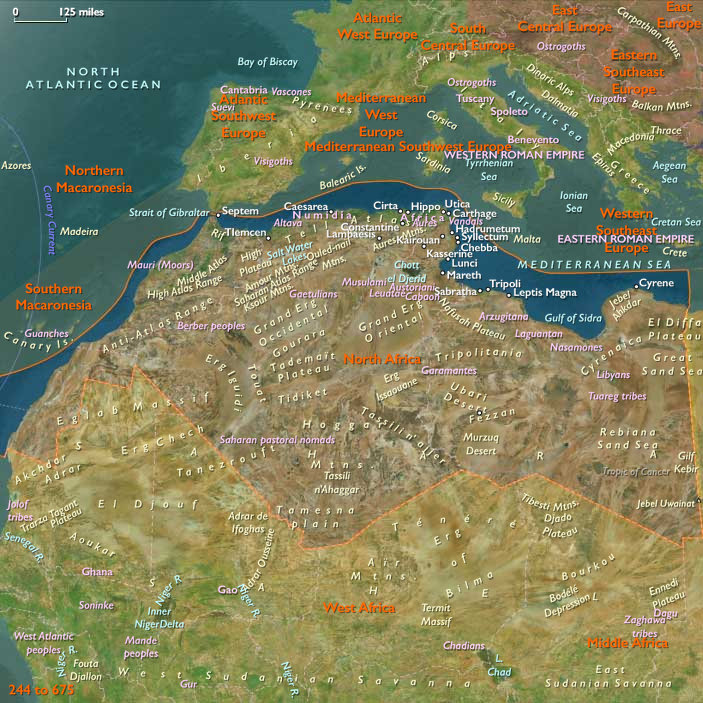
Between 400 and 411 CE, North Africa experiences increasing instability as broader imperial turmoil begins to seriously impact the region. Roman administrative authority, although still intact, begins showing signs of strain, while economic productivity and urban life remain resilient but vulnerable.
A critical turning point occurs in 405 CE when the Western Roman Empire faces mounting pressures from barbarian invasions in Europe, significantly disrupting traditional lines of trade and communication. Despite this turbulence, cities such as Carthage, Leptis Magna, and Caesarea (Cherchell) maintain active commercial networks, ensuring regional economic stability through trade in grain, olive oil, and luxury goods.
This period is notably marked by escalating religious conflicts, particularly centered around the persistent Donatist schism. The dispute culminates in the significant ecclesiastical Council of Carthage (411 CE), convened to resolve the ongoing conflict between Donatist and Orthodox Christian communities. Presided over by an imperial commissioner, the council decisively rules against the Donatists, declaring their beliefs heretical. Despite this official ruling, Donatist communities remain strong in rural and frontier regions, prolonging religious tensions.
The influential bishop Augustine of Hippo Regius plays a crucial role during this era, further developing his theological and philosophical positions against the Donatists. His writings continue to shape Orthodox Christian doctrine, particularly regarding the validity of sacraments and the authority of Christian rulers to enforce religious conformity through legal and even coercive measures.
Frontier security faces increasingly severe challenges during this period. Berber tribes, previously contained along the edges of Roman-controlled territories, grow more assertive, exploiting weakening imperial defenses. Nomadic groups, including the Mauri (Moors), intensify their activities, affecting the region’s security and posing ongoing threats to settled agricultural and urban communities.
In 408 CE, the execution of Stilicho, the Western Empire’s capable general, results in weakened Roman defenses throughout the empire, including North Africa. Stilicho had previously quelled the Gildonic revolt (398 CE), and his death destabilizes military cohesion, leaving the province more vulnerable.
By the end of 411 CE, North Africa remains economically productive and culturally vibrant but faces substantial pressures from internal religious conflicts, external tribal incursions, and broader imperial instability. These developments foreshadow significant political transformations, paving the way for the eventual collapse of Roman authority and the impending Vandal incursions.
Groups
Subjects
Regions
North Africa
View →Subregions
