Northeast Europe (1540–1683 CE): Baltic Empires, Lutheran…
1540 CE to 1683 CE
Northeast Europe (1540–1683 CE): Baltic Empires, Lutheran States, and Militarized Maritime Corridors
Geographic Parameters
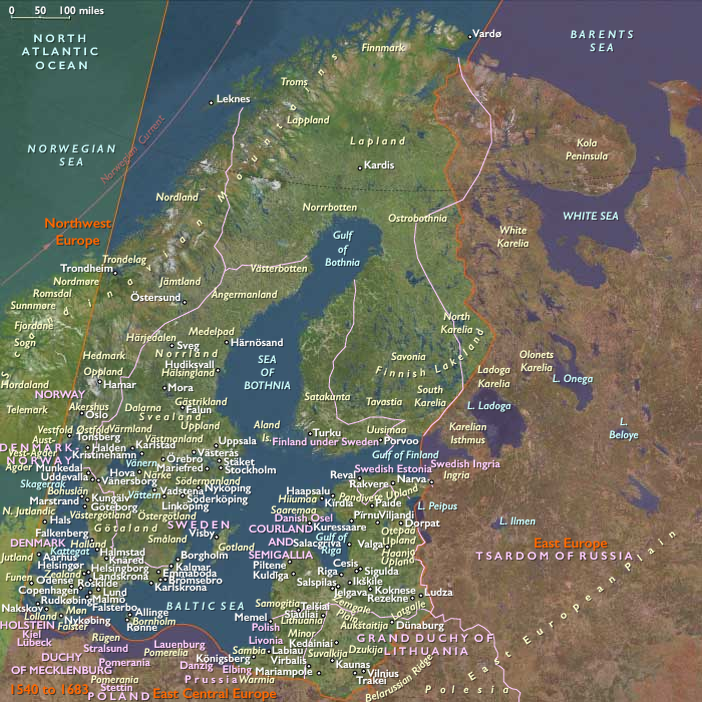
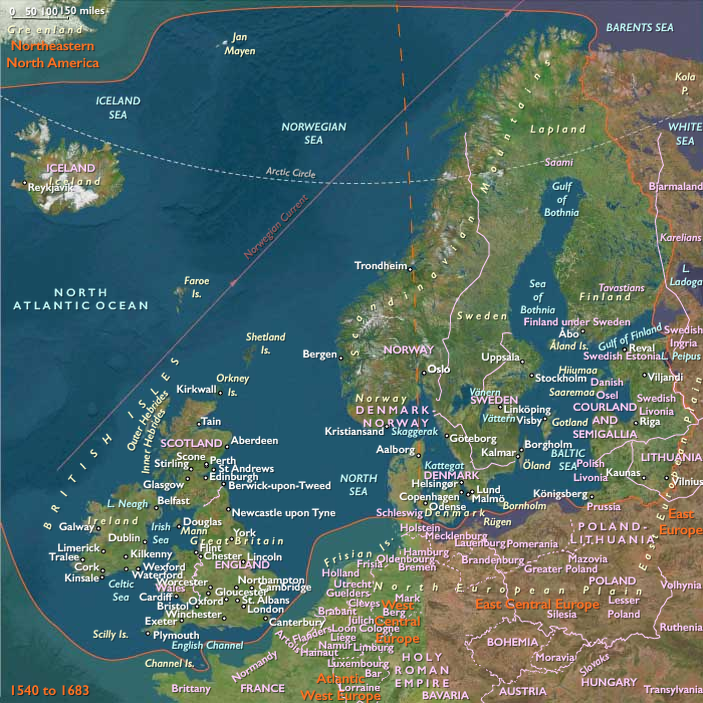
Northeast Europe comprised Sweden, Finland, Estonia, Latvia, Lithuania, the Kaliningrad coast, eastern Denmark including Zealand and Copenhagen, and eastern Norway including the Oslofjord. The Baltic Sea remained the subregion’s central connective environment, linking the Øresund, Stockholm archipelago, Åland, the Gulfs of Bothnia, Finland, and Riga, the Estonian islands, and the lowland river systems of the eastern Baltic.
The region continued to divide into distinct environmental zones. Denmark, southern Sweden, Lithuania, Latvia, and parts of Estonia contained the broadest cereal-producing districts. Finland, central Sweden, and the northern interiors were dominated by forests, lakes, bogs, rocky uplands, and short growing seasons. Archipelagos, river mouths, winter roads, and sheltered inlets remained essential to trade and administration even as larger fleets, artillery fortresses, estates, and state institutions expanded.
Environmental Continuity
The basic forest–sea structure of the subregion endured beneath the rise of stronger territorial states. Most people continued to live in farms, fishing settlements, forest clearings, estate villages, island communities, and small towns. Capitals, arsenals, shipyards, fortresses, academies, and commercial ports remained concentrated nodes dependent upon rural production and maritime access.
Forests supplied timber, charcoal, tar, pitch, potash, fuel, game, and construction materials. Agricultural districts supported grain, livestock, flax, hemp, and dairy production. Coastal waters, lakes, and rivers sustained fisheries, transport, milling, and military logistics. In the north and interior, farming continued to overlap with swidden cultivation, woodland grazing, hunting, trapping, and seasonal mobility.
Climate and Environmental Change
The Little Ice Age continued to shape the region through long winters, wet or unstable summers, and recurring harvest failures. Harbors and rivers froze for extended periods, limiting naval operations and delaying trade. Severe winters created temporary sled routes but increased the costs of provisioning towns, forts, and armies.
Poor harvests could become especially destructive when combined with war, requisitioning, livestock loss, or interrupted commerce. Finland, Sweden, Livonia, and Lithuania all experienced periods of scarcity. Rural households therefore depended upon fishing, livestock, forest products, food storage, local exchange, and access to imported grain or salt.
State expansion intensified environmental pressures. Naval construction consumed large quantities of timber, tar, hemp, and iron. Mining and metalworking increased charcoal demand. Fortress building, urban expansion, drainage, estate agriculture, and wartime destruction altered selected coastal and river landscapes, though the wider subregion remained heavily forested and agrarian.
The Principal New System: Militarized Territorial States
The age’s principal new organizing system was the transformation of older royal and commercial corridors into militarized territorial states. Taxation, conscription, Lutheran churches, estate administration, artillery fortresses, naval bases, and permanent bureaucracies coordinated larger regions than before.
This transformation was uneven. Stronger states did not erase local law, noble privilege, peasant communities, urban autonomy, Sámi mobility, or religious and linguistic diversity. Authority was concentrated along ports, roads, estates, river mouths, mining districts, castles, and military frontiers.
Sweden and the Baltic Empire
Sweden emerged as the subregion’s most expansive military power. The Vasa monarchy strengthened taxation, crown estates, military levies, mining regulation, and Lutheran ecclesiastical administration. Swedish rulers drew upon iron, copper, timber, tar, grain, customs, and peasant taxation to sustain armies and fleets.
Finland formed an integral but distinct part of the Swedish realm. Finnish farms, forests, ports, soldiers, horses, ships, and tax revenues supported royal expansion. Turku remained an important ecclesiastical and administrative center, while Viipuri guarded the eastern approaches. Coastal towns and fortresses connected Finland to Stockholm and the wider Baltic, but most of the countryside remained organized through farms, parishes, forest work, fishing, and local markets.
The Livonian War from 1558 to 1583 shattered the political order of medieval Livonia. Muscovite, Swedish, Danish, and Polish-Lithuanian forces competed for ports, castles, tribute districts, and access to the Baltic. Northern Estonia came under Swedish rule, while other territories passed to Denmark and the Polish-Lithuanian Commonwealth.
Swedish power expanded sharply during the seventeenth century. Under Gustavus Adolphus and his successors, Sweden became a major participant in the Thirty Years’ War and acquired territories beyond the subregion. Within the Baltic, Sweden gained Estonia, Livonia, Ingria, and strategic German ports and provinces. By the middle of the seventeenth century, the crown sought to make the Baltic a controlled Swedish commercial and military sphere.
This empire remained dependent upon a dispersed productive base. Mines required charcoal, armies required grain and horses, navies required timber and tar, and fortresses required peasant transport and labor. Swedish authority was therefore strongest along selected administrative and maritime corridors rather than uniformly across forests, islands, and rural districts.
Denmark–Norway and the Struggle for the Baltic Entrance
Denmark–Norway remained Sweden’s principal Scandinavian rival. Copenhagen grew as a royal, naval, administrative, and commercial center. Danish authority drew heavily upon the Øresund, crown estates, maritime customs, agricultural production, and a large fleet.
The Northern Seven Years’ War from 1563 to 1570 and the Kalmar War from 1611 to 1613 reflected continuing rivalry over trade, dynastic claims, borderlands, and access to the Baltic. Later conflicts again pitted Denmark–Norway against Sweden, culminating in major territorial losses after the Treaty of Roskilde in 1658.
Eastern Norway, including the Oslofjord, remained tied to Danish royal administration while retaining strong regional dependence upon timber, farming, fisheries, and shipping. Christiania, rebuilt after the 1624 fire, became a more planned administrative center, though the broader fjord landscape continued to consist of farms, forests, sawmills, ports, and smaller settlements.
The Danish crown strengthened absolutist rule after 1660. Royal administration, taxation, military institutions, and estate systems became more centralized, but local officials, nobles, clergy, merchants, and peasant communities continued to mediate state reach.
The Polish-Lithuanian Commonwealth and Lithuania
The Polish-Lithuanian Commonwealth, formally established in 1569, connected the Grand Duchy of Lithuania with the Polish Crown while preserving many Lithuanian institutions, laws, and elite structures. Lithuania remained a multiethnic and multireligious political field containing Lithuanian, Ruthenian, Polish, Jewish, Tatar, German, and other communities.
Vilnius remained a major administrative, religious, commercial, and intellectual center. Noble estates expanded their control over grain, livestock, forests, flax, and peasant labor. River and overland routes linked the Lithuanian interior to Riga, Königsberg, and other Baltic ports.
The Commonwealth competed with Sweden and Russia for Livonia and eastern Baltic access. Warfare repeatedly crossed Lithuanian and Livonian territories, damaging farms, towns, roads, and estates. Noble political privilege and elective monarchy limited centralized royal power, but regional administration, estate networks, and military organization remained substantial.
Catholic renewal, Orthodox traditions, Protestant communities, Jewish institutions, and Uniate developments created a complex religious landscape. State and noble patronage shaped churches, schools, printing, and confessional competition without producing uniform belief.
Livonia, Estonia, and Foreign Rule
The dissolution of medieval Livonia left Estonia and Latvia divided among Swedish, Danish, and Polish-Lithuanian authorities. Northern Estonia came under Swedish rule, while southern Livonia remained contested before eventually passing largely to Sweden.
German-speaking nobles, merchants, and urban councils retained extensive influence. Swedish rulers often governed through these established elites rather than replacing them. Estonia and Latvia therefore combined new imperial administration with older estate jurisdictions, German urban culture, and locally rooted Estonian, Latvian, Livonian, and Latgalian communities.
Riga developed into one of the Baltic’s major ports and became Swedish in 1621. Tallinn retained commercial importance, though older Hanseatic structures increasingly operated within royal imperial systems.
Rural populations bore heavy burdens through estate labor, rents, transport obligations, taxation, and wartime requisitioning. Swedish reforms later improved some legal and educational institutions, but they did not eliminate noble dominance or peasant dependency.
Kaliningrad and Ducal Prussia
The Kaliningrad coast formed the core of Ducal Prussia, centered on Königsberg. The territory remained under Polish suzerainty until the mid-seventeenth century and was increasingly linked to Brandenburg.
Königsberg developed as an administrative, commercial, educational, and confessional center. Grain, timber, amber, flax, and other products moved through its port, while estates organized rural labor and production.
The University of Königsberg, founded in 1544, became an important Lutheran and intellectual institution. Prussia’s political trajectory increasingly connected the Baltic coast to the rising Brandenburg state, foreshadowing a new military and administrative power in the following age.
Lutheran State Churches and Religious Transformation
Lutheranism became firmly institutionalized in Sweden, Finland, Denmark, Norway, and many Baltic territories. Royal governments controlled bishops, church appointments, property, liturgy, parish discipline, and religious education.
The church became a principal instrument of local administration. Clergy recorded births, marriages, deaths, household composition, and moral conduct. Catechism instruction and vernacular preaching promoted literacy, while parish organization linked rural communities to the state.
In Finland, Mikael Agricola’s earlier work provided the foundation for Finnish-language religious literature. Finnish, Swedish, Danish, Norwegian, Estonian, Latvian, German, Lithuanian, Polish, and other written cultures expanded through printing, translation, schooling, and church use.
Religious uniformity remained incomplete. Catholicism remained strong in Lithuania. Orthodox Christianity continued among eastern communities. Jewish congregations sustained religious, commercial, and intellectual life. Sámi ceremonial traditions persisted despite growing missionary pressure. Folk beliefs, healing practices, sacred places, seasonal rites, and older customs survived within officially Lutheran societies.
Confessional states could be coercive. Dissenters faced legal penalties, and governments treated religious conformity as a political obligation. Church discipline strengthened state reach into household and village life.
Education, Literacy, and Intellectual Institutions
State and church expansion encouraged new schools, academies, printing houses, and universities. The University of Tartu was founded under Swedish rule in 1632, while the Academy of Turku followed in 1640. These institutions trained clergy, officials, physicians, and teachers.
Literacy spread unevenly through catechism requirements, parish schooling, administrative records, and urban print culture. Education served both religious instruction and state consolidation. It also supported the development of vernacular languages and regional literary traditions.
Knowledge of navigation, cartography, mining, artillery, medicine, law, and administration became increasingly important to state power. Technical knowledge remained concentrated among specialists, officers, clergy, merchants, and urban craftspeople, while oral knowledge continued to guide farming, fishing, forestry, winter travel, and household production.
Agriculture, Estates, and Rural Labor
Agriculture remained the productive foundation of the subregion. Rye, barley, oats, peas, flax, hemp, livestock, hay, and dairy supported households, towns, armies, and export trade. Potatoes had not yet become a major regional staple.
In Denmark and southern Sweden, large estates and crown lands intensified grain and livestock production. In Estonia, Latvia, Lithuania, and Prussia, noble estates expanded labor obligations and commercial grain production. Rural communities faced rents in labor, produce, coin, transport, and military supply.
Swidden cultivation remained important in parts of Finland and Sweden. Forest colonization expanded settlement into selected inland districts. Crown authorities encouraged new farms where they increased taxation, food supply, or frontier control.
The demands of war intensified extraction. Peasants supplied soldiers, horses, carts, grain, timber, fodder, and labor. Harvest failure or military destruction could therefore push already burdened households into famine, flight, or indebtedness.
Mining, Iron, and Naval Supply
Swedish iron and copper production expanded dramatically. Bergslagen and other mining districts combined mines, furnaces, forests, charcoal production, roads, waterways, and export ports into coordinated industrial corridors.
The crown regulated mining and recruited foreign specialists, especially from German and Walloon regions. Iron became a major Swedish export and supported military manufacture, ship fittings, tools, and state finance.
Naval construction created extensive supply networks. Timber came from forests across Sweden, Finland, Norway, and the Baltic provinces. Tar and pitch were especially important Finnish exports. Hemp and flax supplied rope and sailcloth, while iron supported anchors, cannon, tools, and fastenings.
These industries remained geographically concentrated. Large areas continued to rely on household-scale forestry, local smithing, fishing, and mixed farming.
Maritime Commerce and Port Systems
The Baltic remained an international commercial sea. Swedish, Danish, Dutch, English, German, Polish-Lithuanian, Russian, and regional merchants carried grain, timber, tar, iron, copper, fish, flax, hemp, wax, hides, cloth, salt, wine, and colonial goods.
Dutch merchants became especially influential in bulk Baltic trade. Their ships carried grain and naval supplies toward western Europe and returned with salt, manufactured goods, and imported commodities.
Ports such as Stockholm, Copenhagen, Riga, Tallinn, Königsberg, Turku, and Oslo expanded warehouses, customs facilities, shipyards, and defensive works. Yet major ports remained dependent upon smaller coastal landings, river carriers, island pilots, rural storehouses, and seasonal navigation.
Merchant vessels grew larger and increasingly used carvel construction, while clinker-built craft remained common for fishing and local transport. Armed merchantmen and naval vessels reflected the close relationship between commerce and warfare.
Fortification and Gunpowder Warfare
Gunpowder transformed strategic landscapes. Medieval castles and town walls were modified with lower, thicker defenses, artillery positions, earthworks, bastions, and outlying forts. Coastal batteries guarded harbor entrances, straits, and naval bases.
These fortifications were expensive and labor-intensive. They required stone, timber, earth, iron, skilled engineers, soldiers, food storage, and road or water access. They therefore appeared at selected strategic nodes rather than across the whole landscape.
Armies increasingly depended upon firearms, artillery, disciplined infantry, permanent officers, and organized supply. Cavalry, local militias, naval forces, and fortified garrisons remained important.
Military corridors left deep marks without turning the entire subregion into a battlefield. Forts, burned farms, abandoned fields, damaged towns, military roads, and requisitioned boats appeared alongside continuing agriculture and ordinary settlement.
War, Famine, and Population Loss
The Livonian War, Northern Seven Years’ War, Kalmar War, Polish-Swedish wars, Thirty Years’ War, and later Scandinavian conflicts repeatedly disrupted the subregion. Estonia, Latvia, Finland, Lithuania, Denmark, Sweden, and the Norwegian borderlands experienced troop movements, requisitioning, siege, epidemic disease, and destruction.
The Long Wrath in Finland from 1570 to 1595 brought raiding, burned settlements, killings, captivity, and displacement in eastern and northern districts. Border populations suffered especially from repeated campaigns and uncertain protection.
War often damaged food systems more severely than battle itself. Armies seized grain, livestock, horses, carts, boats, and winter stores. Fields went untilled, trade routes closed, and disease spread through mobile populations.
Captivity, forced labor, military conscription, and deportation accompanied imperial expansion. Civilian suffering must be understood as integral to the construction of Baltic power, not as an incidental consequence.
Sámi Territories and Expanding State Claims
The Sámi continued to organize life through reindeer use, hunting, fishing, trapping, seasonal migration, trade, and kin territories. Swedish, Danish-Norwegian, and Russian authorities intensified taxation and missionary activity in northern districts.
State borders increasingly divided routes that had previously crossed broad ecological zones. Mining, settlement, fishing claims, church missions, and trade monopolies placed new pressure on Sámi lands and resources.
Direct control remained uneven. Sámi communities adapted through mobility, negotiation, selective market participation, concealment of resources, and maintenance of social and ceremonial practices. Reindeer pastoralism expanded in some areas, though it remained regionally varied and should not be treated as universal.
Colonial and Overseas Ventures
Sweden and Denmark–Norway entered overseas colonial competition, but these ventures remained peripheral to the Northeast European landscape. New Sweden existed in North America from 1638 to 1655, while Danish and Norwegian merchants and rulers pursued colonies and trading posts in the Caribbean, West Africa, and South Asia.
These ventures connected Baltic timber, ships, iron, administration, and capital to Atlantic systems of trade, colonial conquest, and enslavement. Their direct physical presence in Northeast Europe was concentrated in ports, merchant houses, naval facilities, imported goods, and state finance.
Overseas expansion did not replace Baltic priorities. Both monarchies remained primarily concerned with European warfare, maritime access, taxation, and control of regional commerce.
Adaptation and Resilience
Households continued to survive through economic diversity. Farms combined grain, livestock, gardens, fishing, woodland work, craft, and seasonal labor. Coastal communities added shipping, pilotage, boatbuilding, and port work. Mining households relied upon farming, charcoal burning, transport, and wage labor.
Parishes, villages, guilds, kin networks, estate communities, and urban congregations distributed food, credit, information, and labor. State institutions sometimes provided grain stores, relief, or regulation, but could also intensify vulnerability through taxation and requisitioning.
Commercial networks allowed grain, salt, cloth, and tools to reach regions suffering shortages. Those same networks could transmit price shocks, military blockades, epidemic disease, and dependence upon distant markets.
Communities adapted to stronger states through negotiation, evasion, migration, rebellion, and selective cooperation. Local customs, languages, household economies, and regional identities persisted beneath Lutheran discipline and imperial administration.
Legacy of the Age
By 1683 CE, Northeast Europe had been reorganized by militarized territorial states. Sweden had become the dominant Baltic empire, Denmark–Norway had centralized around monarchy, fleet, and control of the Baltic entrance, the Polish-Lithuanian Commonwealth remained a major but increasingly pressured power, and Brandenburg-Prussia was emerging along the southeastern coast.
Lutheran churches, parish records, schools, academies, castles, customs stations, shipyards, mines, fortresses, estates, and tax systems coordinated political authority more intensively than before. Yet these systems remained dependent upon dispersed farms, forests, fisheries, local boats, mines, charcoal districts, and seasonal labor.
The age’s expansion brought literacy, education, administrative capacity, larger markets, and new technologies. It also brought war, famine, conscription, estate coercion, religious discipline, frontier devastation, and expanding state claims over Sámi and rural territories.
The principal transformation was therefore not simply Swedish imperial ascent or Lutheran cultural consolidation. It was the creation of militarized corridors capable of drawing distant landscapes into sustained taxation, supply, conscription, commerce, and war. These corridors prepared the way for the next age’s Great Northern War, Russian Baltic ascendancy, intensified estate economies, Enlightenment administration, agrarian reform, and the eventual collapse of Sweden’s imperial system.
Images

Northeast Europe in the Early Modern Age
Groups
Topics
Subjects
Regions
North Europe
View →Subregions