
Northwest Europe (1408–1419 CE): Consolidation of Power…
1408 CE to 1419 CE
Northwest Europe (1408–1419 CE): Consolidation of Power and Continued Strife
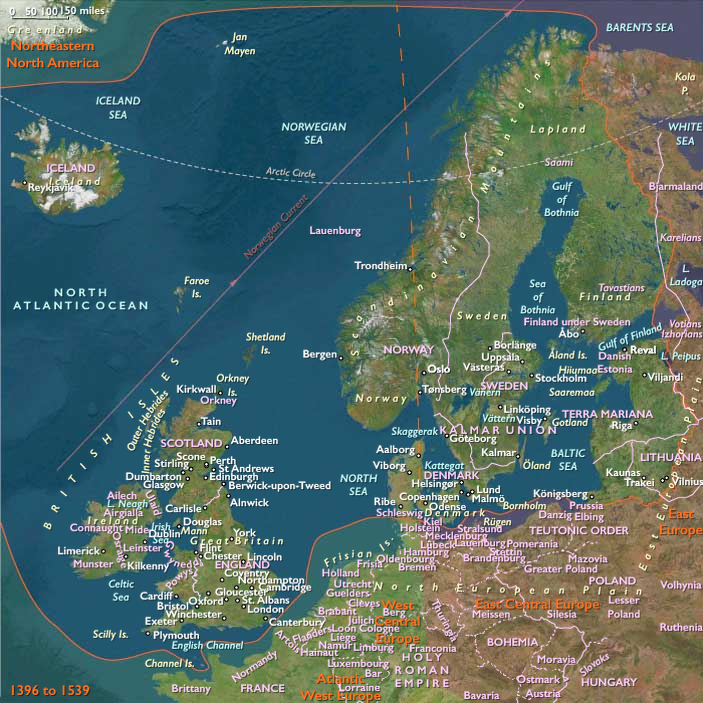
England: Rebellions, Religion, and Regal Challenges
The reign of Henry IV continued to be marked by internal instability and rebellion. The Glyndŵr Rising, initiated in 1400 by the Welsh leader Owain Glyndŵr, persisted until approximately 1415, highlighting sustained Welsh resistance to English hegemony. Henry's reign was further troubled by repeated attempts to suppress religious dissent, primarily aimed at the Lollards, followers of the reformist doctrines of John Wycliffe. The intense persecution peaked with the burning of John Badby in 1410, making him one of the first laymen executed for heresy in England. Upon Henry IV’s death in 1413, his son ascended as Henry V, ushering in renewed English ambitions, particularly against France.
Henry V quickly asserted his authority and re-energized English claims in France, reigniting the longstanding conflict known as the Hundred Years' War. His decisive victory at the Battle of Agincourt in 1415, despite being vastly outnumbered, became emblematic of English valor and military effectiveness, significantly bolstering his reputation and uniting his kingdom under a common cause.
Scotland: Power Struggles and Captivity
In Scotland, power continued to be contested internally amid external threats from England. Following Robert III’s death in 1406, his young son James I remained captive in English hands, held prisoner from 1406 to 1424. The regency was dominated by the Duke of Albany, who effectively ruled Scotland but faced constant political maneuvering and efforts to maintain authority amidst nobility rivalries and border disputes with England.
Ireland: Strengthening Gaelic Dominance
Ireland saw further erosion of Anglo-Norman control, with Gaelic clans such as the O’Neills and O’Briens consolidating their authority and extending their power bases. The English presence was increasingly confined to The Pale, with attempts at military intervention proving ineffectual against the resurgence of Gaelic traditions, customs, and independent rule.
Scandinavia: Stabilization of the Kalmar Union
Under Queen Margaret I and subsequently King Eric of Pomerania, the Kalmar Union strengthened its governance structures. Eric, crowned in 1397, continued Margaret's centralization policies, although Sweden periodically expressed resistance against the union's dominance. Still, by 1419, the Union remained intact, stabilizing northern European political dynamics despite underlying tensions.
Iceland: Continuation of Literary and Cultural Identity
Iceland, although politically subordinated within the Kalmar Union, preserved and continued its vibrant literary culture. Notable Icelandic sagas, poetry, and historical chronicles persisted as important cultural staples, underscoring Icelandic resilience and contributing to a distinct national identity that endured despite political subjugation.
Cultural Flourishing and Architectural Advances
Cultural and architectural advancements continued robustly across Northwest Europe. The ongoing construction of York Minster exemplified the era’s architectural brilliance, showcasing the Perpendicular Gothic style with its large windows and intricate tracery, reflecting both ecclesiastical power and artistic ambition. Musically, the era remained distinguished by the innovative compositions of John Dunstaple and Leonel Power, whose works influenced harmonic developments throughout Europe.
Legacy of the Era
By 1419 CE, Northwest Europe had entered a phase marked by both internal stabilization and external expansion. England, reinvigorated by Henry V's victories, sought renewed continental dominance, Scotland endured dynastic uncertainty, Gaelic Ireland fortified its independent traditions, and the Kalmar Union consolidated northern European influence. These dynamics, combined with continued cultural and architectural achievements, signaled the era as pivotal in shaping the region's subsequent historical trajectory.
People
Groups
Topics
Subjects
Regions
North Europe
View →Subregions
